Published June 18, 2026
Freedom Isn’t Just On Paper: Reflections on Juneteenth
By Dr. Sabrina E. Dent and Jaziah B. Masters
Where you see wrong or inequality or injustice, speak out, because this is your country. This is your democracy. Make it. Protect it. Pass it on. – Justice Thurgood Marshall
Pieces of paper guaranteeing rights might hold up in a court of law, but they do not always ensure lived experiences.
We saw it at the Supreme Court this term, as justices heard about Damon Landor’s case. His head was forcibly shaved in a Louisiana prison, despite possessing a piece of paper showing that he, as a Rastafarian, had a religious right to keep his hair long in devotion to his spiritual practice.
We see this in immigration enforcement across our country, as officers often take people of color into custody first and ask questions later. This is to say nothing to the encounters that turn fatal.
We witnessed this in the Supreme Court’s Callais v. Louisiana decision nullifying the protections guaranteed by Section 2 of the 1964 Voting Rights Act. Previously – in 1982 – Congress extended certain provisions of the Voting Rights Act and adopted an “effects test,” setting forth some clear conclusions about Section 2. As civil rights lawyer Sherrilyn Ifill explains:
…Congress made clear that electoral practices that result in the diminution or denial of Black voting power violate Section 2 of the Act, which protects against electoral practices or systems that deny Black voters an equal opportunity to elect their candidates of choice. Congress’ adoption of this “effects test” was explicitly enacted to overturn the Supreme Court’s 1980 decision in Mobile v. Bolden, in which the Court held that only practices that were intentionally discriminatory could violate the Voting Rights Act.
And, as we mark Juneteenth, we are reminded that the Emancipation Proclamation didn’t truly end slavery with the stroke of a pen in 1863. In cities and towns across the country, it just … continued. The news had to travel, and it had to be enforced.
It wasn’t until June 19, 1865, that the news about the Emancipation Proclamation made its way to the state of Texas, in an order from the Union Army. Juneteenth is a somber reminder that slavery continued for more than two years in the United States after its legal abolition.
Plus, the order did not make things easier for many of the enslaved, and state-sanctioned discrimination continued long after the first Juneteenth.
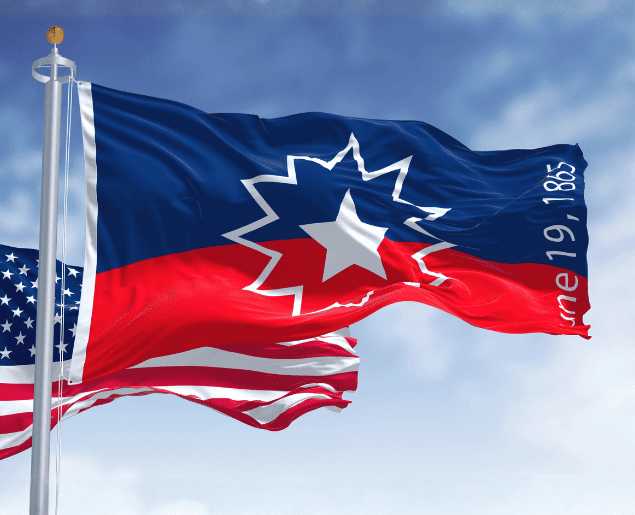
Juneteenth is not just a day of remembrance; it is a day of accountability. Its story is captured within the very flag itself. The Juneteenth flag shares the colors of the American flag. Ben Haith, the Juneteenth flag’s designer, has said this was a purposeful choice — a reminder that Black Americans descended from slaves are exactly that: American.
“For so long, our ancestors weren’t considered citizens of this country,” Haith said. “But realistically, and technically, they were citizens. They just were deprived of being recognized as citizens. So I thought it was important that the colors portray red, white, and blue, which we see in the American flag.”
That acknowledgement of the fullness of the American experience has been articulated by so many. One example is David Walker, a prominent abolitionist and writer in the early 1800s. In his piece An Appeal to the Coloured Citizens of the World, Walker advocates for the immediate end of slavery and a society that recognizes the humanity of all.
Images of a torn version of Walker’s Appeal grace the cover of the second edition of African Americans and Religious Freedom: New Perspectives for Congregations and Communities. This was an intentional choice, symbolizing the ongoing quest by African Americans to realize a truly just and equitable American democracy for all people. The tearing serves as a visual reminder of unfulfilled justice — a theme central to the book’s collection of essays. Just as Walker’s vision outlived him, this book’s second edition continues the urgent conversation on religious freedom, drawing from African American history, culture, and ideas to reimagine its meaning today.
Juneteenth is a freedom holiday. It’s also a religious freedom holiday — if you aren’t truly free, how can you be free to worship? These freedoms are cornerstones to a democratic, pluralistic society where all have dignity and the freedom to express themselves, and they are worth defending. As the Rev. Dr. Marvin McMickle has pointed out, slavery was not ended by any “moral persuasion” but instead by the army in an order on Juneteenth. “But the pain goes on, as does the struggle.”
We cannot wait for others to defend it for us – we must take up the mantle ourselves.
Dr. Sabrina E. Dent is the Director of the BJC Center for Faith, Justice and Reconciliation. Jaziah B. Masters is a recent Research Fellow for the BJC Center for Faith, Justice and Reconciliation.
For more on Juneteenth, visit the resources provided by the National Museum of African American History and Culture.