Published March 9, 2026
Religious Freedom Is Lived
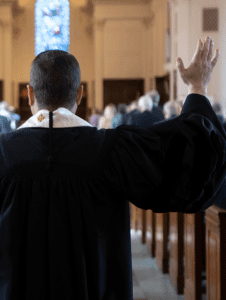

Today, we’re launching our new blog, called “Freedom and Responsibility.” In the coming months and years, this blog will serve to inform and to equip you to take action. It will point you to BJC’s ongoing work in the courts and in legislatures. And it will bring you stories from the ground, where religious freedom is felt most viscerally. Our goal is to work alongside you to build a nation where religious freedom isn’t merely promised, it is lived.
Religious freedom is lived. It is lived the moment a person fasts during Ramadan, attends Ash Wednesday service, or lights the Shabbat candles. It is lived when a parent teaches their children to pray, when a person chooses not to pray, or when a whole community comes together to pray. Religious freedom is lived.
And since religious freedom is lived, its loss is felt. Felt like the Amish farmers who had their livestock seized and sold at auction by the IRS for refusing to pay the Social Security payroll tax in the 1960s. Or like the Native American tribes whose sacred sites near Mount Hood were needlessly bulldozed to add a lane to a nearby highway in the 2000s. Or like Damon Landor, a Rastafarian inmate who was forcibly shaved in a Louisiana prison despite his request for a religious exemption to keep his dreadlocks. Three different faith traditions, three different decades, three instances where the loss of religious freedom was felt in a visceral and unmistakable manner.
Today, the hand of the state in matters of faith takes shape in many ways, not just physical coercion. The state’s encroachment on matters of conscience (whether it be state governments or the federal government) is being felt both viscerally and silently. It is being felt in Southern California, where according to the Roman Catholic Diocese of San Bernardino, a longtime parishioner was detained by ICE on the grounds of his local church (one of a handful of such cases). It is being felt in Texas, where the state government is forcing teachers in public schools to display any privately donated posters or copies of the Ten Commandments in their classrooms due to a law that took effect in September 2025. And it will be felt by anyone seeking medical treatment that authorities deem contrary to their interpretation of biblical teaching – today that is felt by women seeking medical help for an ectopic pregnancy in states that have banned or severely restricted reproductive health access, but tomorrow it might be felt by anyone hoping to take advantage of a future medical breakthrough that falls in a theological gray zone.
At BJC (Baptist Joint Committee for Religious Liberty), we don’t tell people what to believe, how to express their faith, or whether a person should have faith, and we expect the state to do the same. As an organization proudly rooted in Baptist theology and tradition, we believe that faith should never be compelled or coerced. Faith should be arrived at freely and expressed as conscience dictates. And our mission is simple: to protect and expand religious freedom for all.
We are for religious freedom, which is incompatible with Christian nationalism. We are for religious freedom, which is incompatible with government-mandated and government-led prayer in schools. And we are for soul liberty, the idea that every person stands free before God with no intermediary of church or state, which is incompatible with faith that is coerced.
This commitment to religious freedom has been the Baptist position going back to Thomas Helwys’ A Short Declaration of the Mystery of Iniquity published in 1612, and the official position of the United States since the founders themselves made the First Amendment the legal bulwark against the government establishing a religion or hampering the free exercise of faith.
Today, protecting and expanding religious freedom requires us to do more than to protect our schools from government mandated religion or to protect the pulpit from political capture, it requires us to protect and expand our pluralistic democracy. That’s because today, more than ever, religious freedom requires pluralism, and for pluralism to work people must be able to participate fully in civic life without intimidation, deprivation, or state-imposed barriers. Policies that create fear in a community to gather, restrict the ability to partake in the democratic process, enable indiscriminate targeting of minority communities, and bypass the rule of law, directly undermine civic participation. And when civic participation is threatened, pluralism is threatened. When pluralism is threatened, religious freedom itself is at risk.
For 90 years, BJC has stood at the forefront in the fight to protect religious freedom in this country, at the Supreme Court and in Congress. But we need more than that; we need to advance and protect religious freedom in the places where it is lived, where religious freedom is not a promise of courts and lawmakers, but a lived reality – in our communities themselves. And that will take communities coming together to defend their freedom to believe or not to believe, and it will take advancing religious freedom through the legislative process. But more than that, it will take all of us.
We need you to join a local group, and if there aren’t any in your area, to start one. We need you to register to receive our email newsletter so that you can take part in any of our ongoing or upcoming digital campaigns. And we need you in immigrant communities, at school board meetings, standing shoulder-to-shoulder with faith leaders, and bearing witness. We need you to act, because religious freedom can only be lived if we will it to be. Our freedom is dependent on the freedom of others, and what happens at the church grounds in Southern California will have consequences in the pews of Massachusetts. Religious freedom is lived.