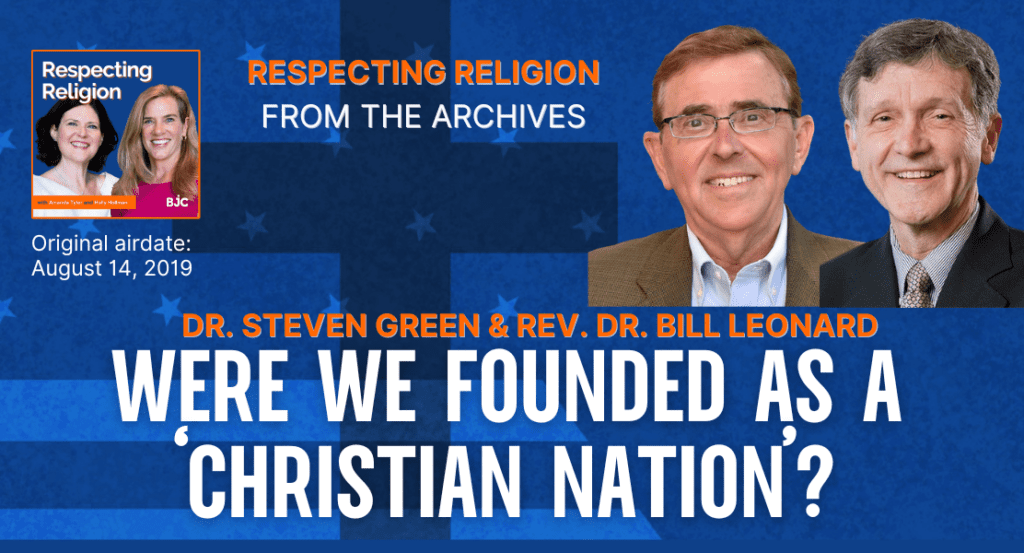
What do people mean when they say we were founded as a “Christian nation”? Is that true?
Revisit this 2019 conversation on the political and religious history behind that mythical idea. BJC Executive Director Amanda Tyler talks with Dr. Steven Green, author of Inventing a Christian America: The Myth of the Religious Founding, about the political history of this concept, including how, when and why it originated. They also discuss misguided claims that the Ten Commandments are the basis of our legal system. On the second half of the episode, we hear from church historian Bill Leonard on what religious leaders said and did during the founding of the United States and how that relates to the freedoms we have today.
This conversation was part of our podcast series on the dangers of Christian nationalism, first released on August 14, 2019.
Show notes
Segment 1 (starting at 02:22): Steven Green on the political history of the idea
This program originally aired August 14, 2019, as episode 3 in our 10-part BJC Podcast series on the dangers of Christian nationalism.
Dr. Steven Green is the Fred H. Paulus Professor of Law and Affiliated Professor of History and Religious Studies at Willamette University. His most recent book – released in 2022 – is Separating Church and State. He is the author and co-author of several books, including Inventing a Christian America: The Myth of the Religious Founding; Religious Freedom and the Supreme Court; and The Third Disestablishment: Church, State, and American Culture, 1940-1975.
Segment 2 (starting at 21:18): Bill Leonard on the religious history of the idea
The Rev. Dr. Bill Leonard is the founding dean at the Wake Forest University School of Divinity, who now holds the title of “professor of divinity emeritus.” He has written some 25 books, and his research focuses on church history with particular attention to American religion, Baptist studies, and the Appalachian religion.
During the episode, Amanda Tyler mentions an article he wrote for Baptist News Global: Legislating ‘In God We Trust’: using the state to do the Church’s work.
To learn more about BJC’s work countering Christian nationalism, visit ChristiansAgainstChristianNationalism.org or BJConline.org/ChristianNationalism. You can also access our discussion guide to go with this podcast series.
Respecting Religion is made possible by BJC’s generous donors. You can support these conversations with a gift to BJC.
Transcript
Transcript: Best of: Were we founded as a ‘Christian nation’? (Originally Aired August 14, 2019)(some parts of this transcript have been edited for clarity)
AMANDA: This year marks the 250th anniversary of our country’s Declaration of Independence, and you’ve probably seen the America 250 logo celebrating this landmark anniversary for the United States.
As my sabbatical comes to a close, we wanted to take a moment to revisit a conversation from 2019 about a question that we often hear: Are we a, quote/unquote, “Christian nation”?
The short answer is, of course, it depends on what you mean. Is the majority religion in this country Christianity? Yes. So you could make a demographic argument.
But were we founded as a Christian nation? The Constitution only mentions religion once, an Article 6 prohibition on a religious test for public office.
We’ve had this conversation in a variety of ways, so we wanted to revisit one of the first times. Back in 2019, I talked to two historians, Steve Green and Bill Leonard. This was part of our podcast series on the dangers of Christian nationalism which we released as we launched our initiative called Christians Against Christian Nationalism.
A deep dive into history is an important part of understanding Christian nationalism, because that ideology relies heavily on a particular view of history to prop up some of its ideas. A lot has changed in our country since 2019, but our history has not. You can find more information about this podcast, including a discussion guide, in our show notes.
First I’ll talk with Steven Green and then Bill Leonard in conversations first released in August of 2019.
[music]
DR. GREEN: The idea of us being a Christian nation is actually one of our chief founding myths. And I use the word “myth” not in a pejorative sense, but in the sense that all nations and all peoples need to have some type of founding myth.
REV. DR. LEONARD: There are no Christian nations, only Christian people, bound to Christ, not by citizenship but by faith.
Segment 1: Steven Green on the political history of the idea (starting at 02:22)
AMANDA: Later in the program, we’re going to hear from Professor Bill Leonard, one of our foremost church history experts, about what religious founders might have thought about the idea of a Christian nation.
But first, we want to explore the political history of our founding, and I’m joined by author, historian, and professor Steven Green. Dr. Green teaches law at Willamette University, where he directs its interdisciplinary Center for Religion, Law, and Democracy. He has written one of the leading books on this topic, titled Inventing a Christian America: The Myth of the Religious Founding.
Historian John Fea, who has also written extensively on the topic, has called Dr. Green’s book, quote, “the most thorough critique of Christian nationalism available today. Anyone interested in this subject must read this book.”
Well, I’ve read it, and I agree with Dr. Fea. I’m delighted to have you on the program today, Steve.
DR. GREEN: Happy to join you.
AMANDA: So as we get started, I’ve found that people have different definitions of Christian nationalism, so can you give us your working definition of Christian nationalism and how that relates to an idea of a Christian nation?
DR. GREEN: Well, Christian nationalism is actually a — let’s put it this way: an exaggerated form of just American exceptionalism. And by American exceptionalism, of course, we mean that the United States is somehow special, is somehow unique, our constitutional system, our system of democracy, et cetera.
What Christian nationalism overlays on top of that — because that’s a very pervasive belief in society, that somehow that America is special. What Christian nationalism overlays on top of that, which still is somewhat pervasive in society, is this belief that our laws and governing systems, constitutions, et cetera, have at their roots or even at a higher level a Christian basis to them, that the nation was founded on Christian principles, that the framers were chiefly Christian Bible-believing men, that they looked to God for guidance in the founding period, and that kind of running through the Constitution and the nation’s laws are Christian themes.
And so, consequently, the next step beyond that is that therefore that the law today needs to somehow to recognize and to promote Christian values within our society. When we’re talking about Christian nationalism, though, it’s not a kind of nonsectarian form of Christianity. In most instances, it is a very conservative, orthodox Protestant view of Christianity, Christian principles, and to a certain extent, it’s very exclusive of other faith traditions.
And so, consequently, it’s really promoting this idea of primacy, of a Protestant Christianity within the nation and that the intertwining of our church and state is really kind of the original way that this nation was intended to be and that we need to go back and kind of rediscover these roots, so we can see that we really need to have more cooperation between church and state.
AMANDA: So in the introduction to your book, you write, “This book sets out to unravel the myth of America’s religious founding.” So can you explain what you mean and how you talk about myth in the book, and also why it’s important for us to unravel that myth.
DR. GREEN: Certainly. Well, I’m a religious historian, as well as a constitutional historian, and I fully appreciate that probably one of the most popular themes among historians is to write about the religious impulses that existed at the time of the nation’s founding.
And so scholars have been trying to understand that and trying to unpack this many times. And unfortunately — or fortunately, whichever way you want to look at it — the historical record is rather open. And what I mean by that is that it’s not decisive, that you can go back in the historical record and you can find religious statements by members of the founding generation, as much as you can find statements that may suggest more of a kind of a theistic form of religious belief.
And so what has happened in these Christian nation debates is that it’s allowed for a fair degree of what I call “cherry-picking,” that you can basically go back and find something to support your preconceived notions about the nation’s founding.
And then that is brought out in what we call “proof-texting.” Basically you use the selected passages to prove your thesis. And so consequently there is a indeterminacy that exists within the historical record.
So what I set out to do in this book is I wanted to really kind of step back from this tit-for-tat debate and to try to examine, how did this idea of us being a Christian nation come into being. How is it connected to ideas of our kind of nationhood, and why has this continued to have some resonance today?
And so I wanted to approach it from kind of the anthropological idea of myths, and the theme that I came up with — the conclusion that I arrived at — is that this idea of us being a Christian nation is actually one of our chief founding myths. And I use the word “myth” not in a pejorative sense, but in the sense that all nations and all peoples need to have some type of founding myth.
And what founding myths are — it basically explains the past in a way that is digestible and understandable to the present, but then also it has the aspirations of the present that are somehow then transferred back to the past. And these founding myths create national identity.
And so consequently, the United States is unique in one respect clearly from other nations, is that unlike France or Germany or whatever, we know the day of our birth. We know the exact day that America was independent, which was actually it’s July 2, not July 4. But we declared our independence.
But unlike other nations, we don’t have a long history. There were people who were French before France was a country, but we created a country out of nothing. And so consequently, how do we determine our national identity, who we are as a people and what unifies us?
And so this idea that we were specially chosen by God, this idea the Founders worked with God’s providential hand, these were very important ideas to help signify the specialness of the United States and why we are unique.
And to a degree, it was, as I conclude in the book, this really became popular in the second generation where wanting to, again, distinguish this fledgling nation which was one of the most insignificant nations on the planet at this particular point in time, why we were different, why we were different from the European nations, et cetera, that the members of the second generation went back and saw these evidences that they believed of the Founders’ faith, and they constructed this myth to create us as a special nation.
This is where Manifest Destiny came out of, that you’re specially ordained by God. And so this is why I call it a myth. It was intentional, but it was not misleading that the people who came up with this, they said to themselves, How could we have defeated the greatest nation on earth militarily? How did we luck out on having such a good system of government? It must have been God guiding us. That’s the only explanation that we can come up with.
And so consequently, they looked at the evidences they saw with this idea of the importance of sacralizing the founding, and they constructed this myth to explain our national identity.
AMANDA: I find that so much more helpful than trying to go, as you said, tit-for-tat for every quote that’s picked, and then you try to find another quote that disproves it, to look at it from a more holistic perspective.
And I particularly found in the book, when you talk about the political use of religious rhetoric and the religious use of political rhetoric, how that helps explain what some of these quotes might have meant, if you, again, look at the broader context and not just look at the quotes taken out one by one.
So can you just summarize a little bit of what your research showed there.
DR. GREEN: Well, certainly. There is no question that religious rhetoric was pervasive during the founding period. We should not take that on face value, though. We need to ask, Wwhy was religious rhetoric being used?
Now, for many people, it represented a deeply held religious commitment and beliefs. But the pervasiveness of religious rhetoric really goes beyond. I mean, most historians and scholars have estimated that actually church membership was extremely low during the founding period, anywhere from 10 to 15 percent, that there were a lot of people who were nominal Protestants and Christians, but not a lot of really devout people.
So why the pervasiveness of the religious rhetoric that existed? Well, we have to just, once again, step back. If any household in what would become the United States had one book, what would that book be? It would be the Bible. It was the most common book available.
And so the Bible provided a source of common idioms, of rhetoric, of discourse. And so consequently, if you wanted to make a point and you wanted to give a frame of reference to your point, then you would use a metaphor or an idiom from the Bible, and people would understand that in ways that today most people who are not literate in the Bible would not understand that. So it was a common form of discourse that everybody knew.
And so, of course, if you wanted to make some point, you might do an allusion from the Bible, so we need to understand that first.
The second, as I said before, we were at war with the most powerful nation on earth, and we almost lost the Revolutionary War. And the ministers who were very important in creating the patriotic movement, because most of these were defending ministers — and what I mean by this is that we basically have — I’m sorry; I’m going back too far here.
You have to kind of understand the controversies that predated this, and the controversy over appointing an Anglican bishop in the United States back in the 1750s was highly controversial.
And the [supporters?] had been Puritan, but the Congregational and the Presbyterians — or the dissenters — in Colonial America, they very much pushed back on this, and they were very concerned about the power of the Anglican church and that they would remain as religious dissenters, particularly if you now had the bishop. So that was the history.
And so the Calvinist clergy, primarily in New England, but in Philadelphia and New York, too, were very much in favor of the patriot cause. And so consequently, they used religious rhetoric as well as patriotic rhetoric, political rhetoric, to rally support for the cause.
These were very powerful idioms once again. I mean, the most powerful image that existed during this period was to analogize George Washington to Moses, and that he was leading United States, you know, out of their slavery and bondage in Egypt and that King George was Pharaoh.
And so, boy, that’s a very powerful image, so what that did is it helped sanctify at the time the patriot cause. It said, God is on our side. And we should not find any of this surprising whenever since then throughout history, whenever there’s been war or some catastrophe, we have always — our politicians have always referenced how God has blessed us and God is on our side.
So this is one of the things that was intentionally done during the Revolutionary period was to talk about divine providence, to talk about being specially chosen, and to a certain extent, if you want to use this word, to demonize Great Britain while elevating the patriot cause.
And so religious rhetoric was used as a tool to rally support to the cause. Many people don’t realize that throughout the Revolutionary War, approximately a third of the colonists remained loyal to the British. And so it wasn’t a foregone conclusion that you would have support behind the Revolutionary cause.
So consequently, the religious rhetoric was really the most powerful tool available for rallying people to that cause.
AMANDA: I think it’s really helpful, and, you know, even though now we seldom take some of this rhetoric at face value, there’s just this predisposition to look at historic rhetoric and not really question what are some of the reasons behind it. So I’m really glad that your book explores that in a lot of different ways.
It also shows just how pervasive some of these myths are, and, you know, we’re just whetting the audience’s appetite for your book here.
But I was particularly interested when you talked about, you know, this myth of the Ten Commandments as being a foundation of our legal system. It’s so pervasive. It continues to be repeated and repeated so often now that I don’t really think it’s even questioned.
There was an opinion out of the Supreme Court from June in which, again, that statement was made — the Ten Commandments is a foundation of the U.S. legal system — and that piece of the opinion was joined by two of the more liberal justices on the Court.
So can you talk a little bit about what your research has shown about that particular myth and what’s some of the additional context behind that
DR. GREEN: Certainly. And that actually is part of this myth. It’s an adjunct on this myth, in that that idea was actually, again, created more in the 19th century. It was not a common idea that existed during the founding period.
Actually many years ago I wrote an article about this exact question, and I went back and looked at the debates around the Constitutional Convention, looked at numerous sermons, political statements and speeches from the period that are available.
And you find next to no reference to the Ten Commandments, particularly within making statements that the law is somehow derived from the Ten Commandments. You look at early court cases at the early part of the 19th century. There’s this common idea that came out of British common law that William Blackstone, the great treatise writer, had promoted about Christianity being part of the common law.
He was meaning in defense that the Church of England was the established religion, and so consequently, there was a type of integrated relationship between the common law and ecclesiastical law that existed in England.
But that idea that Christian principles were part of the legal system, the common law, that was popular in what became the United States, and people like Justice Joseph Story, he perpetuated this idea.
And even taking their statements about that Christianity being part of the common law, you don’t see references to the Ten Commandments, and you don’t see references to the Ten Commandments in judicial decisions that talk about Christianity being part of the common law. It just wasn’t there.
And so I’m not necessarily sure how this myth came into being, but you do see just later in the 19th century, middle of the 19th century, some religious treatise writers starting to talk about, well, of course, the Ten Commandments, these are laws, and so consequently it must have been as a source of the American legal system. You just don’t find that in the historical record.
Now, the only place you might try to pull this out of would be in the theocracy that existed in Puritan New England, particularly in Massachusetts where they wrote a couple of legal codes, and these legal codes were based very strongly on the Bible.
They did not rely solely on the Ten Commandments. They would reference various parts of the Bible when they were talking about various crimes that existed, but in that instance, the Puritans, when they were writing their initial legal codes, actually did have some references to the Bible.
But that legal code was abandoned in the 1690s, and there’s very little evidence that that legal code was actually that influential on the other legal codes that existed throughout Colonial America.
So there really is just not that much, if any, evidence that, at least at the time we were establishing either our national government or the legal system, that people believed the law itself is derived from the Ten Commandments.
AMANDA: Well, thank you, Steve. I feel like we are just scratching the surface, but I do hope that this provides a nice introduction to the topic for our listeners. And, again, the book is Inventing a Christian America: The Myth of the Religious Founding by Steven Green.
Steve, thanks for your scholarship on this topic, your continuing involvement, and for joining us on the BJC podcast today.
DR. GREEN: Happy to participate.
Segment 2: Bill Leonard on the religious history of the idea (starting at 21:18)
AMANDA: And now I’m joined by a good friend of mine and of BJC, Professor Bill Leonard.
Bill, thanks for being with us here today.
REV. DR. LEONARD: Honored. Thank you, Amanda.
AMANDA: Dr. Leonard is one of our foremost church history experts, with a particular expertise in American religion and Baptist studies. He’s the founding dean of the Wake Forest School of Divinity, and he currently holds the title of Professor Emeritus.
Now, Bill, as I’ve been working more closely with this topic of Christian nationalism, something I’ve learned is that how we understand and define that term or idea really varies, so I find it’s good to start by hearing first from you on how you define or understand Christian nationalism and specifically how that interacts with the idea of a Christian nation.
REV. DR. LEONARD: Christian nationalism really is a continuing theme that has run throughout the history of the American republic, with the idea that the best and most important citizenship is grounded in Christianity and that the government of the United States should give serious attention to the promoting and not undermining Christianity, because that was the foundation of the republic.
That idea grows out of the belief that was in many ways promoted in some of the early colonies, that America was a Christian nation in which the Christian church had a, if not special, a peculiar status over against all others.
And what you find now is that often there are individuals in the contemporary United States who believe America should declare itself a “Christian nation,” not unlike some other countries in the world that have a clearcut religious tradition. And that may be the worst element of both America as Christian nation and Christian nationalism itself.
If you talk about the beginnings of the American experience in the Colonial Period, you really have an understanding that Christians are the majority group that comes to this country, the Pilgrims being one good example in 1622 at Jamestown with Anglicans in 1607, and that two different kinds of Christian colonies developed in Massachusetts and New England.
Puritanism is the normative and established religion, grounded in the Colonial Period. In Virginia and other parts of the South, it’s Anglicanism, but both of those are essentially established churches, that is, the colonial government and those two religious traditions were bound up together.
However, the beginnings are primarily Protestant, so I’ve often said, if you wanted to be specific, you could say that America had its roots, its religious roots, in Protestantism.
AMANDA: I think it’s an important reminder and a clarification that maybe a more appropriate term would be a “Protestant nation,” and, of course, not even all Protestants. And so much of your writing has been about the Baptist experience, Baptists starting out as dissenters, Baptist contributions to the formation of an idea of religious liberty in this country, of course, an idea that led to the disestablishment of those churches that you just named.
We’ve seen an evolution of Baptists over the years, from dissenters to power brokers really in many communities. I wonder if you might speak a little to your study of that evolution of Baptists and their role in American society and what impact that has had on Christian nationalism.
REV. DR. LEONARD: Baptists, along with Quakers and Mennonites, what is sometimes called the Free Church tradition, really represent the early dissenters against those colonial Protestant establishments.
Challenging them from the beginnings of the Baptist movement would date around 1608, 1609 — Baptists are adamant that faith cannot be coerced. God alone is judge of conscience and that neither a particular state or government nor a privileged established church can judge the conscience of the heretic, people who belong the wrong things, or the people who choose not to believe.
And in that, Baptists articulate what will become religious pluralism in America. And by that I mean that they do not simply promote religious toleration in which Christianity is the norm and it merely tolerates other religious traditions or those who are outside religion altogether.
Rather, Baptists say faith cannot be coerced, and all persons should be free to make their choices about faith, that coerced faith is no faith. And so in New England and in Virginia, Baptists challenged these religious establishments that either required or put pressure on persons to baptize citizens in those particular Puritan or Anglican traditions.
The Baptists who first found congregations in the colonies, Roger Williams at Providence and John Clarke in Newport, declare from the very beginning that there are no Christian nations, only Christian people bound to Christ, not by citizenship but by faith.
That is a major departure from Christian environments in Europe, in Britain, and in, as we’ve said, parts of the colonies, because the understanding was to be born in a Christian commonwealth was to be baptized in the particular church that was normative in the colony.
And the early Baptists repudiate that altogether and lobby for religious freedom for all, including, Roger Williams will say, Turks — meaning Muslims — Jews, free thinkers, and others.
AMANDA: I’m so glad that you’ve given that quote in that context, because I think people listening to the podcast who might not know that history, might not have followed the Baptist history as closely might be really surprised, because it’s such a departure from some of what they hear from some Baptist leaders today, at least when it comes to Christian nation.
REV. DR. LEONARD: Yes. And part of the emphasis we have to give is that the reason these Baptists lay that out is because they cannot accept the idea that faith can be coerced. I can’t emphasize that enough.
They are not doing this because of the Enlightenment, although that may become a factor later on. But they are doing it because they have the idea that faith is essential in and of itself, not promoted or coerced by a particular religious establishment that dictates what faith must be like.
AMANDA: Well, and you wrote an article for our friends at Baptist News Global earlier this year titled,”Legislating ‘In God We Trust’: using the state to do the Church’s work.”
You write, “For many Americans, then and now” — I think “then” being back in the 1950s — “American civil religion remains inseparable from Christianity.” So can you talk a little bit about what you mean by “American civil religion” and what impact you see that having on Christianity.
REV. DR. LEONARD: Americans talk about religious liberty as if it’s always been there, but then give religious liberty grudgingly to new groups that appear in the country across its history.
That’s illustrated in so many situations from the boarding up of Baptist churches and jailing of Baptist ministers to hanging Quakers in 17th-century Boston, and compelling Jehovah’s Witness children in the 1950s to be expelled from school because they refused to say the pledge to the flag.
There’s just a continuing list of ways in which Americans have denied freedom to new religious groups that were suspect. All of those pay a terrible price often for being outside the norm, so it’s too much to say that religious liberty has always been the case in the country and to say that it’s not been won with great difficulty by many of the new groups that appeared. So that’s one thing to say.
But Protestantism has in the culture, within civil religion, until the late 20th and then 21st century, Protestantism has essentially been the privileged religious emphasis inside that civil religion. And as long as Protestants were the extensive majority, that prevailed.
But what has happened in the last century really is that pluralism, which was there from the beginning in the Bill of Rights, has become increasingly normative in the larger culture. And so part of what we’re experiencing today is the decline and rapid disappearance of Protestant privilege in the culture, and many people are confusing that with the loss — what they see as the loss of religious liberty.
And I think that’s really much of what’s going on now, because for many of us as Baptists, the central aspect of religious liberty is that all persons have the freedom to choose which religion or no religion, and that is not the point of the culture or the government to emphasize.
But increasingly, Protestants have relied on that implicit privilege, and I think that’s one reason why the idea of Christian nation or “Judeo-Christian” nation is being used by some folks. I’ll remind you that Martin Marty in his three-volume history of Modern American Religion says that the best he can discover, the term “Judeo-Christian religion” as a catch-all for Jewish and Christian groups as the normative groups, that doesn’t really appear until the late 19th century.
So we’re really going through a time when a great many groups and people are trying to re-emphasize America as a Christian nation and increasingly seem to be depending on the state to do the church’s work.
And so posting “In God We Trust,” teaching Bible in schools, changing the way in which government support may go to churches, either for education or for other kinds of services they provide, is being in many ways re-emphasized because of that loss of privilege. Churches are going to have to become more adept at making their case in the culture, without or alongside the state.
AMANDA: Well, and I think that’s absolutely right. And also I think Christians know the danger that Christian nationalism has, not just for the state but also for Christianity, and that’s why we’re seeing such a strong response to this particular initiative, Christians Against Christian Nationalism.
REV. DR. LEONARD: Yes. In many ways, early Baptists would have said that kind of Christian nationalism was idolatry.
AMANDA: Well, you’ve given us a lot to think about, as you always do, Bill, and I’m just so grateful for your work on this subject and for your voice on this issue and for joining us for this podcast.
REV. DR. LEONARD: Thank you, Amanda. Honored to be with you.
AMANDA: Thank you to our listeners and to Steven Green and Bill Leonard for joining us for that conversation on the BJC podcast back in 2019.
You can learn more about the work to counter the dangers of Christian nationalism by visiting our website at ChristiansAgainstChristianNationalism.org.
This episode is available as part of our 2019 podcast series. We also have a discussion guide that goes with this episode and others in that ten-part series. We’ll add links and more details in our show notes.
And Holly and I plan to be back with new episodes in May.