Published August 10, 2026
Why I Testified Against Anti-Sharia Laws


With the approaching midterm elections, candidates for office are making their case for your vote. They’re all claiming to best represent your interests in Congress, state legislatures, and other seats of government on the state and local level. Americans have many concerns right now — affordability, health care, immigration enforcement, the rule of law, access to voting, the war in Iran, AI, education, the environment, civil rights, corruption, and more.
Yet many elected officials and candidates — particularly but not exclusively in my home state of Texas — are focused on an issue that doesn’t make any of the top lists of voters’ concerns: the rise of “Sharia Law.” Sowing misinformation about Islam and Muslims in Texas was a centerpiece of many heated Republican primaries, including the race for Texas Attorney General. One candidate — Rep. Chip Roy, currently serving as a member of Congress — decided to bring his arguments into a congressional hearing room.
As Chairman of the House Judiciary Subcommittee on the Constitution and Limited Government, Rep. Roy called a hearing in May titled “Sharia-Free America: Why Political Islam and Sharia Law are Incompatible with the U.S. Constitution.” It was full of classic fear-mongering, misinformation, and discrimination against American Muslims, falsely suggesting that the practice of Islam and presence of Muslims in a community pose a terroristic threat to the United States.
I was honored to be asked, at the invitation of Democratic members of the Committee, to offer testimony about how targeting individuals and groups based on religion violates our country’s constitutional commitment to religious freedom for all. In fact, it is precisely because of the separation of church and state and the disestablishment of religion from government control that the governing law in this country is secular and not religious in nature. The false idea of any religious law being imposed on everyone is easily debunked by referencing the first 16 words of the First Amendment: “Congress shall make no law respecting an establishment of religion, or prohibiting the free exercise thereof.”
The hearing was built around a premise that betrays our constitutional values — that Congress has the authority to determine which religion is compatible with American life. It does not. That is not a partisan position; it is the founding logic of religious freedom in this country.
Baptists have been making this argument for more than 400 years — and we have been making it on behalf of everyone, not just ourselves. In 1612, Thomas Helwys, one of the founders of the Baptist movement, wrote to King James I and argued that the king had no authority over the religious conscience of his subjects. He named Muslims specifically (as “Turks”) when he said, “For men’s religion to God is betwixt God and themselves. The king shall not answer for it. Neither may the king be judge between God and person. Let them be heretics, Turks, Jews, or whatsoever, it appertains not to the earthly power to punish them in the least measure.”
This is not a new argument for Baptists. It is our oldest one.
What is happening right now in Congress and in campaign rhetoric not only betrays our values, but it also puts our neighbors at risk for violence.
Just five days after the U.S. House held this hearing and two days before a similar hearing was scheduled to be held in the U.S. Senate, two gunmen attacked the Islamic Center of San Diego, killing three people before killing themselves. The perpetrators were reportedly motivated by virulent anti-Muslim hatred and antisemitic conspiracy theories that cast Muslims and Jews as a threat. The brave and self-sacrificial actions of Amin Abdullah, father of eight who worked as a security guard at the center, protected the lives of 140 children who were present at the mosque’s school.
This attack did not occur in a vacuum; it happened as our society is besieged by increasing anti-Muslim rhetoric and fearmongering. The Senate subcommittee’s decision to postpone its hearing following the attack reflects an apparent recognition that anti-Muslim rhetoric has real world consequences. That recognition was fleeting, given that Sen. Ted Cruz, R-Texas, rescheduled the hearing for August, even though the premise of the hearing similarly risks encouraging suspicion toward Muslim Americans and organizations through guilt-by-association. Congress should be working to reduce these harms rather than adding fuel to the fire.
Religious freedom will not be achieved in our society until it is a lived reality for every person, regardless of their faith. With your support, BJC can continue to provide this necessary testimony, from the halls of Congress to state education hearings to communities across the country.
-
Read the Magazine Online
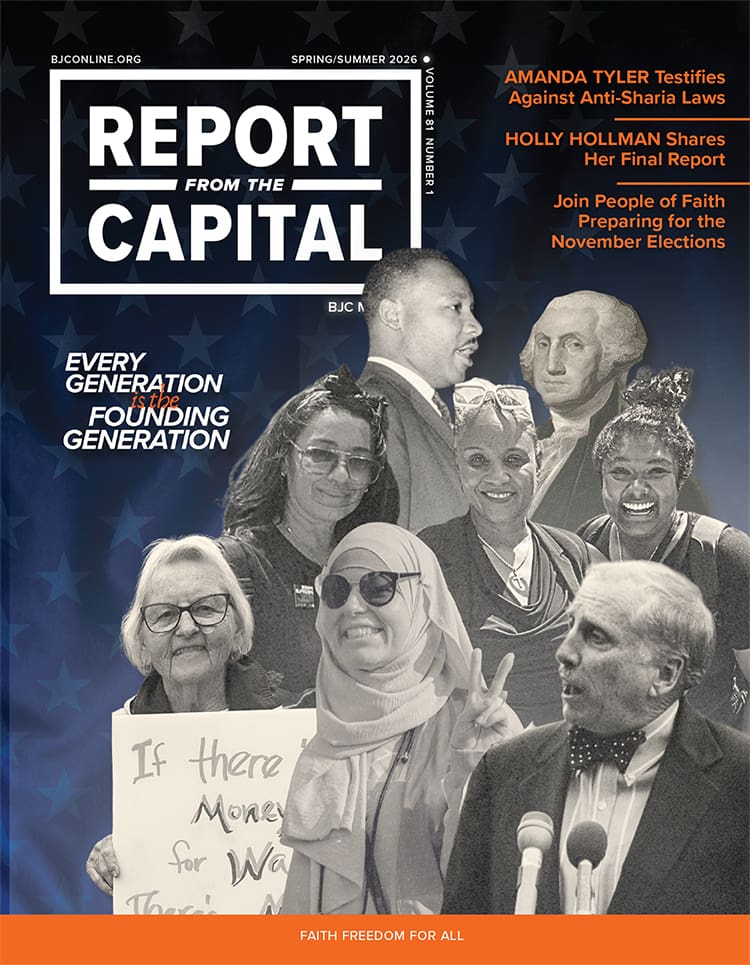
This article appears in the Spring/Summer 2026 edition of BJC’s magazine, Report from the Capital. Visit our page for more articles online, or read a PDF version of the entire magazine.
-