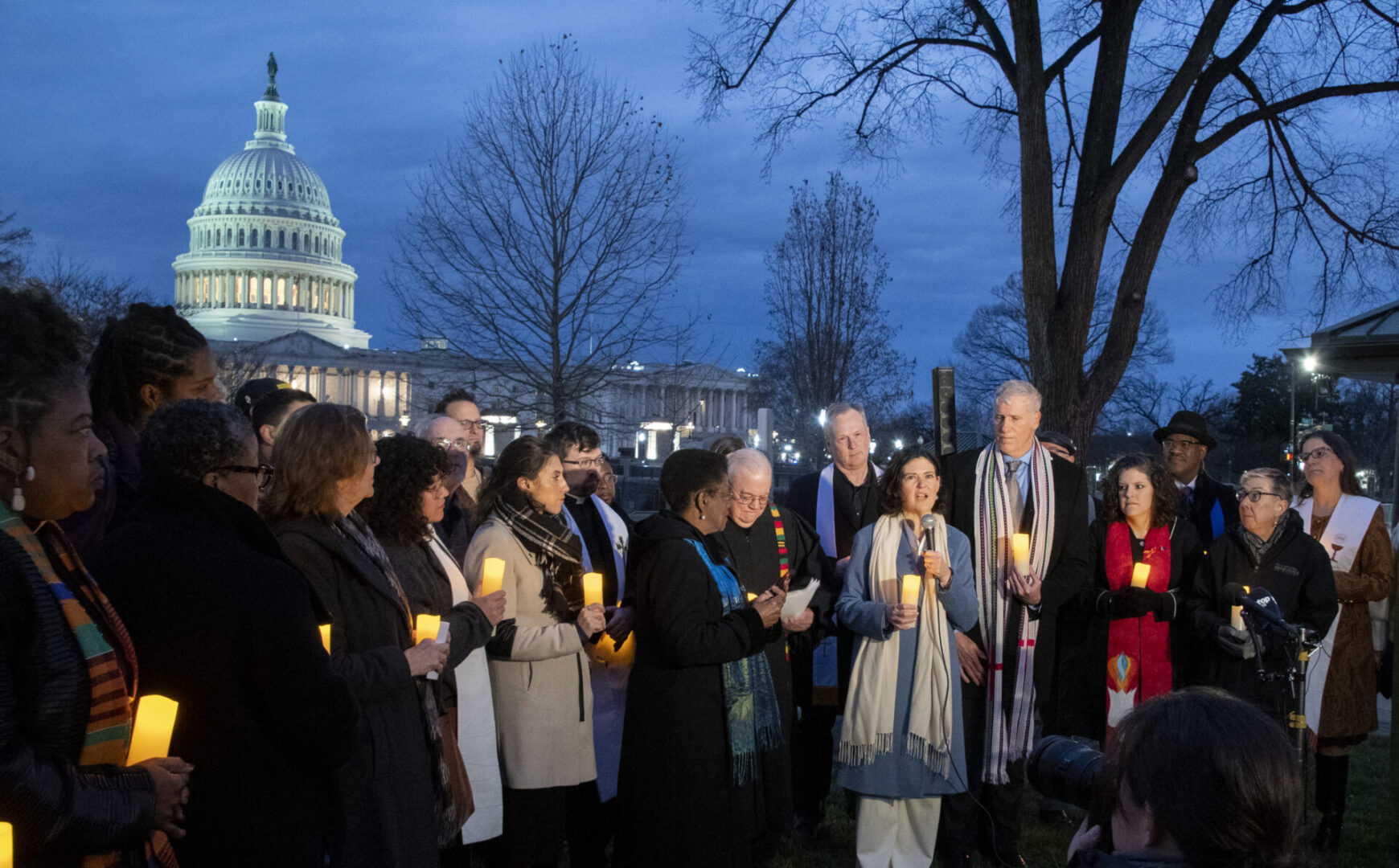
Christians Against Christian Nationalism is a BJC-led initiative that educates and activates people who are ready to defend religious freedom against the threat of Christian nationalism.
Launched in 2019, CACN has brought together Christians from across denominations who believe that Christian nationalism distorts their faith and threatens the religious freedom of everyone.
Through this initiative, our goal is to expose Christian nationalism for what it is, equip people with the language and tools to push back, and activate a network of people who are ready to act — either digitally or as part of a local group — to cultivate and expand religious freedom.
Engage and Connect Online
You do not have to have all the answers to get started, you just have to be willing to take the first steps.
Here are a few ways you can start taking action and getting connected online.
-

Sign the Statement
If you are a Christian, join nearly 50,000 others who have put their name on our statement of principles. It is a declaration that Christian nationalism does not speak for your faith.
-
Connect With Us and With Others
Join others in our private Facebook group, and follow us on social media at @EndChristianNationalism. Share content with your networks. The information battle is fought one conversation at a time.

Local Groups
Be Part of the Movement
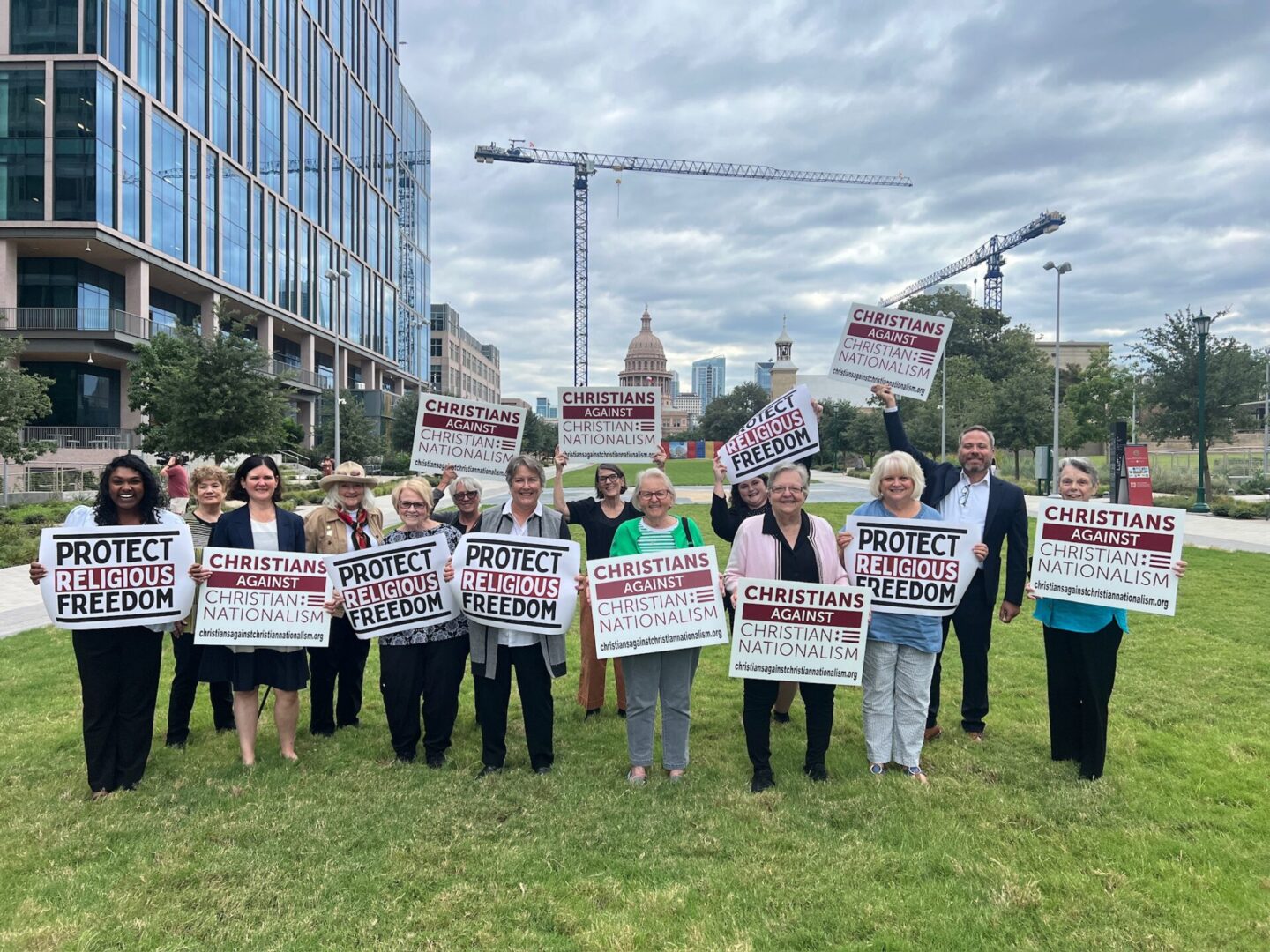
Join us in the work on the ground — where the rubber meets the road — and build power with others in your community to create change. We are shifting toward organizing around specific issues, forming clergy groups, and providing ways to honor the dignity of all people as we work together. No matter your background, you are invited to participate.
We have local groups across the country — join one near you, or start one.

Learn more about this initiative
-
What is Christians Against Christian Nationalism?
Christians Against Christian Nationalism is a grassroots campaign launched in 2019 to combat Christian nationalism in local, state, and national contexts. It is not a response to any one event or statement — it is a sustained effort to resist Christian nationalism and the threat it poses to our faith and to religious freedom for everyone. In 2026, to better serve the campaign and our local organizing groups, we reimagined this work as a digital campaign and redirected the original CACN website to our BJC website.
-
Do I have to be a Christian to be part of this?
No. You do not have to identify as a Christian or sign the Christians Against Christian Nationalism statement to be part of this work. You only have to believe that religious freedom — real, lived, available to everyone — is worth defending.
-
What about religious nationalism in other contexts?
Religious nationalism is not unique to the United States or to Christianity. It has been a recurring problem throughout history and continues to be one around the world today. The expression of religious nationalism we confront most directly in the United States is Christian nationalism, and that is what this campaign addresses.
FAQ
Is the United States a “Christian nation”?
This question could be referring to many things. The Constitution is clear that the country wasn’t founded for Christians or to prefer Christians. The U.S. Constitution created a system of government open to people of any faith – Article VI prohibits any religious test for public office. Sometimes when people say the United States is a Christian nation, they are referring to demographics. Most surveys find around 70% of the American population identify with Christianity, so it can be accurate to say that we are a majority-Christian nation. The numbers decrease when surveys go deeper to ask questions about frequency of engaging in Christian practices, such as prayer, Bible study or attending corporate worship services.
Here are more resources that address this question:
Video: “Is America a Christian nation?” featuring Holly Hollman (runtime: 2:47)
Video clip: Amanda Tyler’s rebuttal for people who claim we are a ‘Christian nation’ (runtime: 0:59, excerpted from a conversation in 2024)
News article by Peter Smith for the Associated Press: Many believe the founders wanted a Christian America. Some want the government to declare one now.
Read Frequently Asked Questions on this topic from the Associated Press.
Article by the Rev. Jennifer Hawks for Baptist News Global: How the Constitution’s original religious freedom guarantee almost didn’t happen
Podcast: Amanda Tyler spoke with historian Steven Green in 2019 for an episode of our podcast series on the dangers of Christian nationalism: Were we founded as a Christian nation?
Book by Steven Green: Inventing a Christian America: The Myth of the Religious Founding (2015)
Book by Michael Meyerson: Endowed by our Creator: The Birth of Religious Freedom in America (2012)
NPR story/podcast: A History of Christian Nationalism, featuring Dr. Catherine Brekus and Dr. Bradley Onishi (October 2024)
Podcast: Christian nationalism and the presidency (2024)
Podcast: The myth of American ‘chosenness’ with Dr. Catherine Brekus (2023)
Can I donate to Christians Against Christian Nationalism?
Yes, you can click here to make a tax-deductible gift to the Christians Against Christian Nationalism initiatve. Your gift will go to BJC, the 501(c)(3) organization that runs it, and your gift will be designated for this work.
You can also click here to make a specific gift supporting our organizing work in North Texas. If you have questions about donating to Christians Against Christian Nationalism, contact [email protected].
I’m not Christian but want to support the campaign. What can I do?
We first approached this project as an interfaith partnership. After talking with our partners of different religious backgrounds and those of no religious background, we realized that this was work that we, as Christians, need to do first. This work began with our statement of principles for Christians to sign.
You do not have to be a Christian to join us in this work. We invite you to join our email list to stay connected and get alerts about opportunities for involvement. We are grateful for the support of our non-Christian partners, many of whom have helped us spread the word about the campaign and who work with us on various projects.
I signed my name to the statement, but there is a typo. What do I do?
Let us know! Contact us, and please include all necessary details.
How does signing this statement make a difference?
Sometimes the public perception of Christians is far more limited than the experience and diversity of Christians. This online statement provides a more accurate picture of how American Christians view Christian nationalism. It demonstrates common ground across the broad Christian family and can serve as a helpful resource for those combating the ideology of Christian nationalism and engaging in civil dialogue. Anyone who self-identifies as a Christian is invited to sign the statement online.
But, you do not have to identify as a Christian or be a signer of the statement to be part of efforts combating Christian nationalism. We invite you to join our email list to stay connected with us.
Who organized Christians Against Christian Nationalism?
We first approached this project as an interfaith partnership. After talking with and listening to our partners of different religious backgrounds and those of no religious background, we realized that this was work that we, as Christians, need to do first. Over the years the campaign has evolved and expanded — from a statement of principles to the emergence of local groups working in their own communities.
Why link Christian nationalism and racism?
The statement says that Christian nationalism “overlaps with and provides cover for white supremacy and racial subjugation.” The deep, abiding problem of racism in this country is much larger than this project, and yet it is undoubtedly connected to this conversation. We recognize the overlap between Christian nationalism and white supremacy and the fact that not all Christians or signers of this statement will view the connection in the same way.
For more on this topic, here are additional resources:
-
Webinar: White Christian Nationalism: How Racism Undergirds Christian Nationalism featuring Dr. Jemar Tisby and Dr. Robert P. Jones (2021).
-
Webinar: Flag and the Cross: White Christian nationalism and the threat to American democracy, featuring Dr. Philip Gorski and Dr. Samuel Perry (2022)
-
Video: A national conversation on white supremacy and American Christianity featuring Dr. Robert P. Jones and Adelle Banks (2020)
-
Podcast: White supremacy and Christian nationalism: A conversation with the Rev. Dr. Jay Augustine (Respecting Religion podcast, 2023)
-
Podcast: Christian nationalism, racism and white supremacy with Dr. Jemar Tisby (Dangers of Christian nationalism podcast series, 2019)
A few books and articles:
- The Color of Compromise: The Truth about the American Church’s Complicity in Racism by Dr. Jemar Tisby (2020)
- Dr. Jemar Tisby also shared his definition in a Substack post, including the use of “white” before the term: A Virtual Roundtable on the Threat of Christian Nationalism, Part 2 of 4
- White Evangelical Racism: The Politics of Morality in America by Dr. Anthea Butler (2021)
- Dr. Anthea Butler also defined white Christian nationalism in her contribution to Christian Nationalism and the January 6, 2021, Insurrection. Her section is on pages 4-6.
- The Flag and the Cross: White Christian Nationalism and the Threat to American Democracy by Dr. Philip Gorski and Dr. Samuel Perry (2022)
- The Hidden Roots of White Supremacy and the Path to a Shared American Future by Dr. Robert P. Jones (2023)
- The False White Gospel: Rejecting Christian Nationalism, Reclaiming True Faith, and Refounding Democracy by Rev. Jim Wallis (2024)
How is nationalism different from patriotism?
“Patriotism” is love of country that is expressed in many ways, such as waving an American flag, volunteering at a food bank, teaching in the public schools, serving in the military, running for public office, or protesting policies with which you disagree. “Nationalism” is an extreme form of patriotism that demands a position of superiority and has little or no room for dissent or disagreement.
Can Christianity influence public policy?
As the statement affirms, “People of all faiths and none have the right and responsibility to engage constructively in the public square.” Separating the institutions of religion and government does not — and should not — silence religious voices in the public square. People approach voting and public policy from a variety of perspectives, including their religious beliefs and ethics. Often, there are religious viewpoints on multiple sides of a policy debate.
What about religious nationalism in general?
Religious nationalism is not unique to the United States or to Christianity; it has been a recurrent problem throughout history and it continues to be one around the world today in various countries. Any type of religious nationalism provides a source of authority by giving a leader or government moral support for its policies. Pew Research Center released a report comparing levels around the world in 2025. The expression of religious nationalism we see most in the United States is Christian nationalism, and this campaign focuses on that phenomenon and issue.
Can you give some examples of Christian nationalism?
Examples of Christian nationalism can range from derogatory and exclusionary comments to issues of life and death.
People who espouse Christian nationalism often use the idea of Christianity or Christian language to demand conformity and promote policies and behaviors that solidify their power or status against others.
Christian nationalism suggests that “real” Americans are Christians and that “true” Christians hold a particular set of political beliefs, and so it seeks to privilege a narrow subset of Americans by law and in societal practice.
A policy or proposal might match up with religious beliefs, and that does not mean it’s necessarily an example of Christian nationalism. For example, robbery is both illegal and against the teachings of Christianity (and many other religions). However, if a policy or proposal is based solely on religious belief and seeks to privilege a certain set of beliefs or a certain type of Christianity in law, it’s a hallmark of Christian nationalism. One example is in the way some states propose public school curriculum with lessons from the Bible under the guise of promoting “religious literacy,” but the lessons tend to focus on Christianity and use Christian texts or Christian interpretations of Jewish texts instead of providing a fair, well-rounded view of religion. You can read more about that specific issue on our page dedicated to our North Texas coalition.
“Christian nation” mythology is often used to marginalize non-Christians in political activity, too. Citizenship is not predicated on our religious belief – you do not have to be a certain religion or any religion at all to belong in the United States. Plus, our country’s separation of the institutions of religion and government does not — and should not — silence religious voices in the public square. People approach voting and public policy from a variety of perspectives, including their religious beliefs and ethics. Often, there are religious viewpoints on multiple sides of a policy debate.
Christian nationalism in the hands of extremists can lead to acts of violence, such as the shootings at Mother Emanuel AME Church in Charleston, South Carolina, and Chabad of Poway synagogue near San Diego, California. At times, these violent acts are perpetuated by those who mix Christian theology with nationalist ideas of exclusion and superiority. Some of the white nationalists who marched through Charlottesville in 2017 wore cross necklaces while chanting “Jews will not replace us.”
For a conversation evaluating several situations — from flags in church sanctuaries to saying the Constitution is “divinely inspired” — listen to the podcast episode titled “But … is it Christian nationalism?” on the Respecting Religion podcast (episode 21 of season 5).
How do you define “Christian nationalism”?
There are various definitions and understandings of Christian nationalism.
The Christians Against Christian Nationalism statement defines it as “a political ideology that seeks to merge Christian and American identities, distorting both the Christian faith and America’s constitutional democracy.”
Visit our page on Christian nationalism for some additional resources. You can listen to a conversation about various definitions of the term in this episode of the Respecting Religion podcast (S4, Ep. 18, released in 2023). You can also watch a short video clip of that conversation that talks about the definition.