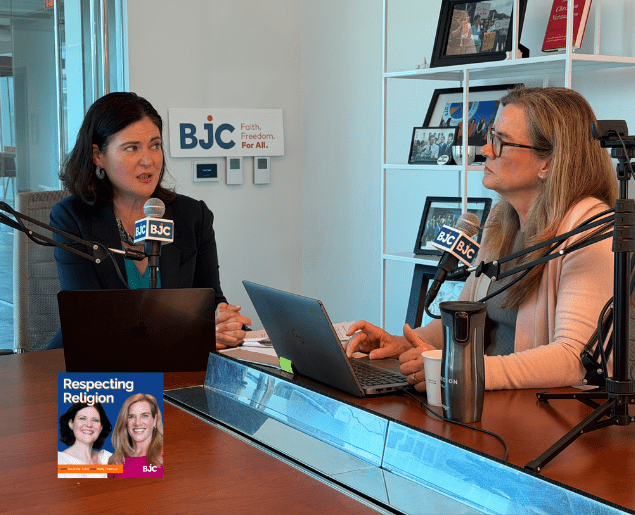
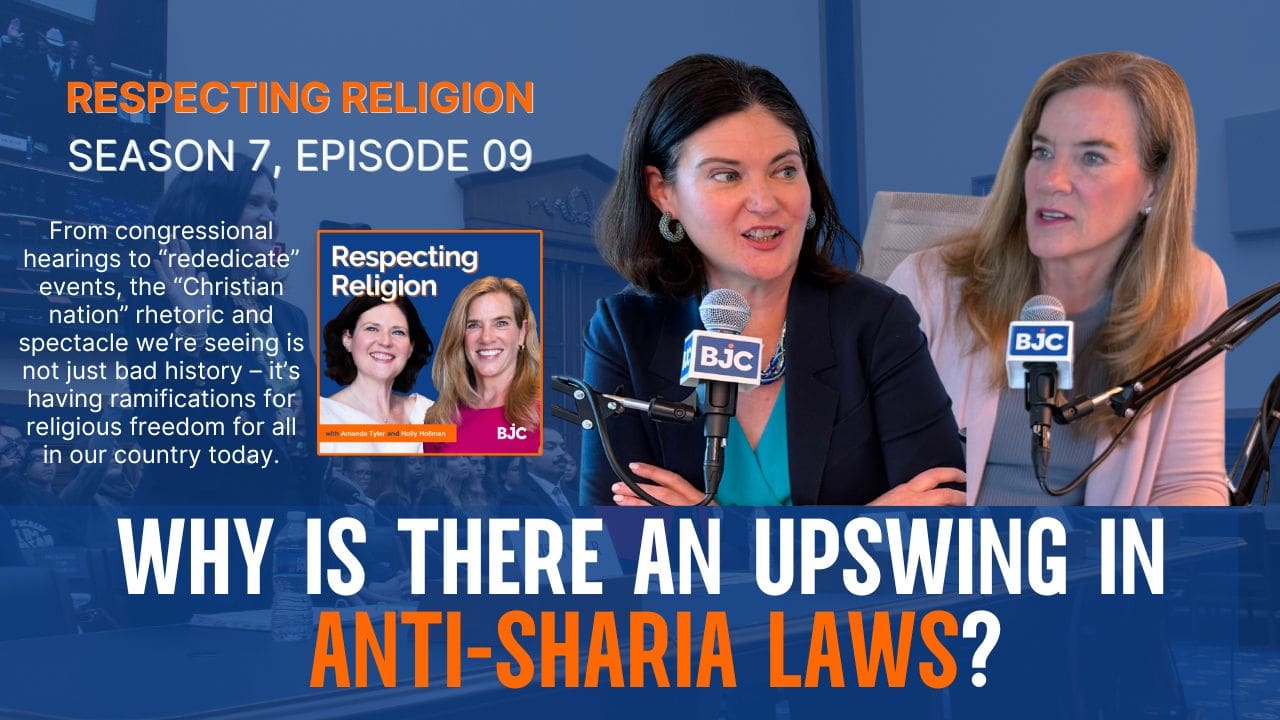
The “Christian nation” rhetoric and spectacle we’re seeing is not just bad history – it’s having real ramifications for religious freedom for all in our country today. Amanda is back from sabbatical, and she and Holly discuss recent developments, including an increase in anti-Sharia legislation and fear-mongering that goes with it. They fact-check last week’s congressional hearing on the topic and share Amanda’s testimony.
Plus, Amanda and Holly discuss the recent “Rededicate 250” event on the National Mall, which elevated common myths tied to Christian nationalism. People can gather to pray, and there have been public worship gatherings before – so, what made that event different? Join the conversation.
Show notes
Segment 1 (starting at 00:35): Christian nationalism, myths, and “Rededicate 250”
Holly is quoted in this article from Religion News Service by Bob Smietana: A Christian nation? At 250, America is still fighting over what that means
Amanda is quoted in this Washington Post article by Michelle Boorstein, Laura Meckler and Natalie Allison: White House to host 9-hour prayer festival focused on Christian roots of U.S.
Amanda is also quoted in this Wall Street Journal article by By Meridith McGraw and Terell Wright: A ‘Revival’ on the National Mall: White House Puts Prayer at Center of Washington
Amanda mentioned this wrap-up of the event – which includes some fact-checking – from Religion News Service by Jack Jenkins, Aleja Hertzler-McCain, and Adelle Banks: Trump allies lead thousands in prayer to ‘rededicate’ America to God on National Mall
You can read Amanda’s op-ed in Baptist News Global about the event: When Government Claims God
Segment 2 (starting at 14:45): The latest congressional hearing on anti-Sharia measures
For more on the tragic shooting at the Islamic Center of San Diego, here’s a story from the Associated Press by Julie Watson, Michael Biesecker, and John Seewer: San Diego mosque shooters met online and left writings expressing hate, FBI says
BJC released a statement on the shooting, which you can read on our website.
The House Judiciary Subcommittee on Constitution and Limited Government held a hearing on May 13, 2026, titled “Sharia-Free America:Why Political Islam & Sharia Law are Incompatible with the U.S. Constitution: Part II.” We played Amanda’s opening statement, as well as a portion of the opening statement of Rep. Jamie Raskin, D-Md.
You can watch the entire hearing and learn more on the website of the House Judiciary Committee.
You can read Amanda’s written testimony at this link.
Do you want special emails about our show? Click here to sign up for our email list!
Video of our episodes are on YouTube! Click here for the season 7 playlist.
Respecting Religion is made possible by BJC’s generous donors. Your gift to BJC is tax-deductible, and you can keep these conversations ad-free with a gift to BJC.
Transcript: Season 7, Episode 09
Why is there an upswing in anti-Sharia laws?
AMANDA: Government action that singles out a single group of people for heightened scrutiny based on religion violates religious freedom. And I had to say that over and over again, because there was a lot of misinformation going on throughout the hearing.
Segment 1: Christian nationalism, myths, and “Rededicate 250” (starting at 00:35)
AMANDA: Welcome to Respecting Religion, a BJC podcast series where we look at religion, the law, and what’s at stake for faith freedom today. I’m Amanda Tyler.
HOLLY: And I’m Holly Hollman. Welcome back, Amanda. I know many of you have been hearing some of our “best of” shows in your feed, but we are glad to be back together in 2026, and there’s a lot to catch up on.
AMANDA: There absolutely is, Holly. It is very good to be back. Unfortunately, of course, in our world, not all that we have to catch up on is good news. But it’s news that we need to be sure comes to the Respecting Religion audience.
I was back in front of Congress last week, as we have seen this strange and very concerning rise in anti-Muslim sentiment that’s coming from our government leaders and politicians, and so we are going to try to answer the question: What is driving it, and what can we do about it?
HOLLY: Yeah. It’s really important. But first, let’s do take a minute to celebrate your sabbatical. I’m glad you’re back, and you had a nice few months off, been out since January. I’m really glad that you had that time for some restoration, relaxation, time with family, and whatever you needed, to give you a little break from the incredible work that you do.
AMANDA: Yeah. And I know, Holly, you’ve had sabbaticals in the past from your work at BJC. I know you know firsthand how restorative they can be, how they can give you fresh perspective on the work.
I do feel rested and ready to go — when I came back, though this first month back has tested the “rest” part of things. But the perspective has stayed with me. And just had a lot of time — a lot of people asked me, Are you going to travel? And I said, No, I travel all the time for work; why would I want to travel during my sabbatical?
And so it was really wonderful to get to stay home and spend time with my family and my friends and just get to know my community. And I really got to know the roads of my community well, because I spent the time away training for a marathon. So I spent a ton of time —
HOLLY: Yeah. Congratulations!
AMANDA: Thank you.
HOLLY: I’m sure our listeners would be proud to know that you finished and did real well and had a fantastic marathon experience out West. Right?
AMANDA: Yeah. So I trained throughout the sabbatical, and then a few weeks after I came back to work, I ran the Big Sur International Marathon in California, which was an incredible experience.
HOLLY: Oh, so beautiful.
AMANDA: It’s beautiful. It’s right along the coast. And so just to be nature, to be with all of thse other runners from all different places. They were — I can’t remember — from every state and D.C. and Puerto Rico and like 30 countries, all coming together for this incredible challenge.
So that was a great capstone to that experience. But I’m really glad to be back, you know. This work is so needed and invigorating and core to my calling, so thrilled to be back here and back to Respecting Religion as well.
HOLLY: Yeah.
AMANDA: So while I was away, I was really grateful that we could bring several of our “best of” shows to the Respecting Religion feed while I was out. And all of those topics really continue to have relevance today.
The most recent episode in our feed, the conversation with Bill Leonard and Steven Green on whether we were founded as a “Christian nation,” is a topic that has been particularly hot recently.
And, Holly, it was also the topic of a piece that you were featured in from Religion News Service. We will put a link to that article in our show notes. It’s titled, “A Christian nation? At 250, America is still fighting over what that means.”
HOLLY: Yes. Seems to be a theme right now. I was glad to talk to reporter Bob Smietana for this piece, which really was a deep dive into this repeated myth about our country as a, quote/unquote, “Christian nation.”
AMANDA: And I noticed, Holly, that you led — or he led — the article with something that I’ve heard you say many times, including on this podcast, that when someone says, We’re a Christian nation, your first response is —
HOLLY: What do you mean by that? I loved that Bob saw that, because he asked me the question. And, you know, we have to stop. What do you mean by that?
AMANDA: Yeah. I thought he captured that response perfectly. The article says, quote, “Hollman explains that if the question is whether most Americans are Christian, that’s yes. But if they’re asking whether Christians should have special legal privileges that others don’t have, she says her answer is a hard no.”
HOLLY: There’s definitely a continuing need for historical truth and examination. We see repeated efforts in some quarters to perpetuate the idea of a Christian nation and to denigrate our constitutional tradition. As we approach the 250th anniversary of the Declaration of Independence, we are seeing some attach and exacerbate this Christian nationalism thinking to the celebrations.
AMANDA: That’s right. And this past weekend on Sunday, May 17, we saw that effort on a very grand scale. There was something called the “Rededicate America” event, “Rededicate 250.”
We had a chance to comment on this, and we’re going to talk quite a bit about our comments in the press and some editorial response that we made. But I want to lead with, when I first heard about this event, which, you know, I wasn’t tracking everything while I was out, so when I came back —
HOLLY: We hope not!
AMANDA: — in April and I saw that this was planned, my immediate response was, the title itself is a lie — right? — that the country was never dedicated to God in any official way, in a governmental way. In fact, our Founders did exactly the opposite: decided to disestablish religion from government control.
So I said, from the very beginning, this is mislabeled and misinformation, and instead of rededicating the — you know, it wasn’t ever something dedicated, so we can’t rededicate it. Instead we need to be dedicated to constitutional principles.
HOLLY: Yeah. That’s a good point, and I am glad that you got to talk to the Washington Post reporters who were writing about that. Of course, we could kind of see it coming, because here in D.C., you know, we pass by the mall on our way to work, and we knew that it was going to be a big hoopla, that it could be a show.
And I want to put in the show notes this piece from the Washington Post, because I think it was a really good overview. It came out before the event. Right?
AMANDA: Yes. A few days before.
HOLLY: A few days before, but the writers spoke to a lot of historians, which was appropriate. They talked about it as an all-day prayer festival, and they quoted you early in the article, I think, making a very strong point about how this was unique — not unique because people are praying on the mall. People do that. We’ve seen all kinds of different sponsored events on the mall.
But you said, “I’m unaware of anything like this with this much involvement of senior government officials on this scale, trying to paint this false picture of the United States as a ‘Christian nation.’”
You know, you noted — again, welcome back! You noted kind of having to connect the dots of some of the rhetoric of the past 18 months that this administration is committed to celebrating — is that what they’re doing? — celebrating this major event, this 250th anniversary with these false ideas of Christian nation. I mean —
AMANDA: Yeah. I mean, I think we need some truth-telling here, and I think part of what — I agree this Washington Post article really went to quite a few historians to try to right the record. I also, in a moment, want to talk about another piece that I think did the same, doing some real-time fact-checking of what was going on on the mall that day.
HOLLY: It quotes the executive director of the White House 250 Task Force — they’ve been getting ready for this — saying that all the — almost all the speakers would be Christian. In fact, about three-quarters of them were, and only — and that’s from evangelical Christians, compared with about a quarter of the Americans over all which fit in that category.
So, they chose very carefully their speakers and kind of their theme for this. And we know it was a very narrow slice of Christianity. I thought it was particularly telling that one of these planners said, “We worked very hard with the faith leaders we trust.” That was really kind of chilling to me.
Again, you can have this public display, but that shows that this official — this event, with all of these high-ranking government officials, were basically uplifting the religious picture that they want to put out there, in a way that, you know, really harms what we would say we should be rededicating ourselves to, which is the vision of a religious freedom America, that, of course, includes people of all different faiths and none.
AMANDA: Yeah. And, I mean, that reminded me — again, I think we have to always put these things in context of the larger push by this administration to make some kind of official religion. You know, last year, the Trump administration opened what it called like the White House Office of Faith.
HOLLY: Uh-huh.
AMANDA: And so this idea, again, that Trump and his administration were somehow going to bring religion back to America. Well, I wasn’t aware religion went anywhere, but they’re really talking about a particular kind of religion and the particular religious leaders that were in lockstep with these government officials, speaking together in this hybrid event that betrays religious freedom values in this country.
HOLLY: Yeah. One thing that bothered me about one of the historians that they cited in this piece said that this is — come on, this is kind of like Thanksgiving proclamations and all.
And I want to take real — I want to strongly disagree with that. Of course, there is a certain amount of religious history and speech and things that we have in our country that we note about, well, the fact that so many Christians are in this country and that some of the Founders identified that way, although they’re not like the evangelical Christianity expressed today.
But Mark David Hall said, “It’s possible that it’s unprecedented in the same way that an MMA fight on the White House grounds would be.” And, you know, that’s kind of a funny line. This is mixed martial arts, and we do have a president who’s quite the showman, doing all kinds of different things.
But it is not like that.
Our Constitution is dedicated to religious freedom for all. It’s a first principle. And so to sort of mess around with the definition of who we are as a nation and to denigrate and say, oh, this is just like any other fun event that this administration might do, I think is really — I think it’s misleading, and it can be harmful.
AMANDA: Yeah. I think it’s cheap, and I will say, Holly, the First Amendment says, “Congress shall make no law respecting an establishment of religion.”
HOLLY: That’s right.
AMANDA: It doesn’t say, Congress shall make no law respecting an establishment of mixed martial arts.
Religion is treated specially and differently in this country because we value it so much, and so I’m glad you brought that to the fore here.
HOLLY: That’s right. We are definitely dedicated to religious freedom for all, and our population shows that, and we know that. And we know that citizens from all different faiths care about our country and want to rededicate themselves, if at all, to our best principles.
AMANDA: Yeah. So we’re going to put a couple of things in show notes. We’ll link to that Washington Post article. We will link to a Wall Street Journal article written by Meridith McGraw and Terell Wright which covered the event and also includes a comment from me in it. And we’ll also include the wrap-up from Religion News Service, written by Jack Jenkins, Aleja Hertzler-McCain, and Adelle Banks, that, I think, does a good job and, you know, does some real-time fact-checking.
And I do want to bring this in, because we’re going to hear this and see this image over and over evidently. But one of the speakers, one of the government speakers at the event, was Secretary of Defense Pete Hegseth —
HOLLY: Uh-huh.
AMANDA: — and he said in a video address, referencing George Washington, kneeling in prayer at Valley Forge, Hegseth said, “Let us pray as he did. Let us pray without ceasing. Let us pray for our nation on bended knee.” And then the writers go on to say, “While Washington was a Christian, historians, including the director of the George Washington Presidential Library at Mount Vernon, have long dismissed the story of his Valley Forge prayer as a likely fabrication.”
So we are seeing this mythology — which is not supported by history, being used to prop up this ideology that America’s just for certain people, not for everyone, and —
HOLLY: And anyone who needs a good, one-stop reminder of that should read your op-ed that was published in Baptist News Global, with the title, “When Government Claims God.” And, you noted that this is an official kick-off of this kind of ongoing commercial that we’ll be hearing, and you, of course, lay out all of the problems with that thinking and how we all need to be not only correcting the myths but standing up very boldly for the vision that protects religious freedom for all. So thanks for that.
Segment 2: The latest congressional hearing on anti-Sharia measures (starting at 14:45)
AMANDA: Well, the “Christian nation” rhetoric and spectacle is not just bad history, but it is having real ramifications for religious freedom for all in our country today. And one important aspect that we want to focus on for the rest of our episode today is the fact that we are seeing active efforts to denigrate the faith and dignity of Americans who practice other faiths and specifically efforts to denigrate American Muslims.
And so I think, Holly, we really need to lead unfortunately with the horrific shooting earlier this week at the Islamic Center of San Diego. That’s a center that includes the largest mosque in San Diego and a school which had 140 children present on the day of the shooting.
Details are still emerging, but what we know now is that two teenagers, apparently radicalized online, shot and killed three people before killing themselves. One of the victims, Amin Abdullah, was the long-time security guard at the center, and authorities say he likely saved many lives by engaging the killers in gunfire and saving time for the school to be locked down and secured in the process.
So, you know, this investigation is just underway, but we will link to an AP story with some of the most recent details about the three victims, the killers, and what we know about how they were radicalized.
HOLLY: Yeah. It’s really a horrifying and heartbreaking story, and, Amanda, you were quick to put a statement out, recognizing that, in our work supporting religious freedom, that we repeatedly note that the freedom to believe and to practice your beliefs requires, at its core, that people can enter a house of worship or other sacred spaces, you know, without fear for their lives.
I mean, it’s kind of the fundamental, basic level of taking up for religious freedom, and that freedom was violated by this shooting.
AMANDA: No person should face violence for gathering in worship. No community should have to wonder whether it is safe to pray.
HOLLY: That’s right. And we want to continue to stand with the Muslim community, any community under attack. We grieve with all those affected by this and call on all public officials and community leaders to cease denigrating our Muslim neighbors.
AMANDA: Yeah. And part of that statement also included this line, that, “this attack did not occur in a vacuum but in the context of a society besieged by increasing anti-Muslim rhetoric and fear-mongering.”
HOLLY: Sadly, anti-Muslim hate and discrimination is not new. Notably we have seen a lot of this at different times in our history. We saw a lot immediately after 9/11, of course. At that time, one of the things that we saw was a spate of anti-Sharia measures, so back in the 2010s, this was kind of a legislative and political kind of idea to propose coming out of a lot of fear-mongering.
And, you know, I had not seen so much of it lately, but we — I know you and I’ve talked about how there has been a dramatic uptick. And I think that leads us to really explore today for a few minutes what we said at the top of the program, which is, you know, why is that. Why now? Why are we seeing this focus?
AMANDA: Well, I think one answer is very hyper-local to me. It’s coming out of the state of Texas. It is Republican primary season in the state of Texas. It has been a particularly long primary season. We had the primary the first week in March, so early voting started in February, and several races went to run-offs, and the run-off election is coming up on Tuesday, May 26.
So for months — and, of course, this is on both sides, but it’s really been heavy in the Republican primary that candidates have been trying to outdo themselves with how much they can spew anti-Muslim hate and fear-mongering, to try to rile up primary voters.
And it’s really bizarre, because —
HOLLY: It’s puzzling.
AMANDA: — it has become the major issue for candidates, though it is not the major issue for voters.
HOLLY: Exactly.
AMANDA: And we’ve seen it not just in campaign ads, but also, BJC was involved with a number of other partners in April in having advocacy before the State Board of Education. We saw arguments about keeping Sharia out of schools in the context of those hearings, when it wasn’t at all on the table. It was really bizarre.
We’ve seen it in state action, with investigations being called on by Governor Greg Abbott and by current Attorney General Ken Paxton, who is running in a very hotly contested Senate primary right now.
And we even saw, in the last few weeks in a suburb of Dallas — close to where I live — shutting down private events at city-owned facilities. Gov. Abbott threatened over a half-million dollars in state funding to the City of Grand Prairie if the city did not cancel the reservation for a private event at a city water park that was geared toward the Muslim community, for a community celebration.
And the city cancelled the event, because they didn’t want to risk the loss of state funding. The organizer said that they had reserved this facility for similar events in prior years without controversy. So there’s something new, different, harmful going on in the state of Texas.
HOLLY: Well, the way you put it, Amanda — so you’ve had a little bit more time to kind of see this from the following politics in Texas, but it’s like they found something they think works, which is really sad to me, is that they are finding more and more ways to raise a profile of something that should never be mentioned in the first place, and just to perpetuate this more and more.
And I do recognize that this has happened in Congress, so it’s Texas politics, but obviously Texas has representation in the Congress. And we’ve noted that there is a new caucus — correct?
AMANDA: Yeah. So, you know, there’s — late last year, two members of Congress from Texas, Chip Roy and Keith Self, formed the Sharia-Free America Caucus. That caucus has now grown to more than 60 members, and that means it’s larger even than the Freedom Caucus in Congress today.
We’ve seen those members of Congress also introduce and co-sponsor legislation that would base immigration policy on adherence to Sharia law.
HOLLY: Well, you know, as I was thinking about it, I was saddened and horrified just to note that when I was trying to think where it came from, I saw some stories it all related to schools.
And, as there’s been a push for more private funding of — more public funding of private religious schools, we are not shocked, but we are horrified to see that then that leads to officials questioning religious schools out of a different tradition, other than whatever Christian schools they thought were going to get funded. If you’re going to provide public funding for private religious education, it’s going to be going to schools of all different faiths.
AMANDA: Yeah. We saw that in Texas, where Texas passed for the first time ever voucher legislation last year. They’ve been trying to implement it, and the state tried to exclude Islamic schools from being eligible to participate in the program.
And, the courts got involved and said, no, you can’t exclude based on religion. If you open it up, you have to accept everyone, which is the right call. We oppose government funding religion period, no matter what religion it is. But if you do open it up, then you have to be fair and even-handed with who can apply for those funds.
HOLLY: Exactly. So with that backdrop, Amanda, how did you feel? You got the call.
AMANDA: Well, so there have been hearings in Congress. There were two hearings in the House Judiciary Committee’s Subcommittee on the Constitution and Limited Government, on, quote, “Sharia-Free America.” The first was held back in February, and then I was called to be a witness at the most recent hearing which was last week.
HOLLY: Right.
AMANDA: And there was actually another hearing that was scheduled for this week. It was postponed at the last minute for the Senate Judiciary Committee’s Subcommittee on Federal Courts, Agency Action and Federal Rights on a similar topic, and I had been invited and had accepted the invitation to testify before that hearing, before it was, at the very last minute, postponed because, unfortunately, I think, in the wake of the shooting on Monday. It was scheduled to be happening actually as we record, Holly.
HOLLY: That’s right.
AMANDA: I will say that I was pleased that it was postponed. I hope that it will be cancelled, because any day that Congress does not single out a group to denigrate based on religion is a good day for religious freedom. But if they decide to hold that again, I’ll be ready and willing to go, to stand up for the principles of religious freedom.
HOLLY: Yeah. So I had that front-row seat at your testimony. Indeed, you did testify at a hearing last week, and so we should talk about that and give our listeners a little bit of view of what that was like, what we saw, what we learned, and how we responded.
You were the only witness called by the minority, the ranking member, Mary Gay Scanlon of Pennsylvania. You testified alongside three witnesses called by the chair, Chip Roy of Texas.
The other witnesses were Amy, known as “Mek,” Mekelburg. She’s the founder and editor in chief of RAIR, Rise Align Ignite Reclaim, Foundation USA. I would say she gave testimony, kind of scary testimony about violent events. I would say she’s an online instigator of anti-Muslim sentiments, and so she had a microphone for a bit.
And then Ammon Blair, a senior fellow at the Texas Public Policy Foundation, gave testimony. And Marco Hunter Lopez, a student from Wylie East High School, Wylie, Texas. His testimony was really about, you know, fair treatment of clubs in schools, that he’d had a problem in his school and got to testify about that.
And it was a pretty well attended hearing. I mean, we go to these things occasionally, and you never know exactly what’s behind them and how they’re going to come out. But this was, you know, well attended and a good bit of interest and Q&A.
And so let’s give our listeners a taste of this by starting with your five-minute opening statement.
AMANDA: (audio clip) I am Amanda Tyler, executive director of Baptist Joint Committee for Religious Liberty. As a constitutional attorney and Baptist Christian, I’m honored to be here and to offer testimony about how targeting individuals and groups based on religion violates our country’s constitutional commitment to religious freedom for all.
In this 250th year of American independence, our country has the opportunity to reaffirm the foundational values that unite our diverse people. Core to what it means to be an American is a rich religious freedom tradition that protects the free exercise of religion of all people by ensuring that government not single out any one religion for special favor or disapproval.
Our Founders made a deliberate choice to disestablish religion from government control. They did so with the experience of government establishments of religion in the places they immigrated from and in the British colonies.
Baptists were instrumental in advocacy for religious freedom for all people in the United States. This advocacy predates American independence by more than 150 years. Thomas Helwys, the co-founder of the Baptist movement, wrote A Short Declaration of the Mystery of Iniquity in 1612. This work is considered the first defense of universal religious freedom written in English.
In it, Helwys wrote to King James I about the importance of freedom of conscience of all people, including Muslims. Quote, “For men’s religion to God is betwixt God and themselves. The king shall not answer for it. Neither may the king be judge between God and person. Let them be heretics, Turks, Jews, or whatsoever, it appertains not to the earthly power to punish them in the last measure.”
As this history informs us, religious liberty is a fundamental commitment, and it should protect all religions. As recently as last year, the U.S. Supreme Court reiterated that the clearest command of the Establishment Clause is that the government may not officially prefer one religious denomination over another, nor pass laws that aid or oppose particular religions.
Anti-Muslim government action violates that clear command. Even proposed legislation targeting a particular religion can undercut our fundamental religious freedom by perpetuating harmful stereotypes and misinformation about Islam and Muslims.
We have seen government initiatives that manufacture an imaginary threat of Sharia as a way of sowing anti-Muslim fear in the past. Unfortunately, today we are seeing a resurgence, nationally and particularly in my home state of Texas, of such efforts.
Efforts like these misunderstand Islam and Sharia, which means “the path to water” and refers to the religious principles that guide Muslims in their beliefs and actions. This broad denigration of Sharia directly impacts approximately 1 percent of the U.S. population.
Particularly at a time of rising political violence, targeting groups based on perceived differences threatens to exacerbate tensions and contribute to a culture of fear, discrimination, and violence.
The Institute for Social Policy and Understanding published its annual national Islamophobia index at the end of 2025. It found a sharp increase in the degree of endorsement of anti-Muslim stereotypes compared to previous years.
It also found that Muslims are the religious group most likely to report experiencing religious discrimination and the only religious subgroup in which a majority reported such discrimination. This includes social discrimination among peers, as well as structural discrimination, such as employment, immigration proceedings, and health care.
Almost half of Muslim families with children in K through 12 schools reported their child was bullied for their religious identity, twice as much as the general public. Roughly half said the bullying came from another student, and half said from an adult, either a teacher or a classmate’s parent.
When the government itself targets religious groups with broad generalizations and baseless accusations, it only adds to the culture of discrimination that already harms Muslim families and children. It models bullying, rather than respect.
What’s more, this targeting does not just harm Muslims. When any person’s religious freedom is threatened or diminished, it weakens everyone’s religious freedom. Rather than fear-mongering and distorting religion for perceived political gain, our country’s leaders should be actively working to make the constitutional promise of full belonging, without regard to religion, a reality for all. Thank you.
AMANDA: So I think the major point I want to pull out from that testimony and that I reiterated throughout the Q&A as well is that government action that singles out a single group of people for heightened scrutiny based on religion violates religious freedom.
And I had to say that over and over again, because there was a lot of misinformation going on throughout the hearing. And so I think for the rest of the conversation about the hearing, Holly, I really would like to go through three buckets or categories of misinformation that we heard and do some fact-checking here.
One thing about testifying in these hearings, they’re not the best medium for actually having a reasoned conversation about this. You’re in a really tightly controlled environment when it comes to — each member has five minutes to question and, you know, I only get to respond to the questions that are sent to me.
HOLLY: Sometimes you’re waiting uncomfortably, like, am I going to get a chance to rebut that?
AMANDA: Yeah. So here we have a chance. We can talk about all of the things that were said that were really unfair. And hopefully, this is helpful not just to talk about this hearing, but I think some of our listeners will hear some of the same misinformation sometimes in their circles, and we hope that this will give you information on what to say on some of these things.
So the first kind of category was based on this idea of Sharia courts, putting forward the idea that there are these proceedings that are masquerading as legal proceedings where Sharia or this particular body of Islamic law is being instituted in place of or over American law. And that is not true.
HOLLY: It is not true. It was a weird kind of point, in that they did not call any Muslim witnesses or scholars, anyone to talk about that. They just kind of put out this idea that there were these private Muslim courts that were approving horrific things. Right?
And I think what we need to be clear about is that there are none of these that have legal status, that are changing the law in America. But there are many religious traditions that have sort of quasi-legal processes to resolve internal disputes according to their religious principles.
There is similar use of religious law in context in Judaism and Christianity, different expressions of Christianity, Catholic tribunals and Protestant traditions. Some of the most common are the Jewish Beit Din courts. People know about some Catholic tribunals that use canon law, particularly around issues like marriage and annulment.
There are Christian conciliation proceedings, where, you know, you’re part of a certain faith, and you agree to take your disputes to those kinds of separate hearings or proceedings. As a Christian Legal Society describes it on their website, “Christian conciliation is a biblically informed alternative dispute resolution, ADR. It’s a process for reconciling people and resolving disputes in a conciliatory manner within a Christian context, rather than an adversarial manner in a civil court.”
These things should not be upsetting in any way. They do not allow some kind of system of lawlessness. The cases that were cited — such as Sharia-based marriage contracts, divorces, or custody disputes — kind of fall within ordinary conflict laws and arbitration frameworks that apply to all foreign and religious legal systems.
And we know that decisions made by religious arbitration bodies, including Islamic tribunals, are enforceable only if they are consistent with state and federal law.
AMANDA: Yeah. So, I mean, I think there was this effort to try to say there’s something different going on. Right? There’s something that is unique, whereas this is actually something that we find in other religious traditions and that it was, again, just a scare tactic.
HOLLY: That’s right. No testimony demonstrated that any U.S. court is compelled to or can in the future ever apply, enforce Sharia law in a way that overrides our constitutional protections.
AMANDA: Okay. So misinformation category number two was this idea that Muslims are imposing Sharia law through legislation. So, first of all, there is no legislation trying to push Sharia law introduced anywhere, at any level in this country, including in the U.S. Congress.
But the scare tactic used here is to say, you know, the Muslim population of the U.S. is growing and that there’s actually this effort to have more Muslims here so that Sharia law can become American law for everyone.
And so for myth-busting on that false point, I think we’re going to hand it off here in the podcast to Representative Jamie Raskin who did a great job in his statement of rebutting that.
REP. RASKIN: (audio clip) The Republicans are afraid the Muslims are going to impose Sharia law on the rest of the population. Now, I’m not so afraid of that, because we have 535 members of Congress, and only four of them are Muslim, which makes it extremely unlikely. How could less than 1 percent of Congress impose Sharia law on the other 99 percent?
And what’s even more reassuring is I actually know some of these Muslim Americans who happen to be in Congress, and they’re all civil libertarians who stand up for the separation of church and state. But even if they changed their minds and convinced all the Christians, Jews, Hindus, and free thinkers in Congress who are 99 percent of the House to vote for Sharia law, I am sure someone on the Senate side, where there are no Muslims at all, would put a hold on it, like everything else that we send over there.
So I’m a pretty good vote counter, and I don’t think there would be a single vote to establish Sharia law in the United States Congress or in any state of the Union.
But, anyway, I had this idea to take advantage of the fact that we all agree on this point. Why don’t we generalize the proposition of this anti-Sharia law movement to say that the government should not be endorsing or establishing any religion in America, whether it’s Islam, Christianity, Judaism, Jews for Jesus, Seventh-day Adventism, Jehovah’s Witnesses, Mormonism, Fundamental Mormonism, Unitarian Universalism, Branch Davidianism, or Hare Krishna?
I was playing with some language, and I came up with this rough cut, Mr. Chairman. It goes like this: “Congress shall make no law respecting an establishment of religion or prohibiting the free exercise thereof.” What do you think about that? Do you think that covers it? We could call the first part the Establishment Clause. We could call the second part the Free Exercise Clause.
HOLLY: Yes. Let’s rededicate ourselves to the First Amendment. Thank you, Congressman Raskin.
There was quite a bit of discussion of this at the hearing, where Republican members would cherry-pick from the Quran or take fringe examples where people were engaging in violence and then saying it was based on their religion.
These examples were easily refuted. The government clearly has compelling interests against violence, terrorism, and interests in favor of equal opportunity, and those interests are not required to give way to any particular religious view. The U.S. law prosecutes violence, regardless of religious justification, and those laws will supersede any ostensible or purported religious law to the contrary.
AMANDA: Yeah. In this 250th year of American independence, let’s celebrate the fact that, shortly after — I guess, 15 years after independence — we got a Bill of Rights that says that we will have no government establishment of religion.
And that protection continues to serve us well against the imposition of any religious law, though we have to note that there are attempts to put certain Christian laws into force for everyone else, Holly, like trying to post the Ten Commandments in public schools, and we are opposing those efforts, just like we would oppose efforts to impose Jewish law, Islamic law, or any other kind of law to be a law for everyone in the United States.
HOLLY: Absolutely.
AMANDA: Okay. Final fact-check that we want to do here is just a fact-check on Islam, that throughout the hearing there were just gross mischaracterizations of this global religion, a religion that about 2 billion people in the world adhere to, trying to suggest that Sharia — and by extension Islam — are inherently dangerous, that they lead to terrorism, and somehow that they’re not actually a religion.
This was being pushed over and over again by referring to, quote/unquote, “political Islam.”
HOLLY: Uh-huh.
AMANDA: And I did have a chance to fact-check this a little in almost like a closing statement I had at the hearing, where I reiterated, there is nothing inherently political about Islam, just like there’s nothing inherently political about Christianity. There might be people who try to use their religion in political ways, but that that is not actually inherent to the religion itself.
And so, you know, I think it’s important — we’ve been talking about Sharia. Sharia actually just means “path to water,” and it refers to the religious principles that guide Muslims in their beliefs and actions. It’s not unlike any other set of religious codes. And one principle of Sharia for Muslims is that they are to follow the law of the land in which they live.
HOLLY: Well, I thought that was really important that you got to say that, Amanda. Obviously you made very clear, you’re not a Muslim scholar. You weren’t there representing all Muslims. You were there as a religious freedom expert, but, you know, set the record straight and make sure that no group was being demonized, because we know that fear-mongering misrepresents Islam and American Muslims.
They were producing this violent caricature of Islam. You know, we saw that by the members and the witnesses. And we all should be and are rightly concerned with the impact on our communities, including this horrific violence we saw this week, and you noted other examples, real-life effects of violence and discrimination and bullying that comes out of such mischaracterizations and actually just bigotry against Muslims.
AMANDA: Yeah. You know, we talked earlier about, why is this happening, why is this even being used as a partisan campaign tactic? Unfortunately, it’s a pattern that we’ve seen in a lot of different places, where you take a small minority. Muslims make up about 1 percent of the United States. And you single them out to misrepresent who they are, try to infuse some kind of fear of them in society.
We’ve seen the same thing against trans people in this country, trying to single out a small minority and try to make it seem like they have more power and nefarious intent or pose some kind of threat. And then that has direct implications on the dignity and the ability of our neighbors to live freely in our society. It’s something we should all be concerned about.
And so, I’ll wrap here by saying, you know, why I testified and why I will testify if that hearing gets rescheduled in the Senate and if called again on this topic. This is really in the DNA of what it means to be Baptist, to stand up for the rights of all people.
And I think that I do have a unique perspective, both in leading this work for BJC, but also in living in Texas — where this hate seems to be really focused and growing from for the rest of the country right now.
And I also know from living in Texas that this rhetoric does not match the reality of pluralism in our communities. And I think it’s important that that perspective be shared, not just on this podcast but in Congress and wherever else our voice is needed.
And I just want to say to listeners here that your support is making all of this possible. So thank you for listening. Thank you for sharing this information, this podcast with anyone else you think needs to hear it.
And also many of our listeners are financially supporting the work of BJC as well, so I want to say a special thank you to you. We always include a special link to donate in our show notes, and so we appreciate your support, particularly now in these challenging days.
And we also want to keep up with you. As we head into the end of this Supreme Court term and return to new shows in your feed, please be sure you get the latest from us. You can sign up in the link in our show notes to be added to our special Respecting Religion email list.
During our “best of” series, you might not have heard new content on the feed, but people on that list got an email from Holly about the series, so we’re going use that email list more to share updates and behind-the-scenes information, so please sign up.
HOLLY: And that brings us to the close of this episode of Respecting Religion. Thanks so much for joining us, through our “best of” series and for being part of this new episode.
AMANDA: For links related to today’s show and a transcript, visit our website at RespectingReligion.org.
HOLLY: And learn more about our work at BJC, building a movement for faith freedom for all, by visiting our website at BJConline.org.
AMANDA: Sign up for emails from us at BJC and Christians Against Christian Nationalism with the special link in our show notes. Using that link lets us know that you are interested in hearing from us about this podcast.
HOLLY: You can send both of us an email by writing to [email protected].
AMANDA: You can find clips of this show on social media. We’re @BJContheHill.
HOLLY: And wherever you listen or watch, take a moment to leave us a review or a five-star rating to help more people find this program.
AMANDA: Thank you for supporting this podcast. You can donate to these ad-free conversations by visiting the special link in our show notes.
HOLLY: Join us on Thursdays for conversations Respecting Religion.