What remedies does a person have if their religious freedom rights are violated in a state prison? In our season 7 finale, Amanda and Holly go in-depth on the disappointing Supreme Court decision in Landor v. Louisiana Department of Corrections – the justices make new law that impacts religious freedom rights and potentially congressional power more broadly. Amanda and Holly also look at ways people are protecting rights in Texas, as the fight continues against mandated Bible readings in public school. Plus, they share a quick rundown of the big Supreme Court decisions in the past two days as justices end this term…and get ready for the next.
Show Notes
Segment 1 (starting at 00:35): The Supreme Court’s final decisions of the term
We discussed the Landor case on two previous episodes:
- What’s at stake: S7 Ep01: The Supreme Court in a New Era
- The oral arguments: S7 Ep05: A Religious Freedom Caes Flying Under the Radar
To read BJC’s statement after the decision, to see our brief, and to access other resources, visit our website page dedicated to Landor v. Louisiana Department of Corrections.
Segment 2 (starting at 11:57): Unpacking the Landor decision and dissent
For more reading about Landor:
- Steve Vladek’s piece on One First: The Ascension of Westside Mothers
- Liz Reiner Platt’s piece in Religion News Service: A Rastafarian’s Supreme Court loss shows religious freedom depends on who you are
Segment 3 (starting at 30:37): Taking action – in Texas and beyond
Want to get updates on our work, as well as on the show? Join our email list. You can let us know at the bottom if you are interested in particular topics.
If you’re in North Texas, consider joining our coalition in that area. Click here to sign up for their email list.
Learn more about our work combating the problematic reading list in Texas on our website.
Read more in this piece by Sarah Mervosh for The New York Times: Texas Public School Students Will Be Required to Read the Bible
Interested in one of our 90th anniversary T-shirts? Become a monthly donor to BJC’s work! Click here to sign up and learn more. When you sign up, let us know if you’re a podcast listener! You also can make a one-time gift to BJC to keep these conversations ad-free.
Video of our episodes are now on YouTube! Click here for the season 7 playlist.
Transcript: Season 7, Episode 12
A disappointing religious freedom decision to end the SCOTUS term
AMANDA: This was a particular violation by these prison officials. There were other prison officials who had —
HOLLY: Who followed the law.
AMANDA: — respected the law. How are we, as a people, going to hold people accountable when they break the law?
Segment 1: The Supreme Court’s final decisions of the term (starting at 00:35)
AMANDA: Welcome to Respecting Religion, a BJC podcast series where we look at religion, the law, and what’s at stake for faith freedom today. I’m Amanda Tyler.
HOLLY: And I’m Holly Hollman. It’s our season 7 finale, and we’re going to talk about the end of the Supreme Court term and in particular, the decision that we’ve been waiting for about a claim for damages for an egregious violation of religious freedom. The decision came out last week, and, well, we’re not happy about it.
AMANDA: That’s right, Holly. We are not. And we are happy, though, to be back together.
HOLLY: It’s good to be together.
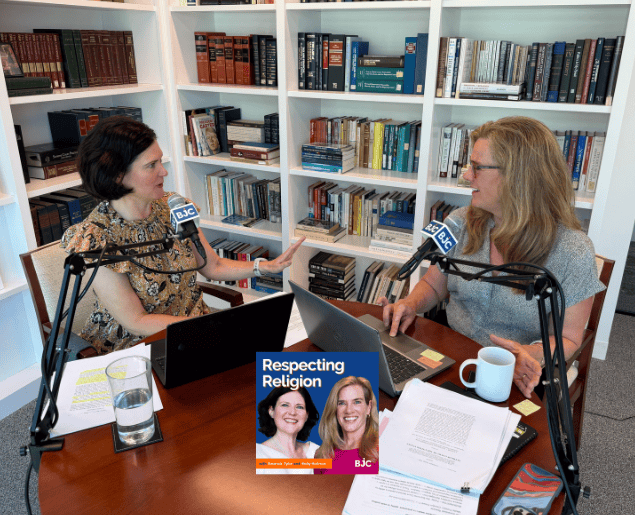
AMANDA: We are in the room together again, and we’re in a new location, for those of you who are watching us on YouTube. You might see a new background. We’re in our beautiful new library in our new office space, and it is doubling as our podcast studio.
HOLLY: Exactly. It works.
AMANDA: And we’re recording on Tuesday, June 30, minutes after the Supreme Court has issued its final decisions of this 2025 term, and it has been a whirlwind of activity over there at the Court over these last few days. We thought we’d just go through a very quick summary of the cases that came out just in the last two days.
The Supreme Court has held that President Trump can fire a Democratic member of the independent Federal Trade Commission but that he cannot fire a governor of the Federal Reserve without the chance to rebut the claims brought against her.
The Court has also declined to take up a case involving Trump’s request to challenge a $5 million civil judgment against him in a case involving assault and defamation brought by E. Jean Carroll.
In a voting rights case, the Court upheld a grace period for Mississippi voters, saying that the state can count mail-in ballots that come in up to five days after election day, provided that those ballots have a postmark of election day or earlier.
The Court also said that colleges and universities can determine eligibility for women’s and girls’ sports teams based on biological sex of the athletes.
In a campaign finance case, the Court held that the law’s limits on political parties’ coordinated expenditures violate the First Amendment.
And finally, in perhaps this term’s biggest and most anticipated decision, Trump v. Barbara, the Court upheld birthright citizenship and struck down Trump’s executive order that had disregarded that constitutional right.
HOLLY: That’s right. That is a lot of big news, a lot of big legal news, in just the last couple days, and it kind of sticks to the story that we often hear and tell, which is they often save some of the biggest cases to the very end. And, you know, those are significant cases to add to what the Court has already decided this term.
It’s been an impactful term, and we’ve discussed some of those cases. And while this end of the term will certainly give journalists covering the Court a break, as we’ve been watching — you know, is it going to be today; is it going to be Thursday? When’s the next decision going to come out? There’ll be a lot of reporting today and tomorrow, and then at least those journalists will get a break.
And then the cases, of course, will provide plenty of material for advocates and academics and concerned members of the public to ponder in the coming months.
AMANDA: Yeah. I know I have printed off a lot of pages. Sorry, environmentalists. I do need to still read on paper sometimes, so I’ve got a lot of reading to do in these cases, and I’m sure that will impact future conversations and legal strategies.
But today for our podcast and our listeners, we are really going to focus on a decision that we had been waiting for, Holly, that may not be making huge headlines but is very consequential, not just for religious freedom but also more broadly for congressional power.
HOLLY: That’s right. It may have more of an impact than even we knew going into this case. The case is Landor v. Louisiana Department of Corrections, and we’ve talked about this before. The case centered around Damon Landor’s religious freedom rights while incarcerated.
He’s a devout Rastafarian who took an oath to let his hair grow long, and he was serving, I think, a five- or six-month prison sentence and was moved to different prisons. And at one point he was moved to a prison and actually had with him a copy of a decision, a court decision applicable to that jurisdiction, showing that the rights of Rastafarians to have their hair grow long was a legitimate, recognized religious practice.
And he presented that, but the officials at the new facility apparently were not impressed. They took that from him, held him down, and forcibly shaved his dreadlocks.
Horrible case, and the lower courts – he sued, and the lower courts decided against him but recognized this egregious violation. But the case is, of course, about what he can do about that and what remedies are available.
BJC joined a brief in the case, an amicus brief, which we often do in Supreme Court cases, supporting Mr. Landor. We filed this alongside a number of groups, often that don’t see eye to eye on religious freedom issues at the Supreme Court. It was led by the Christian Legal Society, and it was joined by the ACLU and the Alliance Defending Freedom, as well as the Ethics and Religious Commission of the Southern Baptist Convention and many others.
And, you know, we were glad to do that, Amanda. In this case, we were glad to see that this group of different religious liberty advocates were in agreement here and really wanted to support RLUIPA.
That coalition I kind of named on the brief sort of is a little microcosm of the large coalition that it took and that did work together for the passage of the statute at issue, which is, of course, the Religious Land Use and Institutionalized Persons Act of 2000, known as RLUIPA.
Our brief noted that Mr. Landor, as someone who is under state authority — under government authority in prison — has the rights to religious freedom according to the statute. And the statute demands that prison systems not impose substantial burdens on the religious exercise of individuals without some compelling justification.
AMANDA: Yeah, that’s right. And I think we’ve talked about this case a few different times on the podcast, and we’ve emphasized that there really was no question in this case about whether his rights under the statute had been violated.
I mean, it was an egregious violation. Everyone agrees about that, but it was rather about what remedy was available, what he could receive in return for the violation of his rights.
So, as you noted, it was a relatively short prison sentence, and so once he was released from prison, there was no further opportunity for what’s called injunctive relief. You couldn’t say to the prison, Stop doing what you did, because his prison term was finished. And so then it turned to, well, what kind of damages could he receive in return, monetary damages, for the violations that had previously occurred.
HOLLY: That’s right. And for those that aren’t familiar really with RLUIPA, it is this important statute that’s been around 25 years, that is supposed to ensure that religion is accommodated, so that can be things like people have access to things to express their religion or use. There may be certain reading material or access to certain kind of dietary needs and things like that.
So often an injunction is the right remedy, is to change the prison policy that is getting in the way of accommodating someone’s religion. In this case, as you note, Amanda, this is about a one-time horrible event. Injunctive relief is not really applicable here.
And he sued the prison officials who did this in their individual capacity, asking for monetary damages. And this is what went up to the Court was specifically, are these kind of damages against these individual defendants, is that available under RLUIPA’s statutory language of appropriate relief that’s available under the statute.
And the decision was released last week, and the Court held that, no, those damages are not available. The Supreme Court denied the ability to receive monetary damages from individual correction officers, even for this kind of egregious violation of religious freedom.
It was a 6-3 decision. The majority opinion was written by Associate Justice Gorsuch, and it said that individuals may not be held liable in their personal capacities under this federal statute, absent express consent for such a remedy.
So, of course, you know, we were waiting for this. Our immediate reaction was disappointment, to see Mr. Landor fight this hard, make it all the way to the Supreme Court, to have so much support from a broad group of people across the political and religious spectrum.
But it was very disappointing that the Court held that not only did he not get this remedy, but that Congress couldn’t get that remedy under the statute.
AMANDA: And so, as we often do in cases in which we’re involved, we issued a statement. And, Holly, you issued the statement on behalf of the organization. We’ll link it in show notes, but just in your own words, if you want to just read the statement here for our listeners.
HOLLY: My immediate reaction was just to note that this statute was passed on a simple premise: Religious freedom is for everyone. States and local governments accept federal money to run their prisons on the condition that they respect the religious rights of the people held there.
And both the lower court and the Supreme Court, we felt like, had acknowledged, by taking this case, that the officials had grossly violated Mr. Landor’s rights. Yet today, the Court held that the statute’s promise of appropriate relief against a government does not allow money damages against the individual officers responsible.
Therefore, you know, we see this as weakening prisoners’ ability to seek justice and to deter future violations. So we were, of course, disappointed, as were our coalition partners. We are committed to continue to support RLUIPA and the religious freedom that it guarantees, doing what we can to raise attention to the importance of religious freedom for everyone, including the most vulnerable people that are in custody.
AMANDA: So you issued that statement like just a little behind – you get this opinion. It’s like 50 pages. You’ve got to process it very quickly, issue kind of, as you say, an immediate reaction. The great thing about Respecting Religion podcast is we can dig a little deeper.
HOLLY: Yeah.
AMANDA: We can have a little more of an extended conversation about it, so that’s what we want to do here today.
Segment 2: Unpacking the Landor decision and dissent (starting at 11:57)
HOLLY: So we’ll unpack the case just a little bit. As I said, it was a Gorsuch opinion, and really it was a single theme. Once you realize, okay, he lost, and the Court held that this remedy’s not available — not for Mr. Landor, not for anybody — the goal then is like to understand why, how, and what effect this might have.
But Justice Gorsuch frames the case as just whether RLUIPA permits plaintiffs to sue nonconsenting state employees, which kind of tells you the answer right there, by saying “nonconsenting,” and noted that, of course, congressional support -– this is Spending Clause legislation –- comes with strings attached.
So basically, Congress acts in a way, according to its enumerated powers. And in this case, it’s a Spending Clause power. You know, you get the money, and you abide by the law.
So the opinion kind of goes through that explanation but says that Congress cannot use that spending power really to regulate behavior. That’s what it said. Instead, the Court really said that there had to be basically contract kind of consent in order to get individual damages.
Since RLUIPA is based on the Spending Clause – this is Article 1, Section 8, clause (1) — the Court said, okay, it’s based on that, that congressional authority, and the questions before us are: Does the statute allow individual damages against these parties and does the Spending Clause allow it?
And then Gorsuch really just skipped to that second question, which was notable, because we know in other cases, the Court tries to avoid the constitutional question to answer something under a statute. Right? But here just said, No, there’s no power under the Spending Clause, absent more explicit consent to get money damages.
He said, it’s undisputed that the Louisiana Department of Corrections is a recipient of funds and has agreed to suits. That’s appropriate relief. But that is for claims against the state. Here there is only claims against individuals in their personal capacity, and there are no allegations that the individuals voluntarily and knowingly consented to answer private suits under RLUIPA.
AMANDA: Yeah. So, I mean – and we’ll get more into this when we talk about the dissent in this case that, I think, really kind of points out how this is a departure from how the Court has previously understood and interpreted statutes that were passed by Congress under their Spending Clause authority.
And just like – let’s do a little schoolhouse rock here. You know, as far as Congress is a body under our federalism system with limited power, important power but limited power.
HOLLY: Right.
AMANDA: Right? And so, therefore, Congress can only legislate under, as you noted, one of its enumerated powers. And there are different powers that Congress has one of them –- and I would say one of its more controversial powers in some ways –- is this Spending Clause authority –- right? — that it has the power to spend money.
When it does so, it can pass legislation contingent on that funding to states –- but when it does it, it has to be explicit in the statute about what the requirements are. And this has — over the past several decades, the Court has kind of used contract law as an analogy to understand whether they’re abiding by that or not, like, are you being clear in what’s required, thinking of it like a contract.
HOLLY: Yeah. So we should probably say, this is kind of taking us back to first-year law school. All law school students -– I’m sure they still do -– have to take contracts, kind of basic class.
But there are certain elements to contracts before courts will enforce them. And you have to have an agreement. You have to have clarity. You have to have an offer, an acceptance, and something that’s exchanged of value. And, of course, it makes sense that in a contract, if a court’s going to uphold it, there needs to be clarity.
So as you said, Amanda, they’ve looked to contract law as kind of analogies to make sure that whatever conditions came in Spending Clause legislation – right? — was clear enough and related enough to the spending.
AMANDA: Yeah.
HOLLY: But what we hadn’t seen is the Court going this far. So the majority opinion just concluded by saying that under the Spending Clause, Congress’s power to spend money does not include the power to regulate. Spending Clause statutes can bind only those who voluntarily and knowingly undertake obligations by agreement with the federal government.
So reading this statutory language, you know, that they are looking more at these kind of contract principles to see, did the individuals contract to be sued in their individual capacities.
AMANDA: Yeah. So, I mean, essentially he’s saying, yeah, the state –
HOLLY: You agreed to it. Yes.
AMANDA: You agreed to this. You, quote/unquote, signed this contract with Congress. But each of these officers who are named in this suit, by the way, as Officers Does 1 through 10 – right? — that those people did not sign a contract with Congress. I mean, let’s just kind of lay this out.
HOLLY: They didn’t bargain for this.
AMANDA: Right. But, I mean, do any of us when Congress passes a law? Do we usually –- I mean, imagine –- you think Congress is slow and ineffectual now — if they had to actually go out and sign contracts with each of us before we agree to be bound by the law. That would be a big departure.
HOLLY: Uh-huh. Uh-huh.
AMANDA: And we’re getting a little bit more into the dissent here, but just to kind of say that basically they’ve taken what was an analogy, and turned the statute, at least as it applies to individuals and not the states, into more like a contract.
HOLLY: That’s right. So the majority made this big sweeping conclusion about the Spending Clause, and not surprisingly, there was a spirited dissent by Justice Jackson. She was joined by Justice Sotomayor and Justice Kagan.
And, like all opinions, it starts with generally looking at the law at issue. She noted that Congress enacted RLUIPA to ensure that state and local prisons respect prisoners’ rights to religious exercise.
When it wanted to do that, what did it do? It passed a law. Congress passed a law, and RLUIPA requires these state and local prisons that accept federal funding to accommodate prisoners’ religious exercise, more generously than the Constitution mandates.
And then she goes on to say, “Like many, this law comes with an enforcement mechanism. To ensure compliance, RLUIPA authorizes an impacted prisoner to sue any prison employee who violates a statute. Such suits, the statute provides, may proceed against the employee in the employee’s individual capacity and may yield appropriate relief.”
And then, you know, we have the rest of the opinion, saying like, what’s going on here; like this is an unprecedented move. She just really points out like this is bizarre to separate the injury, the violation of the law from the remedy.
So reading this dissent, I mean, after the majority opinion, it was a notable difference – right? — in how she looked at this complaint in the first place.
AMANDA: Yeah. I mean, just, one, just based on quantity, the dissent is much longer than the majority opinion, so I think we’ll point that out. And then on – well, maybe not quality, but content, it’s different. And one piece of that content is the dissent really gets much more in depth on the facts of the case again.
HOLLY: Yeah. Just making sure that readers know the context here. And, of course, our listeners know the context, because we’ve talked about that a lot. But she wanted to make clear that this is the exact kind of situation that you would hope would never happen because you have this law.
She says, “It is not” — let me quote here. She says, “It is not often that a real-life incident so clearly illustrates Congress’s reasons for adopting legislation or the Constitution’s wisdom in enabling it.”
And, you know, she goes on to recite the facts of his commitment, under his understanding of the Bible, to let his locks grow long, and noting that for a Rastafarian like Landor, locks are the physical embodiment of his spiritual identity in connection to God, and that he preserved that by letting his hair grow all the way to his knees.
That had been respected in Louisiana jails and at the two facilities that housed Landor for the bulk of his prison time, but not when he got to a new place.
And she noted that, you know, that respect for him in the earlier prison facilities, the first prison facilities, did not just happen. They respect that not just because it was the right thing to do but because federal law required it. You know, this law’s been around for 25 years.
AMANDA: I mean, I think by pointing that particular fact out, she’s saying, this was a particular violation by these prison officials. Right? Like there were other prison officials who had –
HOLLY: Who followed the law.
AMANDA: — respected the law. So what’s the recourse then when there are prison officials who don’t abide by the law? How are we as a people, not just Mr. Landor as a person, but how are we going to hold people accountable when they break the law? Because that is what happened here to Mr. Landor by these prison officials.
HOLLY: Both parties agree that Congress had the power to impose RLUIPA’s substantive directives on the prisons, that they had to accommodate religious freedom. But the majority adopts this peculiar position that Congress is powerless to create and the state is powerless to accept what she calls the natural next step, a damages remedy.
And she calls this severance of rights and remedies a sleight of hand, and as we note, it comes by way of this contract analogy, taking it way beyond what the Court had ever done before.
AMANDA: Yeah. And she clarifies in so doing the fact that when used as an analogy –
HOLLY: Makes sense. Right?
AMANDA: Right. It made sense, right. That it’s helpful. But then she says why actually turning this piece of legislation, you know, essentially into a contract, that that is not helpful. And I’ll just quote here from her decision.
She says, “Under our precedent, this is where contract law principles should come into play, not as a substantive limitation on Congress’s power as the majority uses it today, but as a demand for statutory clarity.”
And then she goes on to explain how RLUIPA is actually quite clear as a piece of law and that Congress in 2000, when they passed this piece of legislation, provided an express private right of action, that this was something that Congress was clear about and that this law has been around for now 26 years, and it is only now that the Court is kind of changing the rules of how we should consider how to interpret this piece of long-standing law.
HOLLY: That’s right. She says the Spending Clause is the power to legislate, not merely to negotiate.
AMANDA: Right. That a law is not a contract. A law is something different, and Congress has this extraordinary power, a power to legislate that is given to Congress by we, the people, that Congress is the most accountable branch of government of the three branches to the people with regular elections and with elected representatives.
By turning this into just almost like a private contractual matter, that it is not just robbing Congress of power; it’s robbing the people of power to pass laws that impact all of us.
HOLLY: So let’s talk for a minute about what she said about the impact of this decision, Amanda.
AMANDA: Well, you know, she starts by – and this is towards the end of the decision. But she first kind of has a broad view of what does this mean generally for Congress.
And she writes that, “Today’s decision might well land a serious blow to Congress’s effectiveness, or it could end up merely a bothersome statutory drafting guide. If Congress adapts its Spending Clause legislation to fit the Court’s newly prescribed formulas and if the Court lets it do so, then the majority’s robotic importation of contract principles will have little real-world effect.”
And I’ll pause there to say, I was struck in reading her dissent how many times she used the word “new” or “novel,” you know, really expressing the fact that what the Court is doing here is a departure from what they had done under prior precedent and prior interpretation, and that the impact kind of remains to be seen.
And so also, after she, you know, kind of says this broadly, then she says what could be the impact for religious freedom in particular.
She writes, “As for RLUIPA itself, the consequences are more predictable. Prisoners like Landor who suffer violations of their religious freedom in state prisons, no matter how blatant, will often be left remediless, and encroachments on prisoners’ statutory rights are likely to happen with fair frequency, as state-empowered prison officials will have little incentive to abide by federal law, even if it is handed to them on a piece of paper.”
And, you know, so we know there are certain prison officials who will abide by the law, both because it’s the right thing to do, as she said earlier, and because it’s federal law.
And then we’ll have some people who won’t be abiding by federal law, even when it’s handed to them, as Mr. Landor did in a prior court case, but that might have been deterred if they were concerned that they would be sued as individuals and liable for damages. That particular incentive or deterrent is no longer available.
HOLLY: That’s right. Yeah. And, of course, RLUIPA remains good law to require the accommodation of religious rights of prisoners, and injunctive relief remains. And the Court noted that, you know. We’ll see what comes next.
The opinion ends with saying that to be very clear about this, the Court’s decision does not eliminate all damages liability from RLUIPA, that a prisoner who happens to be housed in a local rather than a state jail may recover, and that is because of these complex principles of sovereign immunity that does not apply the same way to local governments.
And, of course, there is this injunctive relief. Some of what RLUIPA provides is based on commerce, the commerce power, so, there are some complexities here. We know it’s just a very unfortunate decision, both for Mr. Landor and for the expansiveness that we believe Congress meant to ensure that religious freedom rights of prisoners were given as broad a meaning as possible.
AMANDA: Yeah. And so at this point, I think we wanted to bring in a couple of other commentaries that we had read and thought about. One is from law professor Steve Vladeck who is at Georgetown University Law Center and has a really well-done blog on Substack called One First. And he used one of his posts in the past week to analyze the Landor opinion.
HOLLY: He saw it as a sleeper case.
AMANDA: He did. He used his post, he wrote, “to argue that Landor is actually a massively important holding with constitutional dimensions, one that reflects the culmination of a long-term conservative legal project to weaken one of Congress’s most important regulatory powers.”
And, you know, also, “how it comes at the direct expense of private individuals like Mr. Landor for whom Congress has expressly created an array of federal statutory rights.”
HOLLY: Yeah. He really takes the dissent’s concern and fleshes it out in all of the possible ways that it could have an impact and really lessen the rights of Congress and, therefore, the rights of the people.
We also want to note our friend Liz Reiner Platt, who’s the director of the Law, Rights, and Religion Project. She wrote a piece called, “A Rastafarian’s Supreme Court loss shows religious freedom depends on who you are.” She’s contextualizing the impact of the decision in light of larger inequities inherent in the criminal justice system.
And she notes that even where you have an extraordinary statute that’s supposed to provide the broadest religious freedom, that it is kind of mediated through the systems of law in prison. And it’s very difficult then to have it achieve its goals.
AMANDA: Yeah. And, you know, just to quote from her piece, which we will link both of these pieces in the show notes, she wrote, “In this way, the case highlights an important but often overlooked aspect of religious liberty law, the ways in which religious rights are deeply but often invisibly shaped by race, class, status, nationality, and other factors seemingly unrelated to faith.”
And we know how racialized minorities are disproportionately represented in America’s prison systems, and so to the effect that there are fewer rights or fewer remedies to those rights available to people who are incarcerated, the impact will be disproportionately felt by certain communities as well.
Segment 3: Taking action – in Texas and beyond (starting at 30:37)
AMANDA: Sometimes you hear a story like this and you think, what can I do for Mr. Landor. How do we bring Mr. Landor some sense of justice? And often, you know, sadly it is out of our particular hands. Right? You have Congress passing a statute. You have Supreme Court limiting those rights.
But there are so many other ways that we can both bring attention to the gaps of really realizing full religious freedom in our society, and then when we see our officials, particularly our officials on the local and state level, trying to pass policies that would widen those gaps even further, we can speak up and we can speak out.
So in my home state of Texas, I talk a lot about how in Texas we live under two levels of authoritarianism, both at the federal level but also at the state level. And a lot of that is really impacting religious freedom rights, in trying to -– for the state, in different ways, to legislate a particular way of being religious and to do so increasingly through the public schools.
And something we’ve seen in Texas is action being taken by the State Board of Education. They approved a curriculum a couple of years ago, really pushing the teaching of Bible stories into the curriculum but in an optional way.
This spring, they took up a new required literary list that in order to graduate from a Texas school, that throughout your K through 12 education, you would have to read certain texts.
And a number of us were alarmed when some of those required readings were taken from the Christian Bible and were in different translations, particularly the King James version, translation of the Bible and also some evangelical translations of the Bible.
And we helped bring a diverse coalition of people together who were saying, This is a violation of religious freedom, for the public school to pick and choose among religions and religious texts, and to require them.
And so we saw a real outpouring of opposition to this from a diverse coalition that was taken in public testimony, in public comments filed, both back in April and then most recently in June.
On June 22, in particular, the State Board of Education held hearings about this new proposed reading list, and later that week, they voted to accept this reading list. It was at that point that we had a ton of media attention. And I’m just going to say, this is frustrating to me, Holly. Where was this media attention in April and in June when it was being considered? Right?
HOLLY: Yeah.
AMANDA: Most people heard about it – of course, we had been talking about it. And there was some reporting in particularly state and local media about it. But then there was a lot of national attention, once the vote already happened.
HOLLY: Yeah. And to be fair, Amanda, there is a lot of news in Texas, a lot of violations to cover. Okay? So not everything can be the headlines, but I understand that frustration. And I am glad to see people paying attention and really thinking about what religious liberty means, how do we protect religious liberty in the public schools, how are we good citizens to be involved in those debates.
AMANDA: And I am. I’m glad that, one, there is reporting on what’s happening, and two, the level of opposition that we’ve heard. The people are really shocked and really concerned about the turn that’s being taken, that, you know, from what we can tell, for the first time, a state is requiring -– first time in a long time, I should say, that the state is requiring the reading of the Bible as part of the public school curriculum, in a way that has not happened.
And so this is an issue that we have been involved in at BJC. We will continue to be involved in, and so really want to encourage people, if you’re not already on our email list, we always include a link in the show notes to join our email list. Please stay involved with us on this topic, because there will be opportunities to push back against this before it actually takes effect.
And so we will provide a link in show notes to a piece from the New York Times that covered this story. You know, we’re grateful to be continuing to do this work and grateful for our listeners for being part of it.
HOLLY: As we end this season, we just want to thank you all for listening. And, Amanda, I think we should say, as we do that, we are also recognizing that we at BJC are celebrating an important anniversary. And as we close this episode and season 7 of Respecting Religion, we want to include our listeners in our celebration.
AMANDA: Yes. So this year marks the 90th anniversary of BJC, Baptist Joint Committee for Religious Liberty. People like you have been part of this organization for nine decades now, and we are honored to continue the work of our predecessors for religious freedom and the challenges that we face today.
HOLLY: And while many things have changed — the issues come and go, court decisions go up and down, we have different presidents and government officials — some things are consistent across the decades, and that is our country’s promise of faith freedom for everyone set up in the Constitution and fought for by Baptists and others for centuries.
AMANDA: That’s right. And we kicked off our 90th anniversary a couple of weeks ago. We were in Jacksonville, Florida, for a regular luncheon that we hold with some of our supporters and friends and advocates, and we even had some of our Respecting Religion listeners who were local to the area come out and see us there, which was really fun.
And during the event – and if you’re on YouTube, you can see it, because I’m holding up – we gave out these tee shirts. It says, “No one has religious freedom until everyone has religious freedom.” It’s an homage to a quote from Fannie Lou Hamer, that no one is free until everyone is free.
HOLLY: Yes. And people were very happy to have these shirts. It reminds them to do what they can, that even if they’re doing okay, look out for their neighbors. And we were glad to see that people put those shirts on and went out into the world. We even saw the shirt pop up on CNN over the weekend as Pastor David Stippick wore it for an interview about the new and troubling reading list in Texas.
AMANDA: Yeah. I happened to watching CNN when that story came on –
HOLLY: Hey, there it is!
AMANDA: — and I was like, That’s our T-shirt. So if you want to have one of our shirts, like Pastor Stippick wore on CNN, we want to give one to you. And so here is how you can get one of these great tee shirts.
If you are already a monthly donor to BJC, we’ll be reaching out to you about getting one. But we would love to invite listeners who are not already supporting our work to become a monthly donor to BJC.
And so I say it every time when we close this show, but we really could not bring this show to you without supporters and without your gifts, so we’re happy to keep these conversations ad-free, and our supporters make that possible.
HOLLY: So please join us. Become part of our monthly donor community. It’s known as the FaithFULL Community, and in the next month, we’ll be sure to send you a shirt.
AMANDA: There’s a link in our show notes that you can use to sign up, or you can go to BJC’s website, click the Give button at the top. When you sign up to be a monthly donor, let us know in the notes section that you came here through the podcast.
HOLLY: And you can also join the Respecting Religion email list with special updates on the show. Use the link in our show notes for that, too, and we’ll keep you posted about our next episode as we end this season.
And with that, we are at the end of this episode and this season of Respecting Religion. Thank you so much for joining us.
AMANDA: For links related to today’s show and a transcript, visit our website at RespectingReligion.org. That takes you to our new look for our home page.
HOLLY: Learn more about our work at BJC, building a movement toward a just society that cultivates and expands religious freedom for all by visiting our website at BJConline.org.
AMANDA: And as we mentioned, sign up for emails from us with the special link in our show notes. Using that link lets us know that you’re interested in hearing from us about this podcast.
HOLLY: You can send both of us an email by writing to [email protected].
AMANDA: Be sure to follow BJC on social media, too. We’re @BJConthehill.
HOLLY: And wherever you listen or watch, take a moment to leave us a review or a five-star rating, to help more people find this program.
AMANDA: Thank you for supporting this podcast. If you become a monthly donor in the next few months, we’ll send you one of BJC’s new 90th anniversary tee shirts. You can donate to these ad-free conversations by visiting the special link in our show notes.
HOLLY: Thanks for joining us for conversations Respecting Religion.