Court Case
Ten Commandments Cases
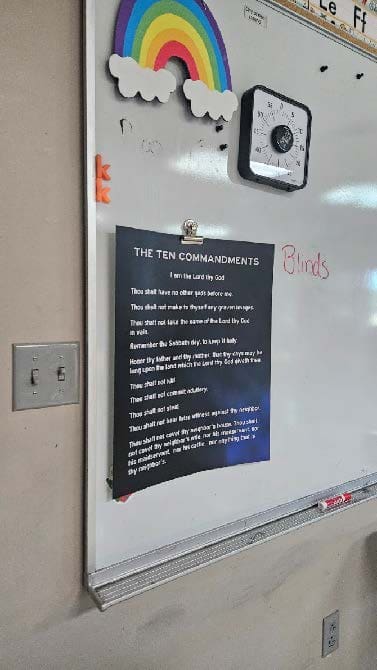
At issue: Can a state require public classrooms to display copies of the Ten Commandments?
BJC says: No. The government’s role is not to teach religious beliefs, coerce students into believing, or endorse a particular faith.
Case status
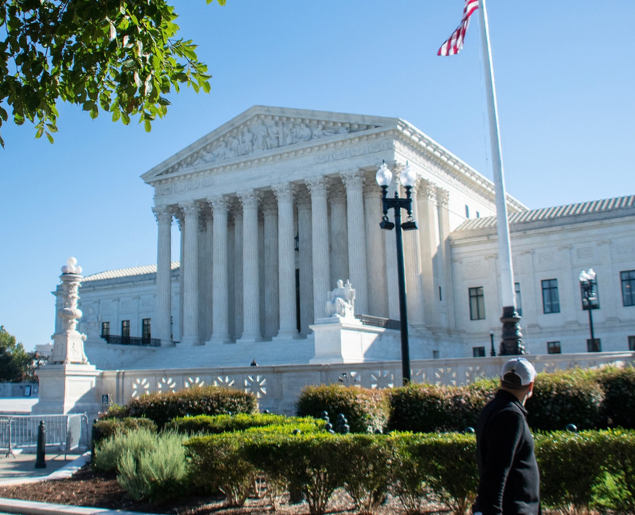
The question of whether a state can force public schools to display the Ten Commandments was appealed to the U.S. Supreme Court on August 17, 2026. The Court has not yet determined whether it will hear the case.
Since 2024, Texas, Arkansas, and Louisiana have passed laws to require government-approved versions of the Ten Commandments in children’s classrooms. Parents sued to stop them, challenging the laws as a violation of their religious freedom.
BJC supported families in these cases. There is a stark difference between state-sponsored religious indoctrination and teaching about religion.
Several different lawsuits challenged these laws in the various states, including Rabbi Nathan v. Alamo Heights ISD in Texas, Roake v. Brumley in Louisiana, and Stinson v. Fayetteville School District No. 1 in Arkansas.
BJC led briefs in two of those cases, noting how these laws create unavoidable state-sponsored religious indoctrination. These laws select a preferred version of the Ten Commandments that aligns only with certain faiths and denominations.
As the cases worked their way through the courts, judges were consistently siding with the families, striking down the Ten Commandments laws in Louisiana and Texas as clearly unconstitutional under a decades-old precedent in Stone v. Graham (1980).
The legal landscape shifted, however, at the 5th U.S. Circuit Court of Appeals. After first striking down the Louisiana law in 2025, it heard both a Texas and Louisiana case at the same time, en banc. It released two different decisions in 2026, both allowing the laws to be implemented.
The Texas families are now appealing their case to the U.S. Supreme Court. We likely won’t know until sometime in December 2026 if the Supreme Court will hear the case. If it decides to do so, oral arguments would be expected in the spring of 2027.
BJC will continue to advocate against government-sponsored religion and for religious freedom for all students.
Details On The State Laws
Louisiana was the first state to pass legislation regarding the Ten Commandments. Their law – passed as “H.B. 71” – mandates the posting in every public school classroom in the state. Nine Louisiana families — from religious and nonreligious traditions — challenged it in a case known as Roake v. Brumley, saying the law violates their religious freedom and the separation of church and state as protected by the First Amendment. BJC led a brief in support of those families.
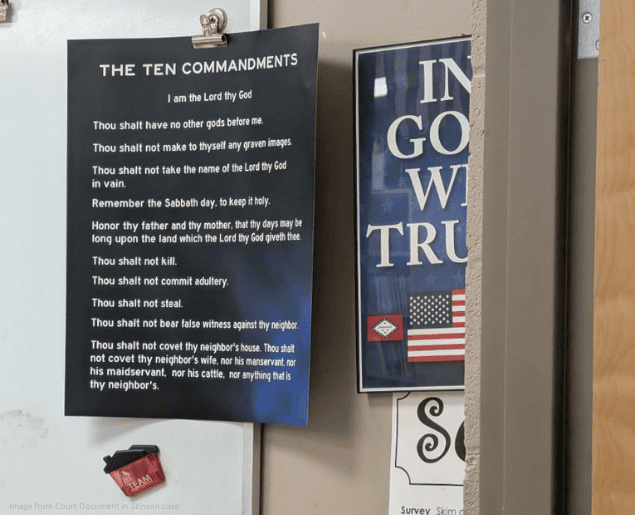
In Arkansas, Act 573 requires that the Ten Commandments permanently be displayed in every classroom and library of every public school in Arkansas. BJC led a brief in support of the families who sued to stop the law in Stinson v. Fayetteville School District No. 1.
In Texas, SB 10 requires all public school classrooms to display the Ten Commandments in a “conspicuous” place. The Ten Commandments must meet certain size requirements, be visible from anywhere in the classroom, and it must be in the King James translation. Schools are not required to purchase their own copies, but they are required to accept donations that meet the parameters.
While not part of these cases, Alabama also passed a law (SB 99) in 2026 requiring the posting of the Ten Commandments. That law says it is to be posted in 5th-12th grade history classrooms and in common areas in schools. It has not yet been challenged in court.
There are other state laws allowing the displays of the Ten Commandments.
Information on Various Court Rulings
A three-judge panel of the 5th U.S. Circuit Court of Appeals originally agreed with the families and BJC’s brief in the Louisiana case of Roake v. Brumley, issuing a unanimous decision June 20, 2025 that stopped the law from taking effect.
A federal district court ruled similarly for the Texas families on August 20, 2025 in Rabbi Nathan v. Alamo Heights ISD, finding Texas’s Ten Commandments law to be an unconstitutional establishment of religion. That ruling blocked the law’s enforcement.
However, Texas appealed that ruling, and Louisiana requested that the 5th Circuit rehear its case en banc (which means in front of a full panel instead of a 3-judge panel). The 5th U.S. Circuit Court of Appeals agreed to hear both cases – the Texas appeal and Louisiana rehearing – together en banc. BJC’s amicus brief in the Louisiana case spoke for our position in both cases.
In a Feb. 20, 2026 decision, the court said it was premature to determine the constitutionality of the Louisiana law, because the law had not yet been implemented. On April 21, 2026, the en banc court upheld the Texas law in a 9-8 decision, finding that the posting of the Ten Commandments in classrooms is in keeping with history and tradition, and it is not an establishment of religion.
On August 17, 2026, the families in the Texas case of Rabbi Nathan v. Alamo Heights ISD filed a cert petition asking the Supreme Court to hear their appeal. They consistently argue that Texas’s Ten Commandments mandate violates the Establishment Clause and their right as parents to direct the religious upbringing of their children. The Supreme Court has not decided yet whether it will take the case.
Meanwhile, a group of families in Arkansas challenged their state’s Ten Commandments law in Stinson v. Fayetteville School District No. 1. On August 24, 2025, an Arkansas district court granted a preliminary injunction blocking the law. The state appealed the decision to the 8th U.S. Circuit Court of Appeals, which heard oral argument in the case on September 22, 2026.
Resources on the cases
Read, watch, and listen for more on the cases regarding government-mandated displays of the Ten Commandments.
-

BJC's Brief in Louisiana
BJC filed a brief on behalf of the Louisiana families at the 5th U.S. Circuit Court of Appeals, noting that H.B. 71 chooses a particular version of the Ten Commandments, picking sides and improperly expressing a preference in long-standing religious debates among — and between — religious denominations.
-
BJC's Brief in Arkansas
BJC led a brief on behalf of the families in Arkansas in the case of Stinson v. Fayetteville School District No. 1 at the 8th U.S. Circuit Court of Appeals. The brief explains the many problems with the law, including that it grants preferential treatment to a single version of the Ten Commandments.
-
What Freedom Do We Have?
Parents opposed to government-mandated Scripture displays aren’t saying the Ten Commandments don’t matter. Instead, they argue that it is the job of families, not lawmakers, to decide how and whether to teach religion.
-
Related Ruling in the Texas Case
In April 2026, the 5th U.S. Circuit Court of Appeals broke with precedent and said that the state of Texas may require the posting of the Ten Commandments in public school classrooms in Rabbi Nathan v. Alamo Heights ISD. It’s the first decision on the merits upholding such a statute.
-
Podcast Conversation
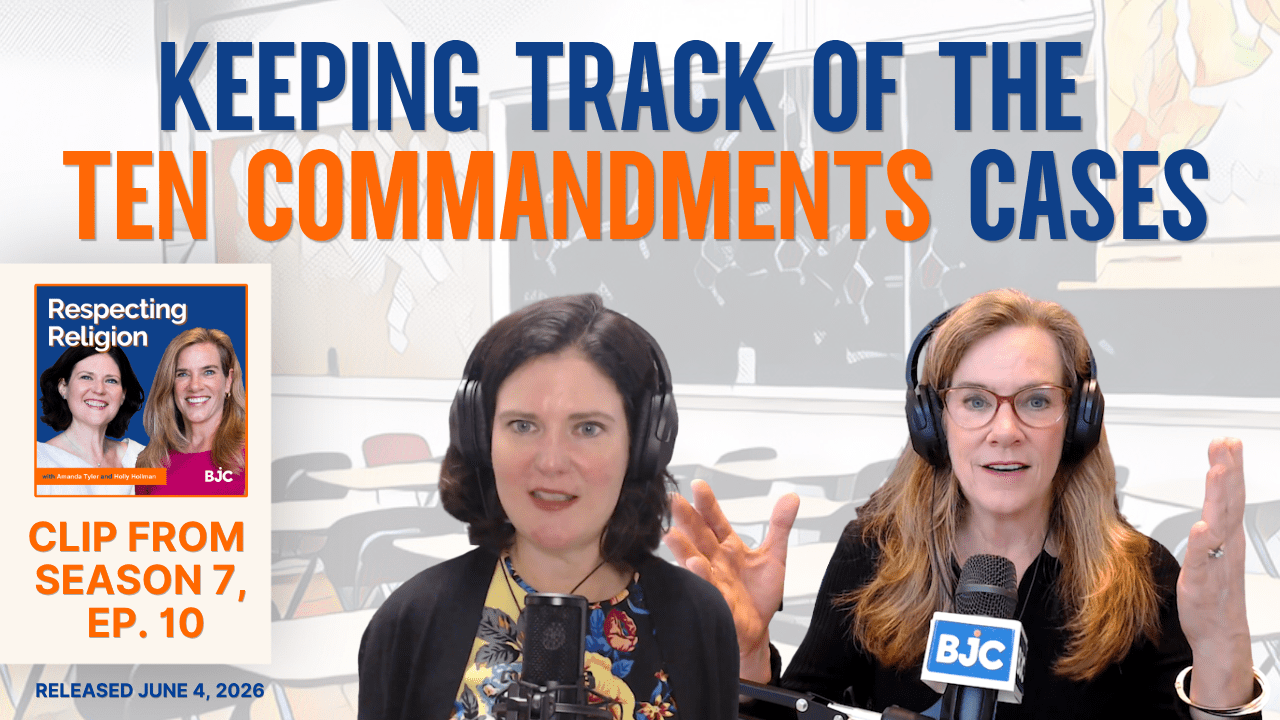
In this clip from the Respecting Religion podcast, Amanda Tyler and Holly Hollman look at the various lawsuits challenging mandates to post the Ten Commandments in public schools. This conversation was released June 4, 2026.