S7, Ep. 04: Criminalizing Mercy: Sanctuary and Government Repression of Migrant Justice
When did mercy become a crime?
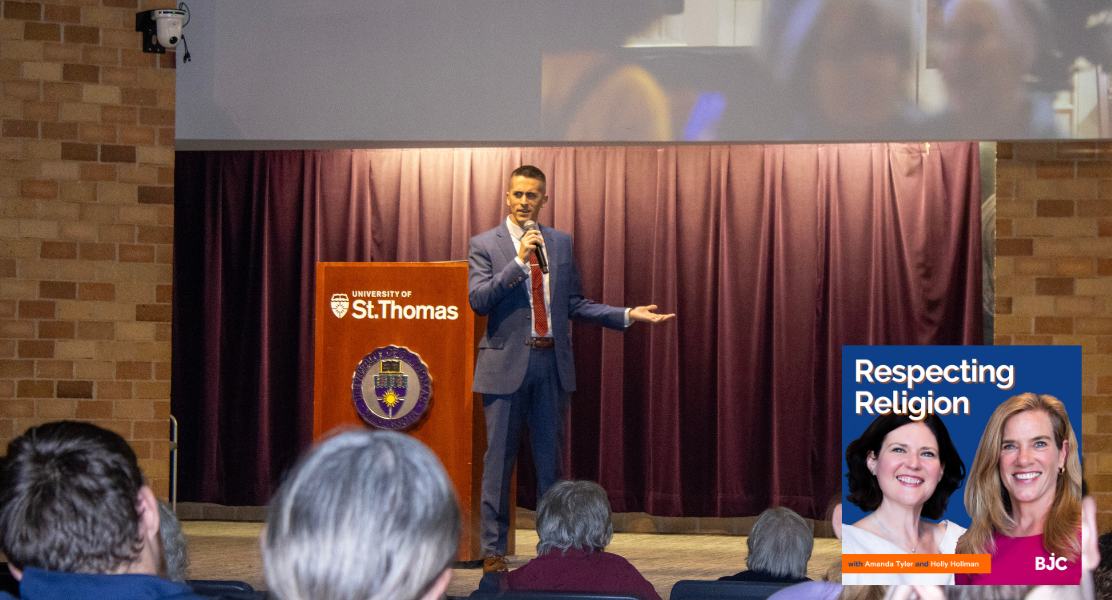


Today, we are bringing you a special presentation on the contested issue of “sanctuary,” which continues to cut into the immigration debates in our country. Dr. Sergio M. González traces the sanctuary movement to its roots in the 1980s and examines how we arrived at a moment where mercy is met with repression. This presentation was given on the campus of the University of St. Thomas in St. Paul, Minn., on Oct. 22, 2025, as part of BJC’s annual Walter B. and Kay W. Shurden Lectures on Religious Liberty and Separation of Church and State.
SHOW NOTES
Segment 1 (starting at 00:35): Introduction
Dr. Sergio M. González is a historian of U.S. immigration, labor and religion. A professor at Marquette University, he is a co-founder and former organizer for the Dane Sanctuary Coalition.
He also is the co-creator of a podcast titled “Sanctuary: On the Border Between Church and State.”
Segment 2 (starting at 04:45): Presentation from Dr. Sergio M. González
This is a recording of a lecture from Dr. Sergio González that took place Oct. 22, 2025, at the University of St. Thomas in St. Paul, Minn. Watch the full presentation, including the audience Q&A, on BJC’s YouTube channel at this link: https://www.youtube.com/watch?v=ZSnDp8hPNIo
Dr. Gonzalez mentions a document called “Religious Liberty and Immigration: Legal Analysis of Past and Future Claims.” You can access it on the website of the Law, Rights & Religion Project.
This program was part of BJC’s annual Walter B. and Kay W. Shurden Lectures on Religious Liberty and Separation of Church and State. Learn more at BJConline.org/ShudenLectures.
Video of our episodes are now on YouTube! Click here for the season 7 playlist.
Do you want special emails about the show? Click here to sign up for our email list!
Respecting Religion is made possible by BJC’s generous donors. Your gift to BJC is tax-deductible, and you can support these conversations with a gift to BJC.
Transcript: Season 7, Episode 04: Criminalizing Mercy: Sanctuary and Government Repression of Migrant Justice (some portions of this transcript have been edited for clarity)
DR. GONZÁLEZ: The question that remains for us, as it did for the Sanctuary workers of another generation, is not whether mercy will be criminalized, but whether we will have the courage to practice it anyway.
Segment 1: Introduction (starting at 00:35)
AMANDA: Welcome to Respecting Religion, a BJC podcast series where we look at religion, the law, and what’s at stake for faith freedom today. I’m Amanda Tyler.
HOLLY: And I’m Holly Hollman. Today we’re bringing you a special presentation that provides some perspective at a time of harsh and unpredictable immigration enforcement in our country. It raises the question others have been asking lately: When did mercy become a crime, particularly in efforts to provide sanctuary and to work for justice for migrants?
We’re going to hear from Dr. Sergio M. González in just a moment on this topic. It’s a presentation he gave two weeks ago in Minnesota as part of BJC’s annual Walter B. and Kay W. Shurden Lectures on Religious Liberty and Separation of Church and State. And, Amanda, you were there.
AMANDA: Yes, Holly, I was. On our live show two weeks ago, I was broadcasting from Minnesota, and I had just heard this presentation. And I’m still thinking about much of it. Dr. González traces the Sanctuary Movement to its roots in the 1980s, which really started with offering refuge to Central American migrants at that time.
He does a great job in this lecture, examining how we arrived at a moment where, as he says, mercy is met with repression. He notes that the contested issue of sanctuary really cuts into the immigration debates we have had and are continuing to have today.
HOLLY: Well, before we hear from him, let’s tell our listeners a little bit about Dr. González. He’s a historian of U.S. immigration, labor and religion, and a professor at Marquette University. Dr. González also is a co-founder and former organizer for the Dane Sanctuary Coalition. And for our podcast listeners, he’s also the co-creator of a very helpful podcast titled “Sanctuary: On the Border Between Church and State.” We’ll link to that in our show notes.
AMANDA: Yeah. It was wonderful to meet Dr. González in person. I had listened to many episodes on that podcast series, and, in fact, that’s where we first became acquainted with him and his research and his scholarship. I was so impressed with just how personable he was and how he really brings his extensive research to life in this lecture and in the rooms where we had the lecture series in Minnesota a couple of weeks ago.
HOLLY: Well, I’m so glad we have this connection with him, because I thought that podcast series was really helpful, too, as a matter of historical understanding and inspiration. And in this presentation, I really appreciate how he tells stories, how he shows us that looking at the past can really shed light on where we are now.
And during this talk, he mentions a document from the Law, Rights & Religion Project called “Religious Liberty and Immigration: Legal Analysis of Past and Future Claims.” We’ll put a link to that in our show notes, as well as a link where you can watch the full separate video that includes this presentation, the opening remarks, and the audience Q&A afterwards. I thought the conversation with the audience and engagement with the questions really provided a lot of helpful conversation, too, Amanda.
AMANDA: Yeah. I really appreciate that resource that you mentioned that we’ll link in show notes, and I also can commend the Q&A. It was really too long for us to include on the podcast feed here, but it was an incredibly engaging 45 minutes of Q&A following this lecture, and we actually had to cut off questions.
That is something you don’t often see, to have so many engaged and thoughtful questions from people from the community, people from all ages, including college students at the University of St. Thomas which hosted this lecture series this year, so really commend for listeners who want more information after hearing the podcast, to go to that link on our website.
HOLLY: After the music, you’ll hear his presentation now, titled “Criminalizing Mercy: Sanctuary and Government Repression of Migrant Justice.”
Segment 2: Presentation from Dr. Sergio M. González (starting at 04:45)
DR. GONZÁLEZ:So before I get into my talk, I want to offer some caveats to open my time today. The first thing is that this is a brand new project, and so because of that, I’m going to be reading my comments. And I will tell you, I hate reading off of a paper. When I lecture, when I teach, I don’t use any notes, and I love to pace. But I’ve been given a very specific time limit today, and I want to make sure that I hit that time limit, so I’m going to be reading. I’m going to do my best.
The second caveat is I am not a legal historian, which makes me somewhat nervous to be in a room with some legal scholars and some lawyers in the room. I’ll do my best to stay away from the areas that I know nothing about.
The last caveat I have is an honest one, which is to ask, What do I have to offer in these precarious times? Some days I find it much more useful to hear from reporters who are on the ground, like those at ProPublica, who have been investigating conditions in detention facilities all across the United States. And we should always be listening to frontline responders who are developing rapid response networks, engaging in accompaniment at courthouses and crafting innovative strategies to respond to this particular moment in immigration politics.
So what then does a historian have to offer? I have stories. That’s what I have to offer you today. And what I hope is in the 45 minutes that we have together here and the Q&A afterwards, the stories that I’m going to share are going to offer some avenues, some windows to think about the past in a way that can illuminate our present, and most importantly, perhaps offer some insight into the future. So my job today is to tell some stories. All right.
On a crisp October day just a few weeks ago, the Rev. David Black, dressed in black and wearing a clerical collar, stood before the Immigration and Customs Enforcement detention facility in Broadview, just outside of Chicago. He raised his arms heavenward, locked eyes on masked ICE agents on the roof, and he began to pray. Then, as he told a journalist later, he issued what was functionally an altar call. He said, “I invited them to repentance. Come and receive salvation. Be a part of the kingdom that is coming.”
Seconds later, as his arms lowered, agents fired pepper balls. One struck the reverend in the head, producing a puff of white smoke and sending him to his knees. Demonstrators who were on site hurried to help the pastor. Meanwhile, the agents on the roof continued to deploy their nonlethal rounds.
Rev. Black today is a plaintiff in a lawsuit, alleging that ICE and the Department of Homeland Security have targeted him and other clergy in violation of their religious rights. His suit names First and Fourth Amendment violations, as well as infringements of his right to exercise religion, protected under the Religious Freedom Restoration Act or RFRA.
Despite these attacks, Catholic, Episcopalian, Presbyterian, Methodist, and Jewish clergy have continued to gather at the detention center’s gates, waving banners that read, “God’s love knows no borders,” and “Love they neighbor.” They’ve offered interfaith worship services, have sung loudly and proudly, have blockaded gated entrances, doing all of this while risking arrest, and the same type of treatment meted out to Rev. Black.
Rev. Hannah Kardon, one of the pastors who gathers regularly at Broadview, says that she prays for the ICE agents as well as the immigrants detained inside, and she notes, quote, “These are our friends, our family, and they are being stolen.”
In response to these faith-infused manifestations, ICE and DHS have labeled protesting pastors “rioters” and accused them of threatening law enforcement. They say those assembled outside the detention facility, not just clergy and people of faith but a broad representation of Chicago-area residents, throw bottles, rocks, and tear gas canisters. Protesters have rejected that framing, saying that they are doing what their faith demands.
And just yesterday, just yesterday — I do amend my comments — just yesterday, 200 Chicago-area clergy, Catholics, Protestants, Evangelicals, issued a letter decrying ICE’s tactics and stated a willingness to put, quote, “their bodies on the line for immigrants.” The title of the letter: Jesus is Being Tear-Gassed at Broadview.
In this moment, a call for Christian compassion, for Christian mercy, meets repression. A pastor offering spiritual care becomes a flashpoint in the fight over whether faith can protest immigration and detention policies, that a growing number of Americans deem to be unfair, unjust, and cruel.
So how did we get here? How did prayer and protests, the physical manifestation of mercy all become grounds for conflict with the state? When did mercy become a crime?
The confrontation in Broadview is not an isolated moment, a part of a much longer story. What we’re witnessing in Illinois echoes earlier chapters in American history when acts of conscience collided with the machinery of the state.
The question, “When did mercy become a crime?”, in fact, isn’t a novel one. It has been asked before in different decades, under different administrations by people of faith who have found that compassion towards migrants could make them targets of surveillance, prosecution, and even imprisonment.
To understand how we arrived at this moment, where mercy is met with repression, we must turn to the history of sanctuary itself. I argue that today few issues cut more sharply into immigration debates than the contested issue of sanctuary.
President Donald Trump and his advisors have wielded the word like a weapon, invoking sanctuary almost daily for more than a decade while warning of so-called migrant invasions. He’s initiated lawsuits against so-called sanctuary cities and states, as I’m sure all of you are aware here in Twin Cities, as local municipalities refuse to sign 287(g) agreements or share data with the federal government or generally refuse to function as an arm of immigration enforcement.
A local contingent of conservative pastors, meanwhile, has supported the administration’s restrictive immigration policies, arguing that the United States, like heaven, has a gate that must be respected and protected. So the showdown between church and state is not new. The purpose of my talk tonight, which draws from this new book project, will be to detail the nearly half-century history of one of the most robust American movements of civil disobedience.
In this book, I’m hoping to trace a sweeping, yet little known history of pastors indicted for sheltering refugees, city leaders threatened with federal funding cuts, and immigration agents preparing to break the doors of homes and houses of worship.
Moving across decades and geographies, this story reveals how federal and state authorities have targeted religious and municipal actors who have defied immigration enforcement, and how activists, clergy, and communities have built resilient networks of resistance in response.
Today I’ll do my best to trace parts of this archivist history, juxtaposing the stories of the faith communities, municipal leaders, and grassroots activists who have offered protection to immigrants facing what historian Adam Goodman has referred to as “the deportation machine.” I’ll draw extensively from primary source, archival research, oral history interviews, and a deep reading of prior scholarship on sanctuary activism.
Now, at the heart of these contentious conversations lies a central question: What does the U.S. government’s repression of faith-based activism reveal about the moral and political protection that churches can and are willing to offer immigrant communities in America? Today I’ll argue that the implications of this advocacy reach far beyond immigration policy. They cut to the heart of America’s self-understanding. Who is worthy of safety? Who decides where compassion ends and the law begins? And what happens when acts of mercy are treated as crimes?
In interrogating these intertwined questions, I’m hoping that we’ll come to understand sanctuary and faith-based activism, all part of the lineage of what Rev. Black was engaged in at Broadview earlier this month, as one of the most contested fault lines in U.S. debates about who gets to belong in this country.
Now, to understand what’s happening at Broadview, we have to go back to the 1980s, to Central America and to a desert city along the U.S.-Mexico border where a handful of churches decided that mercy was worth breaking the law for.
During the late 1970s and 1980s, El Salvador, Guatemala, and Nicaragua were engulfed in brutal civil wars. U.S. foreign policy, animated by cold war fears of communism spreading across the Western Hemisphere, poured millions of dollars into right-wing regimes and paramilitary forces. By the end of the 1980s, these wars had claimed over a quarter of a million lives. Villages were destroyed, clergy assassinated, whole regions terrorized. And as people fled northward, the violence arrived at the U.S. border.
By the early 1980s, thousands of Salvadorans and Guatemalans were crossing into Arizona, Texas, and California seeking asylum. But the U.S. government, invested in the regimes these refugees were escaping, refused to recognize them as political refugees. Less than 3 percent of Salvadoran and Guatemalan asylum claims were approved during the decade. The rest were deported, often back into the hands of the death squads they had fled.
In Tucson, Arizona, the faith community could not ignore what was happening. The Tucson Ecumenical Council, a coalition of 60 congregations, began offering food, clothing, and temporary shelter to arriving refugees. Border Patrol and local immigration agents had contacted the council and one of their principal leaders, a Presbyterian pastor named John Fife, for help with sheltering Salvadoran migrants who had survived the desert crossing.
Fife and the council initially agreed and then watched those same migrants deported within days, even when it seemed clear that these people had credible claims for asylum in the United States. As deportations accelerated, they realized charity alone was not enough. Fife and others in the council began to see the moral stakes clearly. The law itself, which they had done their best to abide by, had become an instrument of harm.
Around that same time, a Quaker rancher and philosopher named Jim Corbett took in a Salvadoran asylum seeker in Tucson, only to see him deported before a hearing could even be filed. Corbett wrote later that he realized, quote, “Obedience to conscience may require disobedience to law.”
Together, Fife, Corbett, and a growing contingent of borderland residents began to organize what became known as the Sanctuary Movement, a network of churches that would provide refuge to Central Americans denied legal protection. And so on March 24, 1982, the second anniversary of the assassination of Salvadoran Archbishop Oscar Romero, Southside Presbyterian Church in Tucson publicly declared itself a sanctuary for Central American asylum seekers.
The church wrote to the U.S. attorney general, accusing the government of violating both the 1980 Refugee Act and international law. They declared that their congregation, guided by, quote, “justice and mercy,” would act on its God-given right to aid anyone fleeing persecution and murder. That phrase, “justice and mercy,” became the theological foundation of this movement.
Sanctuary was not, these church people argued, a private act of piety. It was a public witness against state violence, an act of moral disobedience in defense of human life. Within days, congregations in Berkeley, San Francisco, and New York followed. Within weeks, churches and synagogues across the country, including here in the Twin Cities and in my hometown of Milwaukee, opened their doors.
They were not hiding people in basements. They were doing this publicly, with press conferences, banners, vigils, and more letters to the attorney general, daring the government to challenge their moral authority. Sanctuary activists grounded their work in what religious studies scholar Lloyd Barba has referred to as “useable sacred histories,” a tradition of refuge that demonstrated a longstanding commitment to providing refuge to those in need.
In scripture, they pointed to Exodus and the story of the Israelites fleeing bondage and to the cities of refuge in Leviticus, where those facing unjust punishment could find safety. They reminded Americans that Sanctuary had deep roots in Christian and Jewish tradition, codified by the early church as a sacred right of asylum.
They also drew from U.S. history. They invoked the Underground Railroad, when abolitionists defied the Fugitive Slave Act to shelter those fleeing bondage. They invoked the moral courage of those who had hid draft resisters during the Vietnam War. Sanctuary, they argued, was part of the nation’s spiritual DNA, a recurring moral test of whether conscience could trump law.
But in the 1980s, offering refuge to Central American migrants meant confronting not only the Immigration and Naturalization Service but also the geopolitical logic of the Cold War. To extend mercy was to challenge the state’s authority to decide whose suffering actually counted.
Within months, the Tucson churches created a transnational network of protection, a 20th century underground railroad, stretching from refugee camps in southern Mexico to congregations across the United States and eventually into Canada. They coordinated with priests and nuns along the route, providing shelter, transportation, and legal aid.
In Chicago, the Chicago Religious Task Force on Central America, led by people like Sister Darlene Nicgorski, a Milwaukee native, helped move refugees northward and organized a transnational coalition of supportive congregations.
As the movement grew, internal tensions at times surfaced. Some participants emphasized immediate humanitarian aid, arguing that the principal goal was to provide housing, food and legal support for asylum seekers. Others, however, pushed for direct political confrontation with the government.
Was Sanctuary a form of civil initiative, as Jim Corbett called it, acting lawfully when the state refused to follow its own law? Or was it civil disobedience, a deliberate breach in the name of justice? The answer, of course, was that it was both. Sanctuary blurred that line, and that’s why it mattered.
Asylum seekers became the moral center of the movement. In church after church, they stood before congregations, faces obscured by sunglasses or scarves to protect their identity, and shared testimonios or testimonies of the violence they had survived. These were sacred acts of truth-telling, practices drawn from Latin American liberation theology, meant to awaken empathy and conscience in the U.S. public.
Each testimonio exposed the contradictions of U.S. policy. The same government funding repression abroad was now punishing those who had fled it. Unlike any social movement, however, Sanctuary’s growth invited a countermovement. Just a few months after the opening of Sanctuary in the U.S.-Mexico borderlands, a coordinated campaign had begun to develop to discredit the movement as a dangerous fusion of politics and piety.
Conservative religious intellectuals, among them Catholic neoconservatives like Michael Novak and Rev. Richard John Neuhaus, charged that Sanctuary was nothing more than left-wing activism draped in clerical robes. Novak, writing in the Washington Times, accused Sanctuary leaders of manipulating, quote, “compassionate audiences” with tales of persecution, calling the movement a fraud that aimed not to shelter refugees but to advance a religious left opposed to President Reagan’s foreign policy.
Think tanks, like the Institute on Religion and Democracy, amplified those claims, warning that mainline denominations had been infiltrated by liberation theologians and, quote, “Christian Marxists,” who used humanitarian language to undermine America’s moral resolve in the Cold War. From their vantage, Sanctuary wasn’t an act of conscience; it was an act of subversion.
The ideological counteroffensive reached into the halls of government. The IRD’s Washington conference entitled “Sanctuary: A Challenge to Churches” drew high ranking officials from the White House, including Assistant Secretary of State Elliott Abrams, who accused activists of creating, quote, “self-appointed refugees” to attack U.S. policy in Central America.
They were joined by the Federation for American Immigration Reform, or FAIR, a restrictionist group that warned Sanctuary would unleash, quote, “a flood of migrants in U.S. communities.” Together, these alliances of neoconservative theologians, policymakers, and anti-immigration activists sought to delegitimize the act of mercy itself, portraying faith-based aid to refugees as naive at best and treasonous at worst.
What we might call a theology of suspicion emerged, a conviction that compassion could be co-opted by political actors with ulterior and perhaps even sinister motives. Yet this opposition did not exist only in the quarters of power or in the pages of conservative journalists. It also took root in local communities and neighborhoods where sanctuary houses and migrant shelters sat side by side with middle-class houses.
In these spaces, the national panic over migration and morality became intensely political. Let’s take Brownsville, Texas, for example. There, a modest Catholic-run shelter called Casa Oscar Romero had, by the mid-1980s, become one of the most visible nodes in the Sanctuary network. It offered food, rest, and safety to Central American asylum seekers who had just crossed the Rio Grande, to people fleeing war, who were traumatized and exhausted.
But for some of their neighbors, Casa represented not refuge but an invitation for invasion. And so in 1987, a group of residents, calling themselves United We Stand, decided to take matters into their own hands. They built what they proudly called a, quote, “illegal alien control tower,” a 30-foot, three-tiered wooden structure, looming over the shelter’s back yard, complete with spotlights, cameras, and night-vision goggles.
Quote: “They’ll never know we were watching,” one man boasted to reporters. Their leader, Joe King, Jr., a Brownsville businessman and devout Catholic, insisted that the shelter was, quote, “hiding under the cloak of Christianity” to smuggle foreigners into the country. He and his neighbors filed lawsuits, harassed the nuns who ran the shelter, and logged the license plates of anyone who visited. They believed Casa was not a ministry to mercy but a front for leftist conspiracy, a place where religion had been hijacked by politics.
King’s language drew directly from the broader anti-Sanctuary discourse percolating through the decade, the same warnings about Christian Marxists, the same insistence that compassion was being weaponized by America’s enemies, and letters to local newspapers and interviews with national outlets. He accused Bishop John Fitzpatrick, the same bishop who had defended Casa’s mission, of defying U.S. law and endangering the nation.
At one point, King went as far as even condemning Pope John Paul II himself for, quote, “putting gasoline on the fire,” after the Pope voiced solidarity with migrants during a border visit. Like many critics of Sanctuary, King fused nationalism with religious conviction, framing his opposition not as bigotry but as righteous patriotism.
And while United We Stand never represented a mass movement — its protests were small and its membership thin — its symbolism mattered. That tower that Joe King built became a local monument to fear, a physical manifestation of the belief that compassion had gone too far. Refuge itself was being surveilled. The shelter’s residents, many of them traumatized by death squads back home, mistook the cameras for the same enemy soldiers they had fled.
And in that sense, the Brownsville story distills the entire paradox of the 1980s. Acts of mercy that sought to heal the wounds of war could instead reopen them on American soil.
When we look at these layers together, the think tanks in Washington, the anti-immigrant lobbyists, the neighborhood watch towers on the Texas border, we see that these attacks on mercy were more often more than efforts to keep churches clean of politics. They were intensely cultural and communal. These attacks were built and nurtured through a coalition of actors convinced that the church’s embrace of refugees represented not holiness but heresy.
Sanctuary, in their eyes, became the site where law, faith, and belonging collided; a collision that revealed as much about America’s fear of the stranger as it did about the limits of a theology of love.
For several years, federal officials tolerated the movement publicly, while infiltrating it privately. By 1984, Border Patrol and INS agents began surveilling Sanctuary nodes, arresting volunteers, and raiding churches. The first convictions came in Texas of that year, 1984, where two Catholic layworkers were sentenced for, quote, “harboring refugees.”
But the government’s most aggressive move came in 1985, when a federal grand jury in Tucson indicted 16 Sanctuary workers, including Corbett, Fife, and Sister Nicgorski on 71 felony counts. The government compared them to drug traffickers, accusing them of running, quote, “a smuggling ring.” The press dubbed it “the Sanctuary trial.”
Inside the courtroom, the defendants hoped to explain their actions as moral and religious obligations. They hoped to demonstrate not only their innocence but their righteousness. And their original legal defense sought to claim obedience to a higher law, the laws of compassion and mercy.
But the judge forbade any mention of faith or conscience within the courtroom, and the defendants were not allowed to discuss U.S. intervention in Central America or the violence that refugees had fled. Mercy, in other words, was inadmissible as evidence.
And to make matters even worse for the Sanctuary supporters, the government’s key witness, it turned out, was an informant, an undocumented man coerced into wearing a wire and infiltrating prayer meetings at Southside Presbyterian Church. And when this came to light, Fife called it, quote, “a violation not just of law but of the sacred.”
And the judge, he partially agreed, calling the government’s tactics, quote, “unacceptable but not outrageous.” Shameful as they may have been, he said, he overruled the defense’s motion to suppress the evidence produced by the informant’s surveillance. The trial, which proceeded for more than a year, became a national spectacle.
Just imagine, clergy in collars and nuns in habits on the evening news, facing years in prison for offering sanctuary. And outside the courthouse, hundreds gathered daily to sing and pray. One supporter carried a sign that read simply, “You can’t jail the good Samaritan.”
In May of 1986, however, eight defendants were convicted of transporting and harboring illegal aliens. Those were the terms of the federal government. None of them served time, but the message was unmistakable. Compassion could be a crime, at least in the eyes of the federal government.
As Nicgorski told the assembled media outside the Tucson courthouse on the day of the verdict, quote, “Sometimes we have to stand up to a government that is immoral. The only conspiracy we are involved in is a conspiracy of love.” Fife, however, identified a silver lining in the court’s decision, and he told reporters, quote, “They’ve made the mistake of giving us martyrs.”
And he was right. The prosecution backfired, galvanizing even more congregations to join the movement. And here we see the irony at the heart of this history, at least for the federal government. These attempts to criminalize mercy — it only expanded its moral reach.
By the late 1980s, the Sanctuary Movement had spread to hundreds of churches and synagogues across the country. Cities like Seattle and Los Angeles declared themselves cities of refuge, while governors in New Mexico and Wisconsin proclaimed their states as sanctuary states.
The secular manifestations of Sanctuary represented a growing number of Americans’ realization that they had an obligation, responsibility of challenging U.S. foreign and domestic policies. As San Francisco’s city of refuge ordinance noted in 1989, quote, “The people of the United States owe a particular responsibility to political refugees from El Salvador and Guatemala because of the role that the United States military and other war-related aid has played in prolonging the political conflicts in these countries.”
Even when these pronouncements were sometimes symbolic, these declarations signaled a growing conviction that local communities had the moral right, perhaps even the duty, to resist unjust federal policy.
The movement also deepened ties between U.S. faith communities and Central American solidarity networks. Groups like the Commitment on Solidarity with the People of El Salvador, or CISPES, and Witness for Peace helped Americans to see the connections between foreign policy, human rights, and migration. Sanctuary wasn’t just about shelter then. It was about witness, about exposing the moral costs of U.S. intervention.
By the early 1990s, the original movement had achieved tangible victories, thanks in large part to lobbying by faith groups. The U.S. government created a new legal category for those seeking refuge, temporary protected status, and granted it to Salvadorans and Guatemalans. The government was also forced to settle a major lawsuit filed by religious denominations that resulted in what was called the ABC agreement, reopening thousands of asylum cases.
And as peace accords took hold in Central America, the number of asylum seekers arriving in the U.S. slowed, and the movement’s public visibility waned. But the idea of sanctuary — that moral conviction that mercy can defy the law — it endured.
Veterans of the 1980s movement went on to found organizations like No More Deaths and Humane Borders, leaving water in the desert for migrants at risk. The new Sanctuary Movement which emerged in 2007 as a revival of the 1980s iteration shifted its focus to protecting undocumented immigrants already living in the U.S. from deportation.
That movement grew significantly during the first Trump administration, with faith communities across the nation providing support and acting, again, as public witness for immigrant rights. Today, four decades after the Tucson trials, the United States again finds itself in the midst of an immigration crackdown, animated both by political theater and moral language.
President Trump has promised what he calls the largest deportation force in American history, pledging to mobilize tens of thousands of new agents and National Guard troops to remove millions of undocumented residents. His administration has renewed its assault on sanctuary cities and churches alike, threatening prosecution and the loss of federal funding for communities that refuse to cooperate with ICE.
The, quote, “sensitive locations” policy that once functionally shielded houses of worship from raids was rescinded on his first day back in office, and faith leaders across the country now report plain clothes agents surveilling churches and shelters once considered sacred ground.
As Liz Reiner Platt, director of the Law, Rights & Religion Project at Union Theological Seminary and Rev. Fred Davie noted in a recent Salon opinion piece, President Trump’s anti-immigration agenda has become an attack on the very concept of the freedom of worship. And a quick side note that I would really recommend that everyone read the Law, Rights & Religion Project’s recent report on religious liberty and immigration, because it offers phenomenal legal framing for much of what I’m trying to discuss today. Again, they’re the lawyers, not me.
Trump’s message is clear. No space is beyond the reach of enforcement, not even the sanctuary of a church. Now, one important aspect that connects these moments to the 1980s is that the language of faith is not confined to the movement for mercy. It’s also being wielded by those seeking to restrict it. From pulpits and press conferences alike, pastors such as Franklin Graham and Robert Jeffress have offered theological cover for harsher border control.
They’ve invoked biblical arguments as well, arguing that God established sovereign nations and their borders, Acts 17:26, and that crossing borders illegally violates God’s command to obey civil laws, Romans 13:1-2. Others have argued that Christian love and compassion towards the sojourner and migrant must come second to a community and government’s responsibility to its citizens, Timothy 5:8.
While the Bible commands love for the stranger, then, these people argue that opposing sanctuary practice, that hospitality must remain limited and conditional. In 2025, even the White House has entered the theological battleground. Earlier this year, Vice President JD Vance invoked the concept of ordo amoris or the order of love, a concept rooted in Augustinian and medieval scholastic thinking, in defense of restrictive immigration policies.
This is how Vice President Vance framed it: “You love your family, and then you love your neighbor and then your fellow citizen, and then after you can focus, the rest of the world.” His critics, which included Catholic theologians and Pope Francis, swiftly challenged that reading, arguing that it inverts the Christian logic of universal dignity and reduces neighborly love to concentric circles of exclusion.
In effect, Vance was attempting a theological recalibration of what the Catholic church has taught for centuries, all to argue that migrant care must always remain subordinate to obligation to one’s family or nation. Besides being bad theology, Vance’s statement was more than rhetorical sleight of hand. It served as a move to co-opt the ethic of Christian love in the service of policies that curb sanctuary and justify exclusion.
Vance’s — call it, “amateur theologizing” does not arrive in a vacuum. His comments are echoed elsewhere in the conservative religious sphere, not just in elected office but across social media and even official government communication. Some religious media personalities — they call themselves “Christian influencers” — now warn against what they term, quote, “toxic empathy,” what they see as a form of uncritical compassion or blanket inclusivity that leads Christians to support a number of harmful policies, including endorsing what they say are open borders.
Allie Beth Stuckey, you see in the corner over there, for instance, cautions that, quote, “Empathy becomes toxic when it encourages you to affirm sin, validate lies, or support destructive policies.” Her argument reframes skepticism about punitive border enforcement as a kind of prophetic moral realism, casting advocates for immigrant rights as overly sentimental or politically manipulated.
At the same time, the Department of Homeland Security and ICE have begun using religious language in their social media messaging, invoking mercy, compassion, dignity, and even humanitarian principles. It’s an all non-too-subtle way of adding a religious veneer of moral legitimacy to their enforcement actions.
This layering of sacred idiom over coercive state power makes dissent appear as not merely political opposition but, in fact, spiritual misalignment, raising the stakes when faith communities act in solidarity with migrants. When DHS posts these tweets, they are, in effect, blessing the work of immigrant exclusion, offering a sanctification of the government’s criminalization of immigrants and those who support them.
Now, in contrast to narratives that consecrate migrant detention or subordinate migrant compassion to nationalism in a form of ordered charity, Pope Leo XIV has made several recent statements that reclaim Christian care for migrants as integral, not peripheral, to Christian identity. At a mass in St. Peter’s Square just earlier this month, he declared that Catholics must open their arms and hearts to immigrants, rejecting, quote, “the coldness of indifference or the stigma of discrimination.”
In another address, he explicitly challenged the consistency of, quote, “pro-life rhetoric” that opposes abortion but tolerates what he described as, quote, “inhumane treatment of immigrants.” These statements resist the framing of migrant care as something that can be trimmed back in favor of duties to family or nation, instead insisting that welcoming the vulnerable is central to what it means to live out the gospel.
Within the United States, Catholic bishops and other mainline Protestant leaders have similarly pushed back. The U.S. Conference of Catholic Bishops, in statements from its Migration Committee, has emphasized that charitable acts towards migrants are not optional. They are, quote, “indispensable expressions of the church’s very being.”
Mainline Protestant leaders have also affirmed that Christian faith traditions cannot be neutral on questions of refugee welcome and the dignity of undocumented persons, arguing that policies which dehumanize migrants are not just political mistakes but moral failures, inconsistent with the witness of Christian teaching about hospitality and love for the stranger.
These theologies insist on reconciling faith with action in solidarity, refusing to allow Christian ethics to be co-opted into exclusionary or nationalist agendas. They deploy language written in dignity, hope, vulnerability, and moral consistency.
The story then, it seems, comes full circle. Forty years after Tucson, a similar moral drama is unfolding outside a detention center in Broadview, Illinois. When Rev. David Black raised his arms in prayer and was met with pepper balls, he stood in the long shadow of those asylum seekers, pastors, nuns, and laypeople who defied the Immigration and Naturalization Service in the 1980s.
Then, as now, the government sought not only to punish acts of mercy but to extinguish the relationships of solidarity those acts create, the fragile bonds linking citizens and strangers, pastors and refugees, the powerful and the displaced.
Trump’s campaign to build the largest deportation force in history, his attacks on sanctuary cities and churches, and the chorus of conservative pastors blessing these policies as divinely ordained all represent a calculated inversion of the moral order. They have traded mercy for vengeance, hospitality for hostility, compassion for control.
It is, as the Sanctuary activity Renny Golden told Studs Terkel in 1983, a breaking of the covenant relationship, the sacred commitment to protect the vulnerable and to recognize in the stranger the face of God. And yet, as history reminds us, covenant relationships have a way of being renewed. From the desert trails of Arizona to the suburban streets of Illinois, people of faith continue to risk indictment, surveillance, and violence to practice what their traditions command: Love the stranger, welcome the refugee, protect the suffering.
We do not yet know what form this faith-based solidarity will take in the years ahead, whether the federal government will succeed in its efforts to criminalize mercy or whether new movements will rise to reclaim it. But if the past is any guide, mercy has always found a way to endure. It survives in prayer circles and protest lines, in basement shelters and border chapels, in the quiet conviction that God’s law cannot be enforced by tear gas.
The question that remains for us, as it did for the Sanctuary workers of another generation, is not whether mercy will be criminalized, but whether we will have the courage to practice it anyway. Thank you.
(Applause.)
[music]
HOLLY: That brings us to the close of this episode of Respecting Religion. Thanks for joining us for this important presentation about sanctuary and government repression of migrant justice.
AMANDA: Next week the Supreme Court will hear oral arguments in a case we have discussed on the season premiere which involves the type of remedy that can be given after an egregious violation of a prisoner’s religious freedom rights. The case is Landor v. Louisiana Department of Corrections. Holly, you’re going to be there in the courtroom, and we will discuss the arguments on next week’s show.
HOLLY: For more information on this program and Dr. González’s presentation, visit our show notes and website at RespectingReligion.org.
AMANDA: Learn more about our work at BJC, defending faith freedom for all, by visiting our website at BJConline.org. and sign up for emails from us at BJC and Christians Against Christian Nationalism with a special link in our show notes. Using that link lets us know that you’re interested in hearing from us about this podcast.
HOLLY: Plus you can send both of us an email by writing to [email protected].
AMANDA: You can find clips of this show on social media. We’re @BJContheHill, and you can follow me on X, Bluesky, and Threads @AmandaTylerBJC.
HOLLY: And wherever you listen or watch, take a moment to leave us a review or a five-star rating to help more people find this program.
AMANDA: We also want to thank you for supporting this podcast. You can donate to these ad-free conversations by visiting the special donation link in our show notes.
HOLLY: Join us on Thursdays for new conversations Respecting Religion.