Best of: A decision that continues to create misguided claims: Kennedy v. Bremerton
This conversation first aired July 7, 2022


A 2022 decision from the Supreme Court continues to sow confusion and misguided claims four years later. Today, we’re revisiting our conversation on the Kennedy v. Bremerton decision, where the Court ruled for a public school official and abandoned long-standing Establishment Clause protections in ways that harm the religious freedom rights of students. Hear Amanda and Holly react right after this decision and ponder just what, exactly, would actually constitute “coercion” for this Court. The Supreme Court did not overrule the previous school prayer cases with the decision, but it did gut some of the consensus that protects the religious liberty rights of everyone at public schools.
This conversation was recorded in front of a live audience on June 29, 2022, and was first released July 7, 2022.
SHOW NOTES
Segment 1 (starting at 02:57): Not solving a problem, but creating one: Kennedy v. Bremerton decision
You can read the Bremerton opinion here, written by Justice Neil Gorsuch. Justice Sonia Sotomayor’s dissenting opinion includes photos of the prayer practice at issue (see pages 9 and 10 of the dissent, which are on pages 49 and 50 of the opinion PDF document).
We released three podcasts on this case:
- We previewed the case in April 2022 in Episode 14 of Season 3 in an episode titled “#NoPrayToPlay.”
- We recapped the oral arguments in Episode 15 of that same season: “The coach is the loudspeaker and the field is his classroom: Recapping the arguments in Kennedy v. Bremerton”
- We released this episode as our season 3 finale. The full episode is titled “Not solving a problem, but creating one: Dissecting the Kennedy v. Bremerton decision”
Segment 2 (starting at 26:51): Concluding thoughts
For all of BJC’s resources on this case, visit BJConline.org/Bremerton.
Respecting Religion is made possible by BJC’s generous donors. You can support these conversations with a gift to BJC.
Transcript: Best of: A decision that continues to create misguided claims: Kennedy v. Bremerton (Original show: Season 3, Episode 21) (some parts of this transcript have been edited for clarity)
HOLLY: Welcome to Respecting Religion, as we continue our special series sharing some of our most memorable episodes.
We’re releasing these shows during Amanda’s sabbatical, and today, we want to revisit a key court decision from 2022: The Kennedy v. Bremerton decision.
You might remember the case as the one about the high school football coach who claimed a right to pray with students on the 50-yard line immediately after the game while he was still on duty. It brought up a lot of interesting and important questions about how to best protect religious freedom for everyone in that situation and other public school settings.
One of the troubling things was how the different sides in the case presented different versions of the facts – whether it was only a quiet, personal prayer at issue or a prayer reflecting a pattern of using an official school position to promote Christianity and perhaps coerce students. Under the circumstances, it was certainly fair to ask: Were students being pressured to pray in order to play?
The decision was disappointing, with the Court finding in favor of the coach, and not addressing all the facts presented. The dissent addressed that problem, presenting a more complete picture of the conflict and what is at stake for religion in the public schools.
As we said at the time, “This Court pays lip service to religious freedom but throws out any concern about avoiding government pressure on students. Students should not have to worry about whether their religious beliefs will be in or out of favor with their teachers, coaches and administrators, much less be pressured to participate in religious exercises at school.”
We released three podcasts on this case – one previewing it, one after the oral arguments, and one after the Supreme Court’s decision, which is today’s show. This was recorded in front of a live audience just two days after the decision came down.
It’s important to revisit this case because of its impact for inspiring some to use the Court’s new focus on “history and tradition” to minimize the duty to protect religious freedom for ALL students.
Here’s the conversation – edited to focus on the decision. I’ll be back for the closing.
[MUSIC]
CONVERSATION FROM 2022:
AMANDA: Welcome to Respecting Religion, a BJC podcast series where we look at religion, the law, and what’s at stake for faith freedom today. I’m Amanda Tyler, executive director of BJC.
HOLLY: And I’m General Counsel Holly Hollman. Today, we’re going to talk about the Supreme Court’s decision in Kennedy v. Bremerton, the final religious liberty decision of this tumultuous term for constitutional law.
And, for the first time ever, we’re in front of a live audience as we record. Despite the disappointing decision that we’ll discuss, it’s really good to be with our friends here in Dallas.
AMANDA: That’s right, Holly. This is actually the first time we have recorded in the same room together in … two years?
HOLLY: Quite a while!
AMANDA: So that is special and great, and even more special to be with all of you in my home state of Texas, and of course with our friends and partners here at the General Assembly of the Cooperative Baptist Fellowship. …
AMANDA: Let’s get to our discussion of the recently released, as in two days ago, Kennedy v. Bremerton case. …
But before we get to the decision and what we can make of that and what our takeaways are, I think it’s really important that we understand the facts of this case. And so, Holly, can you remind us what was before the Court here.
HOLLY: As we talked about it in our case preview episode and in our discussion after oral arguments, the factual record in this case particularly is really important, and the factual record was represented in two very different ways by the parties. Those differences are now reflected in the Court’s 6 to 3 decision.
About a third of both the majority opinion and the dissenting opinion is spent giving the factual background and the procedural case history. The majority’s portrayal of the facts was very selective. It focused on the last few events in this long employment saga between the coach and the school that led to this case at the High Court. And understanding that, the Court’s selective emphasis on these last few facts helps explain this very troubling decision.
The lawsuit was brought by a public high school official, Coach Joseph Kennedy, who was an assistant coach for the high school football team in Bremerton, Washington. He had a practice of praying at the 50-yard line as soon as the game was over. While the coach portrayed this practice as a brief, fleeting, and private issue, the record told a very different story.
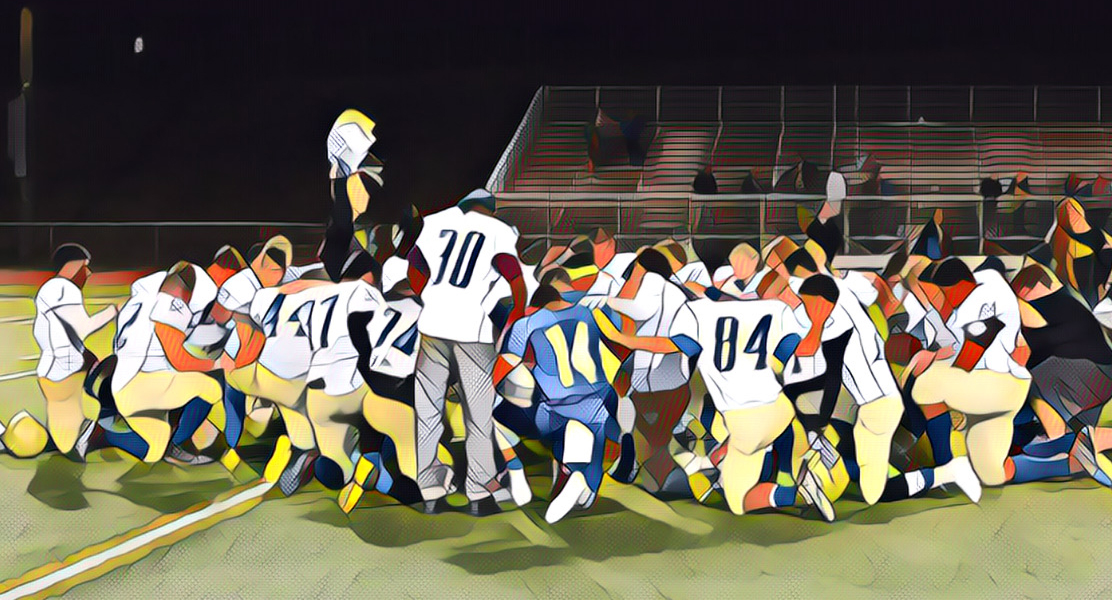
There are pictures, including ones that are printed on page 9 and 10 of the dissenting opinion, that show that players, coaches, members of the media, and other individuals gathered tightly around Coach Kennedy as he prayed. When school officials learned of the coach’s practice, they asked Coach Kennedy to end the practice because of their concerns that it violated religious freedom rights of players and families and amounted to government-sponsored prayer in violation of the Establishment Clause and specifically that it represented an endorsement of religion.
AMANDA: And “endorsement,” I think, is a key term here, and we’ll definitely get more to that in a moment.
HOLLY: So the school officials offered to work with Coach Kennedy to find a suitable alternative in time and place where he could pray without disrupting the event and avoid praying with students and avoid suggesting, encouraging, or discouraging prayer.
AMANDA: And I want to stop there. Just that idea that teachers cannot encourage or discourage prayer, that’s a really common policy, and it’s good religious liberty practice. So that is a point that we think should have been emphasized.
HOLLY: It’s a good policy. It’s protective. But the coach didn’t agree. He insisted on continuing his practice at midfield immediately after the game. Now, in the majority opinion’s selective recounting of the facts, it focused only on the facts after the coach had changed some of his practices, his most egregious practices.
He agreed no longer to give these speeches in the locker rooms and on the field where he filled them with religious content. Instead the Court focused on his practice alone at the center of the field. And the Court focused on the district’s policy, the district’s concern about avoiding looking like they were endorsing the coach’s practice.
When Coach Kennedy didn’t respond to the district’s attempts to accommodate him and instead continued his practice of praying at the 50-yard line immediately after the games, the district put him on paid administrative leave. I think that’s important, because some of you may have heard he was fired. He was put on paid administrative leave after they kept working with him to change his practices.
When Coach Kennedy’s contract expired in the spring, he didn’t re-apply to coach the following year. Instead, he sued the school district, claiming that the school district violated the First Amendment’s Free Exercise and Free Speech Clauses.
AMANDA: And, Holly, I mean, you were an employment lawyer once before you were a First Amendment lawyer. And so we know that with any employment dispute, there are multiple facts. People see them different ways. But what is undisputed in this case is Coach Kennedy’s continued insistence on praying midfield immediately after the games.
I also want to emphasize, not only was he put on paid administrative leave, but also he was not fired. He just didn’t re-apply to get his job back. And so the fact — let’s say he did apply. Let’s say the district decided not to rehire him. I think that would have been entirely reasonable and justified on a number of grounds: insubordination, disruption of school events.
Remember in this case, the coach put out a call on social media to people to rally and support his cause. He created a media circus, one that caused the district to have to place robocalls to parents and ensure them of their students’ safety at the game. Coach Kennedy prolonged this employment conflict, and he exacerbated the problem, and all of those facts of what happened in this case, all of that undercut his claims to simply want a personal prayer of thanks at the end of the games.
HOLLY: I think the lower courts saw that. He lost repeatedly in the lower courts. But this Supreme Court agreed to hear his appeal, and at the High Court, he was represented by First Liberty, an organization that takes these kind of cases and wants to move the law, and former solicitor general Paul Clement, while the Bremerton School District was represented by Americans United’s Richard Katskee.
AMANDA: That’s right. So this Court took the case. On Monday, June 27, this Court decided the case. And what did they decide? Well, you’ve seen the headlines probably by now, but in the decision, written by Justice Gorsuch and joined by the five other conservatives on the Court, the Court ruled for Coach Kennedy, and in doing so, they held that — and this is a quote — “The Free Exercise and Free Speech Clauses of the First Amendment protect an individual engaging in a personal religious observance from government reprisal. The Constitution neither mandates nor permits the government to suppress such religious expression.”
That was the majority of six. There were three dissenters. Justice Sotomayor wrote the dissent, and she was joined by Justices Breyer and Kagan.
HOLLY: As we predicted, this Court would rule for Coach Kennedy. We predicted that, not because he was right, but because this Court is very interested in religious expression. I mean, we are, too, but this Court is very interested in religious expression and not very interested in government efforts to maintain the separation of church and state.
AMANDA: I think that characterization is charitable, Holly, that they’re not very interested in separation of church and state —[audience laughter]
HOLLY: I try to be.
AMANDA: — and it’s fair. And, you know, to also be fair, most people expected this result, particularly after oral argument. Even the fact that the Court took this case after Coach Kennedy repeatedly lost in the lower courts made it seem like this Court was looking to reverse the decisions below.
And so with that background, let’s discuss our takeaways, and starting with what was most important to the majority.
HOLLY: Well, first, as I’ve kind of alluded to, the facts were crucial to how the majority ruled. They took Coach Kennedy’s versions of the facts, ignoring the larger record and what on the whole certainly appeared to be a, quote, deceitful narrative, close quote, as one of the judges on the 9th Circuit referred to it.
AMANDA: And immediately after the decision came out, I saw lots of conversation about this on Twitter at least, about how the facts — including photographic evidence that was put into Justice Sotomayor’s dissent — betrayed the factual story told by Justice Gorsuch. The skewed narrative starts in the very first sentence of the majority opinion when Justice Gorsuch writes, “Coach Kennedy lost his job as a high school football coach because he knelt at midfield after games to offer a quiet prayer of thanks.” Justice Gorsuch goes on: “He offered his prayers quietly, while his students were otherwise occupied.”
I think, Holly, that phrasing is certainly not descriptive of Coach Kennedy’s pattern and practice here. And this portrayal of the facts — call it false, call it selective, call it deceitful — that was necessary for the Court to reach what looks like a foregone conclusion here, that they would have a win for the coach.
HOLLY: You know, what angers me about this is how poorly that false narrative fits with what the Court purports to be upholding. Interestingly, also in the beginning of the opinion, Justice Gorsuch said, “The Constitution and the best of our traditions counsel mutual respect and tolerance, not censorship and suppression, for religious and nonreligious views alike.” I think that’s a great statement. It’s one that if it was offered in a different context, I would be applauding. It’s the kind of thing that we would say.
But here it comes from a majority that just ignored important facts, and the whole public school context of this case, where mutual respect and tolerance does occur, thanks to long-standing principles that have protected students. Those principles recognize the difference between the relative roles of students and teachers, something that we addressed extensively in the brief that we filed before the Court.
Of course, I know that all of us also struggle about the portrayal of facts that claim to just want to give thanks but insist that that has to be done on the 50-yard line.
AMANDA: Right. That idea that that’s core to that religious exercise is something that’s difficult for us to fully understand.
Well, the second main takeaway, I think, from our analysis of the opinion is, as your reference to the brief signals, that the majority ignores the line of public school prayer cases that protect religion by ensuring that the school doesn’t advance religion or lead in religious exercises. And we have a long line of school prayer cases, official prayers, Bible readings, passing laws for prayer during moment of silence, all —
HOLLY: Unconstitutional, unconstitutional, unconstitutional. [Audience laughter]
AMANDA: Right. We thought this was settled law, and it was settled law not just in the court cases but also with an act of Congress, with guidance that has been issued by both Republican and Democratic Departments of Education. This is something that we have come to be able to count on.
And so in light of that settled tradition that has served religious liberty so well, this decision feels entirely unnecessary, except perhaps for this Court’s interest in upending the law and upending our expectations for government’s relationship to religion. And so I think one takeaway, not just from this case but from the last week of decisions we received, is that with this Court, nothing is settled law.
HOLLY: Yeah. I remember when we first talked about this, Amanda, you noted that the Court was not responding to a problem in this situation. It’s creating one. Here the record showed that the school was just trying to do the right thing, work with this coach, this Christian coach that we might like, we might find some good things in common with, we might think okay about some of his motivations, and avoid a constitutional problem, trying to protect students, making sure that the school was not involved in advancing religion.
But in this case particularly, the idea that there was any hostility based on religion is ludicrous, which just brings us to another takeaway. The majority here focused on the Free Speech and Free Exercise rights of Coach Kennedy, and again, this Court gives short shrift to the Establishment Clause and its important purpose in protecting religion.
It was interesting to me that Justice Gorsuch, in writing the majority opinion, mentions how the Free Speech Clause, the Free Exercise Clause, the No Establishment Clause are treated by the courts as separate units, but the three clauses appear in the same amendment. He says, “A natural reading of the First Amendment would seem to suggest these clauses have complementary purposes, not warring ones, where one clause is always sure to prevail over the others.” Yeah.
AMANDA: Sounds familiar to me, Holly.
HOLLY: Me, too. That way of thinking is just like ours, and you can see it in the brief that we filed. Clauses are sometimes in tension, but they should work together to protect religious freedom. So if that’s true and the Court is committed to that idea, then why in this decision did they ignore the settled cases that recognize how the clauses work together in the context of the public schools? That’s what was troubling and puzzling for me.
The Establishment Clause guards against the government itself advancing religion. And that’s recognized even in cases where the Court has found there was not an Establishment Clause violation, cases about religious monuments, prayer at public meetings with adults. But here, we saw lip service to those complementary clauses, and we saw the continuing — what looks like the continuing project of an activist conservative majority that has been moving away from principles of No Establishment for some time.
AMANDA: That’s right. And so specifically, we want to talk a little bit about what’s new in this case. What are they doing? How are they signaling that they’re moving even farther away from Establishment Clause principles?
Well, for one, the Court here in Justice Gorsuch’s opinion, expressly abandons the Lemon test for Establishment Clause cases. That comes from a case that was decided by the Supreme Court in the 1970s, and the Lemon test, as it’s come to be called, is one of many tests that the Court has applied and that has, in this case, been criticized.
And, you know, for one, when the opinion came out on Monday, I saw that Justice Gorsuch had the majority opinion. I knew that this was coming, and that’s because he has been one of the chief detractors from the Lemon test. He’s been writing about it in plurality opinions and looking for a chance to abandon it. He has been questioning about it in oral argument.
The Lemon test, just as a quick reminder, requires the government to act with a secular purpose and without a primary purpose that either advances or denigrates religion.
HOLLY: It’s supposed to be neutral for religion.
AMANDA: But Justice Gorsuch does not like this neutrality proposition and has been showing a lot of disdain for the Lemon test. And some of you may have heard, beyond just that, but in another case at oral argument this term, he referenced — and this is a direct quote from Justice Gorsuch — the “so-called separation of church and state.” So when he said that, when we heard that, that raised a lot of red flags for us about what he planned to do if he had a chance to write an opinion like this one.
HOLLY: The 9th Circuit below in this case had applied the endorsement test, which Justice Gorsuch also doesn’t like. He referred to it as an offshoot of Lemon so that it could also be discarded, because Lemon had been debated so much and criticized so much.
The endorsement test is a way that Justice O’Connor tried to express the values in the religion clauses, that the government could not align itself with religion, sending a message of endorsement or approval toward religion in a way that would kind of create insiders and outsiders based upon religion.
What does the Court put in its place? Well, the majority opinion says that the Establishment Clause should be interpreted anew with “reference to historical practices and understandings.” We’ll be working on that for a while. The Court does cite the Town of Greece for that proposition, a case that dealt with legislative prayer at town meetings. Of course, that’s totally different from the public school context of this case.
Fortunately, Justice Sonia Sotomayor calls all of this out in a very clear dissent. She gives a clear and extensive explanation about the various tests the Court has applied and specifically the way the endorsement test and coercion test have been used very effectively to protect religion in the public schools.
You know, there’s never been a one-size-fits-all test for the Establishment Clause. In fact, that’s what some people complain about Lemon trying to be and that it couldn’t be. And Justice Sotomayor notes that the Court, upon overruling one, “grand unified theory,” the Court introduces another one. That’s what she says in dissent, talking about this new purported history test.
AMANDA: And it’s particularly puzzling that this history test is put out here but not at all applied or given any guidance to school administrators about how that at all applies in this situation. So no Lemon, no endorsement test, some brand new history test that we don’t have any, you know, understanding about but should —
HOLLY: There’s a lot of history.
AMANDA: Right. And according to Justice Gorsuch —
HOLLY: Not all of it’s good, and a lot of it we don’t want to see at all in our public schools.
AMANDA: And is there one history? That’s a whole other thing. Right? If we have two versions of the facts here, how many different versions of history will we have? And we’re leaving it all up to school administrators now. So that doesn’t feel workable at all here.
So what’s left is something called “coercion.” So there’s been this separate line of cases —
HOLLY: At least the majority recognizes that coercion is important in this context.
AMANDA: That that still is the sense, that we don’t want students to be forced to engage in religious conduct. But what’s difficult for us to understand — reading this decision — is to understand these facts were not coercive, that, again, the history of the coach’s participation, of leading the students in locker room motivational speeches that had religion woven all through them, leading the students in prayer, and then saying, Okay, fine, I won’t do that anymore. But I’m going to pray at the 50-yard line; I’m not going to stop anyone from gathering around.
And to see these crowds gathered around him, how is that not coercive to these students who are fighting for playing time before this coach, who are impressionable, who are at an age that it’s really difficult and there’s peer pressure to stand up to their authority figure and their coach? So, you know, they say this isn’t coercive, but
HOLLY: But fortunately, fortunately something that is coercive would be prohibited —
AMANDA: Right.
HOLLY: — presumably.
AMANDA: Right. So they say that. But what exactly constitutes coercion for this Court, that remains unclear, and that fact is unsettling to us.
HOLLY: And it’s never been the law before. It’s never — we’ve never required coercion in order to find an Establishment Clause violation.
AMANDA: So with those takeaways, what now?
HOLLY: What now?
I think in the coming days there’ll be a lot more discussion about this and other important cases, and they’re still being looked at and explained and we’re kind of unwinding what all the implications are. One thing to remember about this case is that it was decided based on a view of the facts that this was purely Coach Kennedy’s personal exercise, that after the game, he’d take a knee and pray on his own.
The school prayer cases are not explicitly overruled. They’re not overruled, though they are largely ignored. We know they’re not overruled, because this Court knows how to overrule a case. We’ve seen that this week. They did so explicitly in the Dobbs case, and they did it about long-standing precedents, and they did not do that here.
Now, this Court has sown confusion, and we know that many people are going to get it wrong. They’re just going to read a headline and they’re not going to understand exactly what this case is about. But it’s very important for us to be explicit about what remains. And while it’s made our work harder, it’s just made it more important, and we’ll keep on fighting.
AMANDA: I think that’s right. And it puts a high burden on us, and I’m not just saying you and me, Holly, or just BJC, but all of us who care about religious freedom. And we all need to continue to support public school administrators by giving them good information about how best to protect religious freedom of their school communities.
We have always and will continue to support truly personal religious expression that does not require or invite student participation. That continues to be true. And so this ruling for Coach Kennedy still means that schools cannot push students into religious exercises. It just means that Coach Kennedy’s individual speech that was not endorsed by the school was protected.
[Applause]
SEGMENT TWO:
HOLLY: Since this decision, we’ve seen a lot of debate about the extent of the Court’s abandonment of prior First Amendment standards and what it means for courts to make decisions referring to “history and tradition.” For now, it is important to recall what the decision didn’t do. It did not say the Constitution allows public school officials to lead students in religious exercises. And we know protecting faith freedom for all insists that we avoid doing that.
That brings us to the close of Respecting Religion. Thanks for joining us for another show from our archives.
For more episodes, you can see a full list of shows, including transcripts, by visiting RespectingReligion dot org.
You can follow BJC on social media @BJContheHill, and you can email the show by writing to [email protected].
I also want to thank everyone for supporting this program. You can visit our show notes for a link to donate to support this podcast.
As always, we want to encourage you to take a moment to find out more about BJC and how we’ve been working for faith freedom for all since 1936. Visit our website at BJConline -dot- org for a look at what we do and some of our latest projects.
During Amanda’s sabbatical this spring, we’ll continue to bring you some shows from our archives. So, join us on Thursdays for conversations Respecting Religion.