Published December 23, 2025
Erasure, faith, and the story America will not tell this 4th of July
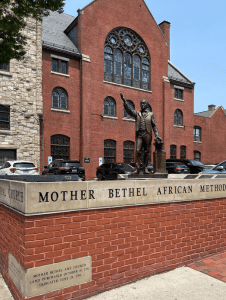

As the nation prepares for its 250th anniversary, we must remember Richard Allen and the underlying narratives about the United States’ story located across Philadelphia and beyond.
Next year, the United States will celebrate its 250th anniversary. Throughout the semi quincentennial commemoration, various festivities throughout the country will culminate in a celebration of Independence Day, and Philadelphia — the revolutionary era capital — will play a central role. Philly is the home of Independence Hall, the Liberty Bell, and the Museum of the American Revolution. For those of us called to the work of religious liberty, there is another Philadelphia site that isn’t so pronouncedly marked: the first African Methodist Episcopal (AME) Church.
The AME Church is the first independent Protestant denomination founded by Black people. It traces its roots to Richard Allen, who freed himself from bondage and left the segregated Methodist Episcopal Church to start his own church where Black people could worship in dignity. Allen was not just a preacher — he also was active in Philadelphia’s abolitionist movement, and his church was a stop on the Underground Railroad. In 1799, Allen and 69 other Black Philadelphians sent a petition to Congress calling for the end of the international slave trade and gradual emancipation. Today, Mother Bethel AME Church in Philadelphia is the oldest piece of land continuously owned by Black Americans in the U.S.
I visited Mother Bethel church this past summer. After the worship service, I enjoyed an insightful and thorough tour of the Richard Allen Museum located in the church’s lower level. The museum is a fully immersive learning experience with both Allen’s remains and original pulpit among its many artifacts that journey from the colonial era to modernity.
While Richard Allen’s name and religious contributions are well known to us, he is a man who deeply understood the intersection of economic justice and religious liberty. Economic justice creates an opportunity for each person to establish a sufficient material foundation upon which to have a dignified, productive, and creative life. With this definition, it is easy to see Allen’s contributions to our society in terms of nurturing faith as well as providing others with the opportunity to make a stable living. With both, individuals can contribute their unique talents and abilities to their faith and broader community.
Allen’s activism recognized the link between the dehumanization and commodification of Black people. He understood that Black people would not be seen as people until they were valued for more than their economic production. He understood that Black people could not exercise their God-given religious freedom so long as society denied full access to their personhood.
Because of generational good stewardship and investment, all who make the pilgrimage to Mother Bethel AME Church can enjoy a walk through an intermingling of religious, economic, Black, and American history all at once. In the book Freedom’s Prophet: Bishop Richard Allen, the AME Church, and the Black Founding Fathers, historian Richard S. Newman writes:
Allen did not purchase property merely to claim economic superiority. Rather, he was trying to secure a solid, irrefutable black place in American society. Allen’s persistent buying of property made an iron-clad claim on the city in which he lived, the country in which he was born, the very soil on which he daily stood. As he subsequently wrote, America was a land that he and thousands upon thousands of Black laborers ‘have watered with our tears and our blood.’
For many, houses of worship are places of dignity where people pool and share resources for the betterment of their community. This economic dimension of churches is rooted in justice. It is a form of ministry aimed at meeting and improving people’s material needs. See a food pantry? That’s economic justice. See a jobs program for unhoused people? That’s economic justice. These programs are rooted in an awareness that some tentacles of circumstance are more than stumbling blocks to faith. By addressing both spiritual and material needs, these sacred sites can create an opportunity for each person to establish a sufficient material foundation upon which to have a dignified, productive, and creative life.
As the nation prepares for its 250th anniversary, we must remember Richard Allen and the underlying narratives about the United States’ story located across Philadelphia and beyond. Mere steps away from Richard Allen’s church is First African Baptist Church, one of the first Black Baptist churches in America. Founded in 1809, two members of the church sold themselves into bondage in order to free another enslaved person to serve as pastor. These stories reveal the limits of our preconceived notions and prove that religious freedom, economic justice, and human freedom are inextricably connected.
At a time when the teaching of accurate history is contentious and debated, we are called not just to learn but to teach these stories. Intersectional narratives are how we come to terms with the fullness of the American experience. Without appreciating the nuances of these stories, we fall into the trappings of erasure and convenient storytelling. During this upcoming year of remembrance, I look forward to raising stories that will shine a light and illuminate the nuance of our country’s history, helping us better envision our national future.
Visit BJConline.org/Center for more about this work at the intersection of religious freedom and justice.
Jaziah Masters is the research fellow for the BJC Center for Faith, Justice and Reconciliation.
This column originally appeared in the winter 2025 edition of Report from the Capital. You can view it as a PDF or read a digital flip-through edition.