Published August 5, 2026
25 Years of Defending Faith Freedom For All


After 25 years at BJC steeped in the fight for faith freedom for all, I am leaving. I do so with deep gratitude — I have loved spending such an extensive stretch of my professional career at a treasured and historic organization, advancing ideals I admire. As I told the BJC staff and Board, the years went by quickly as I put my head and heart into this work.
Now is the right time for something new.
This column has been a consistent part of my work — giving me an opportunity to share with all of you about BJC’s activities in Washington, including in the U.S. Supreme Court, Congress, and the executive branch. Long before the proliferation of constantly updated websites, social media posts, and podcasts, this space provided an outlet for writing about legal developments, what’s ahead, and what it all means. I’m glad to share that one last time.
Supreme Court update
As usual, the Supreme Court released its final flurry of decisions in late June. Among the most significant was the disappointing ruling in Landor v. Louisiana Department of Corrections. In Landor, the Court limited the remedies available under the Religious Land Use and Institutionalized Persons Act of 2000 (RLUIPA), a federal statute designed to protect the religious rights of those in government custody. Based on a cramped reading of that law, the Court’s decision left a former prisoner without compensation for a gross violation of his religious rights. The 6-3 majority also raised questions about Congress’s power to attach conditions to federal spending that goes to the states.
There’s more BJC analysis of Landor elsewhere, but the bottom line is that protecting religious freedom takes persistent effort and enforcement. That’s particularly true for vulnerable populations, such as religious minorities and those held in government custody. The Landor decision imposes new and unfortunate obstacles.
Now that summer has arrived, the Court is focused on filling out its docket for the next term, which begins in October. Already we know there will be at least two cases involving religious claims. In Saint Mary Catholic Parish v. Roy, the Court will (again) review the effect of nondiscrimination conditions on religious organizations. Two Catholic parishes that operate preschools and the parents of a preschool-aged child sued Colorado officials, claiming that the state had unconstitutionally excluded them from a government-funded universal pre-K program. The program conditions participation on a requirement not to discriminate based on protected categories, such as race, religion, sexual orientation, income level, or disability.
The parishes want to participate while serving only families that support Catholic teachings, including teachings on sex and gender. They argue that because the program allows participating providers to give preference to certain student populations (such as those with disabilities or from low-income families), it must also allow the parishes to give preference to families that share their Catholic faith. In effect, the parishes claim that having offered other preferences, the state must grant them a religious exemption from the nondiscrimination provision. Lower courts rejected this claim without applying the higher level of judicial scrutiny that recent Supreme Court rulings demand.
The Court also granted review of Grand v. City of University Heights, a case about a religious gathering in a private home. Daniel Grand, an Orthodox Jewish man, has a long-running dispute with neighbors and local authorities in his Ohio town. The city required a zoning permit and prohibited the use of his home as a place of religious assembly. Grand later withdrew his application for such a permit, but he sued the city claiming various violations of his religious freedom rights, including under the land use provisions in RLUIPA. The lower courts did not address his substantive claims, dismissing the case on procedural grounds. Now the Supreme Court will have an opportunity to strengthen those protections by allowing his case to proceed.
In addition to these cases, the Court likely will be asked to review a recent decision by the 5th U.S. Circuit Court of Appeals that upheld the Texas law requiring the posting of the Ten Commandments in public schools. BJC has led a coalition of Christian groups in filing briefs to support the parents who have challenged these laws in several states, and BJC will continue to stand with the parents and against government-sponsored religious indoctrination if the case proceeds.
All of these cases demonstrate the importance of defending religious liberty and cultivating its expansion through litigation, as well as the growing complexity of the doctrinal landscape in recent years. By remaining active through amicus briefs and legal advocacy, we adhere to our most important principles and advance BJC’s core mission.

Reflections
I first learned about religious freedom, including how freedom and responsibility go together, in a caring Baptist congregation. After college, I had formative experiences — including a BJC internship — working with lawyers who litigated cases and lobbied for changes in the law. I became a lawyer to develop the skills that would allow me to do the same. When BJC was looking for a new general counsel in 2001, I wasn’t sure it was the right time. I had new family obligations that made leaving private practice seem risky. But I took the leap, and I’m so grateful I did. At BJC, I have deepened my skills as an advocate and joined the ranks of specialists devoted to fulfilling the promise of our Constitution, which protects religious freedom for all.
It is not hard to understand why this work has mattered to me. First, religious freedom is a value that provides deep and abiding connections among people who may have little in common. It is profoundly satisfying to stand for the dignity of all people, as reflected in our vision of religious freedom.
Second, church-state law involves interpretation of the First Amendment’s Religion Clauses, as applied to the states by the Fourteenth Amendment. This is challenging and rewarding work. The terrain includes countless legislative and regulatory provisions that define the boundaries between the institutions of religion and government, which are debated with vigor and relevance to everyday lives.
Third, Baptists have contributed to the flourishing of religious freedom from our very beginnings. As persecuted minorities resisting religious establishments in Europe and the American colonies, and as worshipping communities in increasingly diverse settings today, Baptists have invoked their commitment to conscience to demand meaningful separation between government and essential matters of faith and practice. This principled advocacy, informed by history, has operated for the benefit of all. That speaks to my spirit, formed in Baptist Sunday school, so it’s little wonder that I have had such an incredibly meaningful and fulfilling professional life serving BJC.
As BJC enters its 10th decade of fighting for faith freedom for all, its legal advocacy continues. We can all be hopeful and grateful for this organization as it continues to carry the work forward.

Editor’s note: We’ll have more on Holly’s service in the next edition of Report from the Capital. You can also read a note from Amanda about Holly’s career at BJC.
-

Holly speaks to reporters in front of the Supreme Court on March 2, 2005, after oral arguments in two cases about displays of the Ten Commandments.
-
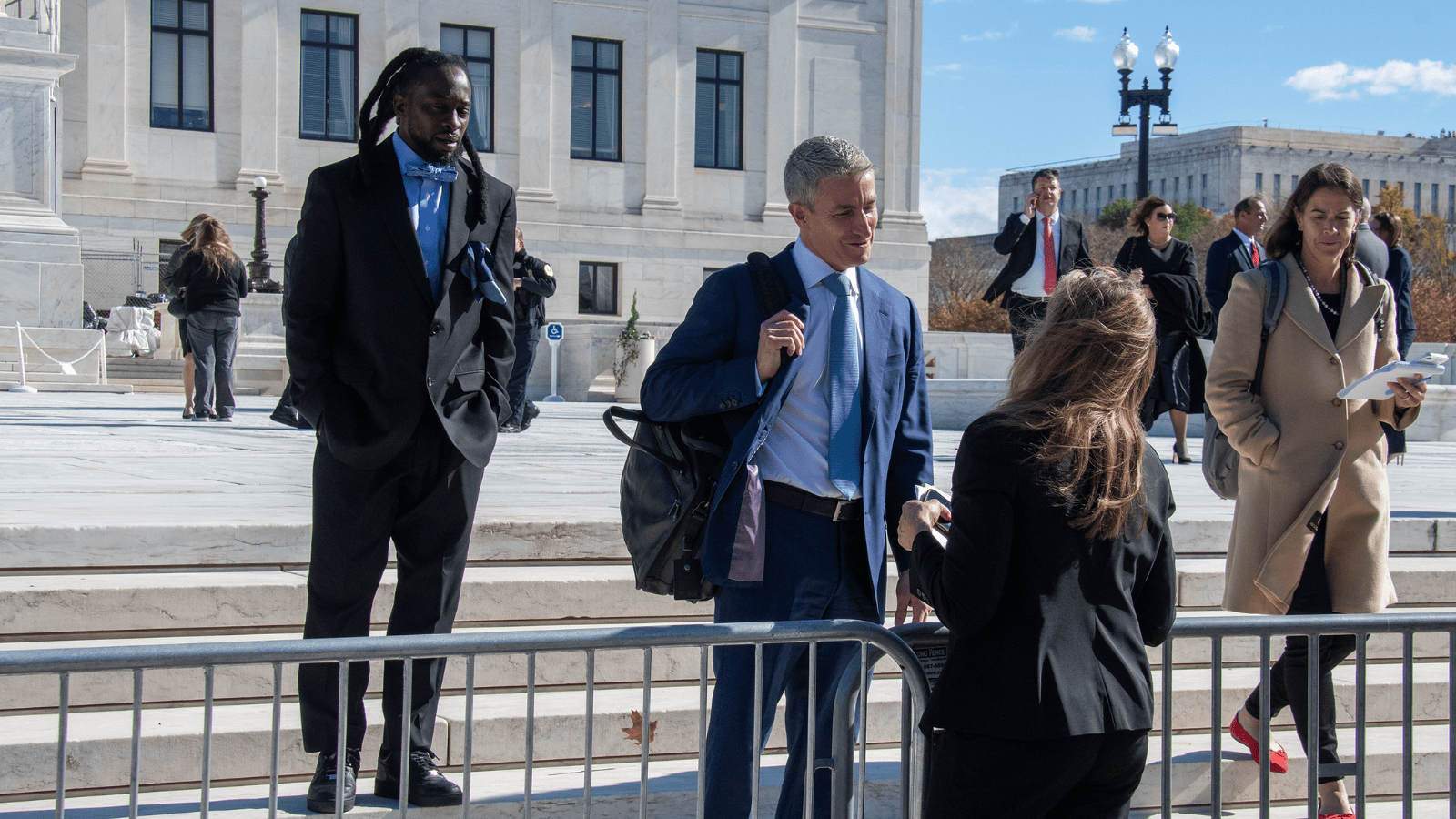
Holly speaks to reporters outside the Supreme Court in 2017 after oral arguments in the Trinity Lutheran case.
-
Amanda and Holly record an episode of the Respecting Religion podcast in 2026.


-
Read the Magazine Online
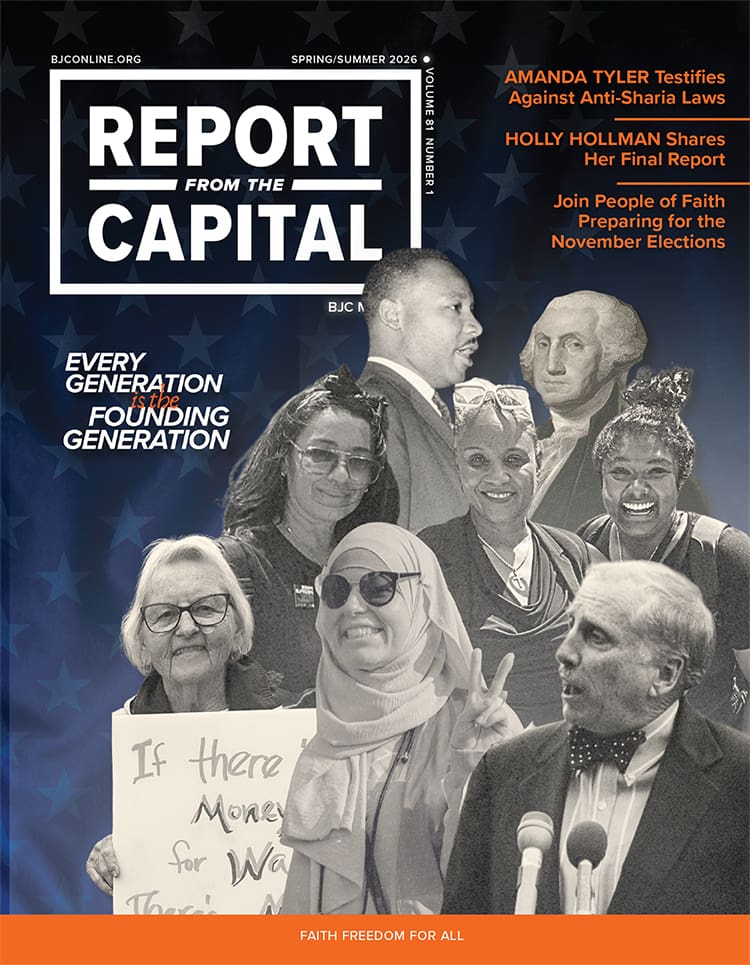
This article appears in the Spring/Summer 2026 edition of BJC’s magazine, Report from the Capital. A PDF version and other articles will be online soon.
-