
SCOTUS Weakens Prisoners’ Ability to Seek Justice for Religious Freedom Violation
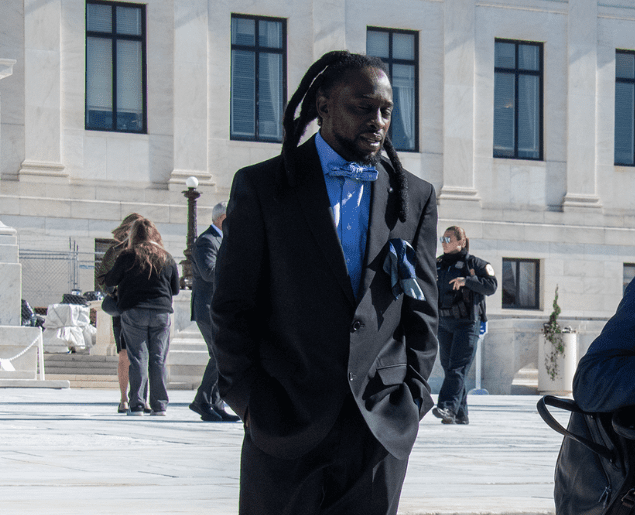
When prison officials in Louisiana shaved Damon Landor’s dreadlocks, courts acknowledged it was a gross violation of Mr. Landor’s religious freedom. But, when he pursued his case for monetary damages, the Supreme Court didn’t provide a path forward, and it undermined a landmark work of Congress.
A devout Rastafarian, Mr. Landor knew the law accommodated his religious practice of keeping long hair. The First Amendment protects the free exercise of religion, and the Religious Land Use and Institutionalized Persons Act (RLUIPA) — championed by BJC and passed by Congress in 2000 — ensures the religious rights of people in government custody.
Officers in previous institutions followed the law, letting Mr. Landor keep his hair despite the grooming policies of the state department of corrections.
When Mr. Landor was transferred to a new facility, he came prepared: He actually brought a physical copy of a federal court decision upholding Rastafarian prisoners’ right to long hair. But these officers threw that paper in the trash, held him down, and forcibly shaved his head.
The 6-3 decision in Landor v. Louisiana Department of Corrections said individuals may not be held liable in their personal capacities under RLUIPA unless they gave express consent to do so.
“The Court held that the statute’s promise of ‘appropriate relief against a government’ does not allow money damages against the individual officers responsible — weakening prisoners’ ability to seek justice and to deter future violations,” said BJC Chief Legal Officer Holly Hollman.
BJC joined a brief in this case supporting Mr. Landor. We were in agreement with a number of groups that do not often see eye-to-eye on Supreme Court cases, including the Christian Legal Society, the ACLU, the Alliance Defending Freedom, and the Ethics and Religious Liberty Commission of the Southern Baptist Convention.
The piece of paper that protected his rights in theory did nothing to stop prison officials. BJC and our coalition partners will continue to defend RLUIPA and the religious freedom it guarantees for everyone.
Johnson Amendment Survives Runaround Court Filing
Pastors say they want to keep it.
People in the pews say they appreciate it.
But there are persistent attempts by some candidates to undermine the law and weaken its protections.
We’re talking about the Johnson Amendment, the portion of the tax code that protects the integrity of 501(c)(3) organizations, ensuring they are not used to intervene in political campaigns by opposing or endorsing candidates for office.
Last summer, the IRS attempted to recast the idea of an endorsement of a political candidate from the pulpit as “a family discussion concerning candidates” in a filing in National Religious Broadcasters v. Bessent. It was a bold attempt to create law through a lawsuit instead of through Congress, and it was a threat toward turning churches into Political Action Committees.
But, in a surprising move, Judge J. Campbell Barker dismissed the case in an order issued March 31. The court found that it lacked jurisdiction to issue the relief sought by the proposed consent judgment.
In the wake of the dismissal, the Trump administration announced plans to develop and issue additional guidance on the application of the Johnson Amendment. As of this writing, none has been released.
BJC will continue to advocate for tax law that protects the integrity of houses of worship and other charitable organizations from pressure to endorse candidates or otherwise engage in partisan ways in elections.
BJC Files Comments on Problematic Religious Liberty Commission Report
After months of airing selective grievances in its highly choreographed hearings, the Trump administration’s Religious Liberty Commission released its draft report in June.
The 224-page report provides the Commission’s analysis, reveals its “findings,” and proposes solutions. Some of it just goes over best practices that everyone should know. But, the analysis is skewed. The findings mostly come from the invitation-only hearings. The solutions would not advance religious freedom for everyone. And the entire tome is full of misunderstandings and misrepresentations of our country’s foundation of religious freedom.
The Commission’s report emphasizes that “separation of church and state” is not in the Constitution, and it refers to the wall of separation “myth” as a “belabored metaphor.” The report never acknowledges how our constitutional framework — which separates the institutions of religion and government — allows religion to flourish by making sure no state power compels or coerces religious belief.
Using selective anecdotes of isolated incidents, the Commission suggests that religious freedom is broadly under attack in public schools. We know issues arise from time to time — that’s why we have legal protections for students’ rights to religious expression at public school. The specific grievances in the report should be addressed, but the Commission instead makes recommendations that cause more problems. For example, they propose expanding school vouchers and displaying the Ten Commandments in schools. Ideas like this don’t secure students’ First Amendment rights — they instead undermine our public schools and religious freedom.
Military chaplains are undercut in this report. These servicemembers are one of the best examples of how the government can use its power to meet various religious needs. But, the Commission wants to emphasize the individual faith of military chaplains instead of ensuring they serve the spiritual needs of all. That would hit minority faiths the hardest, since they are less likely to have access to a chaplain of their same tradition.
BJC told the Commission all of this and more in comments submitted on July 13. We shared the wisdom of Madison and Jefferson, too, who helped create our First Amendment and championed religious freedom for all.
Now that the public comment period is over, we hope the Commission will listen — not just to BJC, but to others, from the founding generation forward, who recognize that religious freedom is for everyone, and church-state separation is vital to protecting it.
Courts Split on Ten Commandments Mandates
As several states try to force public schools to display the Ten Commandments, it looks like the U.S. Supreme Court will get the final say. After an unfavorable ruling from the 5th U.S. Circuit Court of Appeals in Texas, advocates are planning to seek review from the highest court.
In the past two years, Texas, Arkansas, and Louisiana have passed bills to require government-approved versions of the Ten Commandments in children’s classrooms.
Parents sued to stop them, challenging the bills as a violation of their religious freedom.
BJC supported parents in Louisiana, the first state to propose such legislation. We led a brief explaining how Louisiana’s law creates unavoidable state-sponsored religious indoctrination, selecting a preferred version of the Ten Commandments that aligns only with certain faiths and denominations. There is a stark difference between state-sponsored religious indoctrination and teaching about religion.
As the cases in those three states worked their way through the courts, judges were consistently siding with the families, striking down the Ten Commandments mandates as clearly unconstitutional under a decades-old precedent in Stone v. Graham (1980).
The legal landscape shifted, however, when a circuit court that first struck down the mandate re-heard the case en banc, reversing the earlier decision and instead upholding the Texas law. It held that Stone was no longer good law and found no state establishment of religion.
Because of the split in the courts and the disregard for the Supreme Court’s prior precedent holding such displays unconstitutional, this case is highly likely to end up at the Supreme Court. BJC will continue to advocate against government-sponsored religion and for religious freedom for all students.
-
Read the Magazine Online
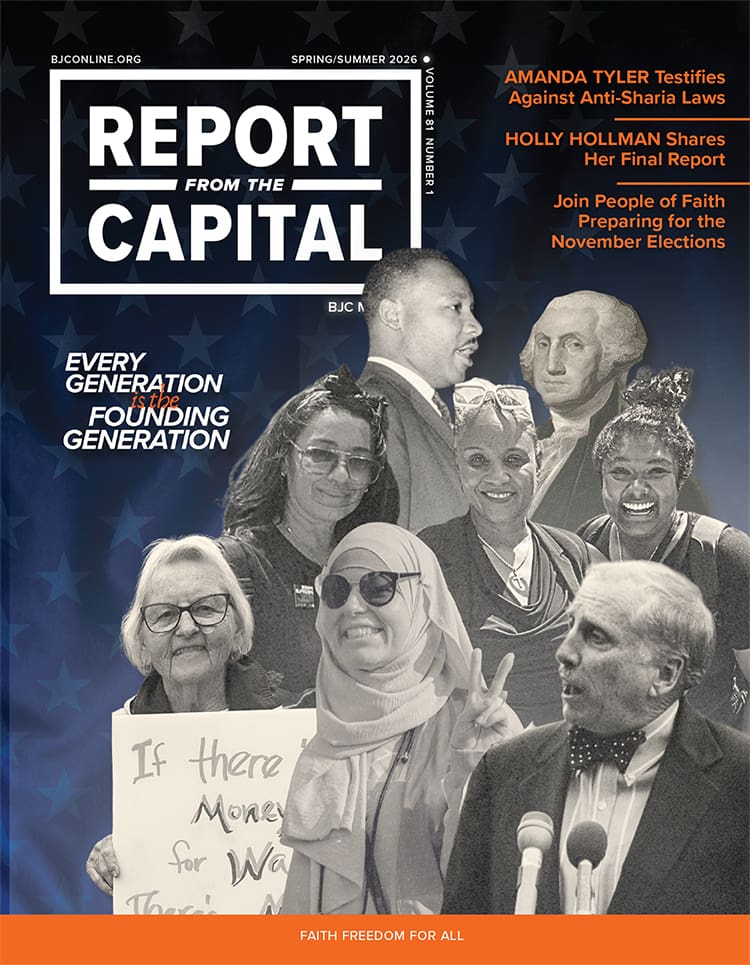
This article appears in the Spring/Summer 2026 edition of BJC’s magazine, Report from the Capital. Visit our page for more articles online, or read a PDF version of the entire magazine.
-