S7, Ep. 07: Religion in the military and the latest from Trump’s Religious Liberty Commission
Amanda and Holly share their reflections on the Religious Liberty Commission so far, including this week’s meeting on religion in the military.


The Trump administration created a “Religious Liberty Commission” in May, and it seems to be a mix of performative posturing and grievance airing, with some policy substance thrown in. Amanda and Holly discuss what this commission has – and hasn’t – done so far, and they look more closely at this week’s hearing on religion in the military. Littered with celebrities, many of the hearings are privileging certain religious views over others, often furthering “Christian nation” mythology and sharing general misinformation.
SHOW NOTES
Segment 1 (starting at 00:33): What is this commission about?
Read Amanda’s statement after President Donald Trump’s comments at the Sept. 9, 2025, meeting of the Religious Liberty Commission at this link.
Segment 2 (starting at 12:48): The hearing on religion in the military
Amanda was quoted in this article by Karen Brooks Harper for the Dallas Morning News: Dan Patrick-led religious liberty commission is solidly rooted in Texas
Amanda and Holly discussed this article by Jack Jenkins for Religion News Service: Defense Secretary Hegseth tests Constitution in Pentagon worship services
Do you want special emails about our show? Click here to sign up for our email list!
Video of our episodes are now on YouTube! Click here for the season 7 playlist.
Respecting Religion is made possible by BJC’s generous donors. Your gift to BJC is tax-deductible, and you can support these conversations with a gift to BJC.
Watch this show on YouTube:
Transcript: Season 7, Episode 7: Religion in the military and the latest from Trump’s Religious Liberty Commission (some portions of this transcript have been edited for clarity)
AMANDA: He has pushed not even religion in general but a specific religious exercise through his official channels.
HOLLY: And that, of course, was not then the topic of this hearing.
AMANDA: No. There was no conversation about whether his actions were violating the Constitution.
Segment 1: What is this commission about? (starting at 00:33)
AMANDA: Welcome to Respecting Religion, a BJC podcast series where we look at religion, the law, and what’s at stake for faith freedom today. I’m Amanda Tyler.
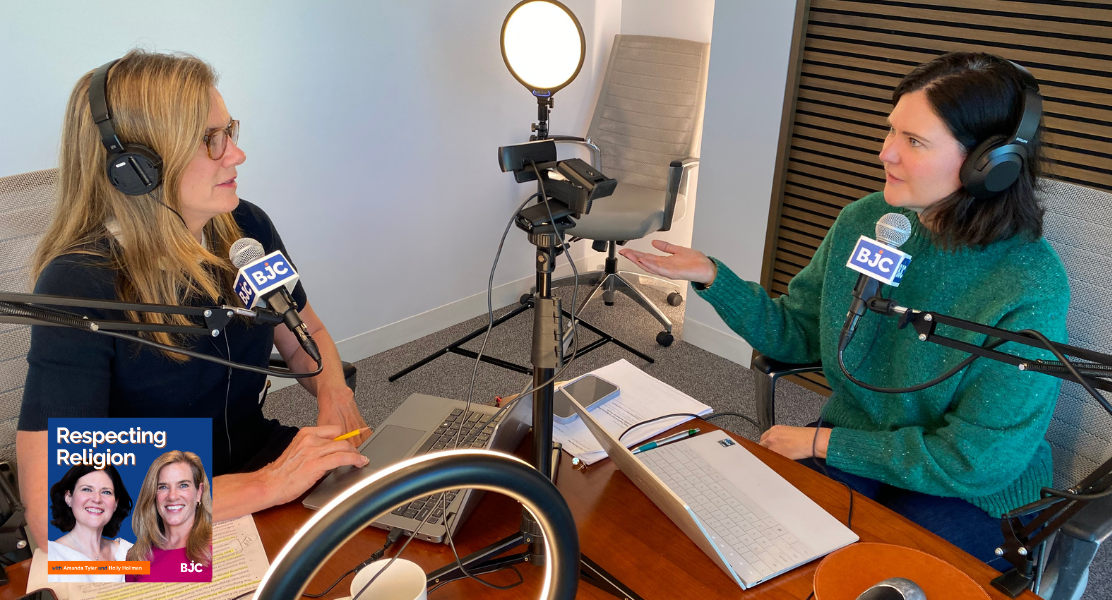
HOLLY: And I’m Holly Hollman. We’re coming to you today from a new location, BJC’s new office space in Washington, D.C. Amanda and I are here together in person, which is nice.
AMANDA: It is.
HOLLY: Glad you’re here. Last month BJC moved into new offices. It was quite historic, the first time our historic agency has moved in 60 years. We are still on Capitol Hill where we like to be, just a few blocks away from our prior location. So those of you watching, though, will notice that, you know, it’s not the same background, and I apologize for my background not being so decorated, because, you know, we’re new. We haven’t filled everything out yet.
AMANDA: No. We’ve got, you know, tables to put our stuff on and chairs to sit in, not as much on the walls yet.
HOLLY: Exactly. A few boxes to unload, but we’re getting there. We are so glad to be continuing in business here.
AMANDA: That’s right. We did have to take a week off of podcasting, though, because moving is a big endeavor, especially after six decades, and we’re learning a lot about this area of Capitol Hill, new places to grab coffee or lunch, new —
HOLLY: New commute route.
AMANDA: — transit options. But it is good to be in our office space and to be together.
What is not new, unfortunately, Holly, is how we’re seeing the misuse of religion, including by some of our governmental and political leaders. And so that’s going to really be the focus of our conversation today.
We are going to talk about the ongoing work of President Trump’s Religious Liberty Commission and specifically, you know, why now. This has been going on for several months, but just this week, there was the latest of these commission hearings, and this one was focused on religion and the military, and so we wanted to have a little bit more conversation about that context, a topic that we really haven’t discussed as much on this podcast.
HOLLY: That’s right. And that’s an important one that we know people think about at times, because our military does stand in the world for America, and so we care very much about that presence in the world. And anytime we talk about military and religion, we’d like that to reflect our core values of religious freedom for all.
Yeah. So that hearing dealt with religious liberty and the military, so we’ll talk about that. But for our listeners who haven’t really heard of the Trump Religious Liberty Commission or haven’t paid a lot of attention to it, we understand. In fact, we’ve only mentioned it once earlier in this season, but we should just talk a little bit about that endeavor as a whole, Amanda.
The way I saw this is, you know, when President Trump announced this commission back in May, some of the language was sort of common to presidents in saying, you know, we care about religious liberty, so I’m going to do something big, and kind of reassert our commitment to religious freedom.
But then, of course, there was the President Trump flavor to this: a big show, appointing commissioners, not only stating goals in a broad way about the importance of religious liberty, but also noting kind of the core issues to work on that happened to fit very much with their policy perspective and a view of religious freedom that I would say is not — certainly not ours and not one that is really mainstream.
AMANDA: Yeah. In early May, we’re actually used to proclamations or statements like this around the National Day of Prayer, and that’s something we’ve talked about before. But what did seem different was a little bit more architecture, a little bit more structure around this, to actually stand up a commission with appointed commissioners with a mandate to hold hearings on different topics and to produce a comprehensive report at the end of their commission hearings.
It was also announced in conjunction with this other task force that we have talked about, about being concerned about this task force to eradicate anti-Christian bias —
HOLLY: Uh-huh.
AMANDA: — and so that confluence of different initiatives also caused us to approach this commission with some skepticism.
A commission for religious freedom certainly is a good thing, but we know from our extensive work in this area, Holly, that religious freedom can mean different things to different people.
HOLLY: That’s right. And the commission itself did not reflect the grand diversity that was sort of announced, that this would be a diverse commission. And, you know, diverse — you have different professions. You had people from the legal community and religious community, as you would expect, but he also just had some celebrity types and some that I still have yet to figure out exactly why they are on the commission. But —
AMANDA: Like Dr. Phil maybe —
HOLLY: Yes.
AMANDA: — is one of the people that we haven’t really talked about a lot on our podcast before as being a real expert in religious freedom.
HOLLY: He admits that he is not, but he’s learning and participating. And, yeah. So it’s a different view.
I think the idea was that you’d have this group of commissioners and that they would take testimony from experts but also everyday Americans. And we have watched this show through these few hearings, and [there’s] a real variety of content, some very troubling and some, if you heard it in isolation, would think, Oh, yeah, that’s good education, good appreciation for some of the complexity.
So the first hearing was back in June, and it introduced all of the commissioners, and then they set out about some hearings on public education, which we know is a very important area for understanding religious freedom, so we were not surprised that they would dedicate time to that.
But during one of those early hearings — I think it was the second hearing in September that was supposed to be about religious liberty and public education — there was late-breaking news that day that President Trump himself would be there.
And so I bet many of our listeners who haven’t really followed this topic, that may have been a time that they did hear about it, because there was a little bit of news. President Trump showed up. These early hearings were at the Museum of the Bible here in D.C., which is a private museum started by the Green family of Hobby Lobby fame.
And so they had these events, even though it’s a kind of commission by the government, held at this private place. And President Trump gave quite a long President-Trump-kind-of-speech about religious freedom on a lot of issues. And, Amanda, I know you made a statement about that.
AMANDA: I did, and we’ll link to the statement that we put out at the time on September 8 of this year in our show notes. But it was. It was a rambling speech, covered a lot of topics, and, you know, at the time I said it was really less about religious liberty and more about perpetuating Christian nationalism.
Some of what President Trump said is that government needed to quote, “bring back religion in America,” and also that the government should privilege so-called Judeo-Christian principles above all else.
He also in that speech directed the Department of Education to issue new guidance on —
HOLLY: Oh, right.
AMANDA: — prayer in public schools. Here we are three months later, Holly, we still haven’t seen that guidance. We’ve also seen, of course, attempts to totally dismantle the Department of Education, so I don’t really know where that particular directive stands.
But, you know, you said earlier that we’ve been watching “this show.” I think that’s really an appropriate label for what these are. These are not hearings in the sense of really, I think, fact-finding or being about really trying to tell a comprehensive understanding or story of Christian nationalism.
They’re carefully curated, invitation only, and there’s very much an agenda here, and I think it is an agenda to try to paint a false picture of Christian persecution in the country or an attempt to silence Christian viewpoints by kind of pulling out some isolated examples without telling the full story —
HOLLY: Right. Yeah.
AMANDA: — and creating this, I think, misimpression and sometimes misinformation about religious freedom.
HOLLY: Yeah. And I listened to some of those hearings, the panelists where you had either lawyers or the actors involved in controversies in public schools, and it was, you know, pretty confusing, too.
So I don’t know if the reports will end up with a more coherent story, because in all of this story-telling, what we learned, too, is that we care about religious freedom in specific ways, particularly in religion in the public schools. And there’s a long-standing tradition of guidelines that have been helpful, so we don’t know the need for any new guidelines. We’ll see what comes out, but, you know, sometimes schools get it wrong and have to be corrected.
AMANDA: Sure.
HOLLY: Other times, a particular person has an agenda, and they want to use the school to advance their own particular religious agenda and have to be pulled back. And the way that’s reported is not always fair to the issues, you know, at bottom, the fact that we need to maintain religious liberty for all, and in the school context, we do that in particular ways.
AMANDA: That’s true. And, you know, I think another thing that makes me think these aren’t hearings in a typical sense — often when we think about hearings, we think about legislative hearings, and of course, there, you have representation at the hearings from both the majority and the minority party. There is no second or third viewpoint on religious freedom —
HOLLY: That’s true.
AMANDA: — that’s reflected in these conversations. You know, when you — I identify very much. I listen in on some of these, and I have questions. I wish that we could get —
HOLLY: Right.
AMANDA: — a little bit more information.
HOLLY: Tell me more.
AMANDA: But there’s no opportunity really for that kind of fact-finding or information-seeking, because it’s all very carefully curated —
HOLLY: Yeah.
AMANDA: — to tell a particular version of the story.
HOLLY: You’re right. There’s not necessarily an understanding. But this will go back to something that you said that I think is true from some of what I have really heard and the story they’re telling is.
Several times there’ll be people who are involved in a controversy, controversy that was addressed, and they continue to talk about it as if it represents some huge problem of persecution against Christians. And, you know, some folks that go through these stories, maybe there’s a little bit of a lesson we could learn from them, but come on. I think that they’re spending a little more time kind of exaggerating in a way that really their lessons that they promote can really give a false sense of things.
And that reminds me. The next religious liberty hearing they had on public schools — I think it was the following one; they did one that really dealt with kind of the money issues about public schools. But Coach Joseph Kennedy of Kennedy v. Bremerton fame, that assistant football coach, was on a panel there, so he could tell his story.
Of course, he won a case at the Supreme Court that ensured that individuals when they are in their individual time, including those that work for public schools, have some opportunity for religious speech. But he’s out there on the circuit, continuing to complain about, you know, how religion is harmed in public schools in ways that I don’t think really tell a good story.
AMANDA: And certainly don’t represent the vast majority of the real experience of religion in the public schools which does respect religious pluralism and religious freedom for all students, teachers, and administrators.
HOLLY: Yeah. So we’ll be following that, and we’ll see how they tell their story when it comes to a report and what kind of recommendations they make.
Segment 2: The hearing on religion in the military (starting at 12:48)
HOLLY: And that brings us to the most recent hearing, which was actually just yesterday. This was the fourth hearing, and it was on religious liberty in the military. It was postponed a couple times, and interestingly, it was moved to Dallas, Texas.
Amanda, you may have your own thoughts about why they would have one of these hearings in Texas, and you were actually called by The Dallas Morning News, a story that was kind of inquiring about that and the endeavor as a whole. What do you think?
AMANDA: Yeah. So it was postponed, and it was postponed to a date that I was not able to attend personally, so I was watching online and not in my hometown, because I was up here in Washington, working in our new offices.
But I did get a chance to speak with Karen Brooks Harper who is a longtime journalist covering Texas politics for The Dallas Morning News, and she was interested in learning more about this Religious Liberty Commission, because she covers Texas politics and politicians. She doesn’t cover the larger world of religious liberty so much.
So what she had noticed and recognized was that there really was a large Texas presence on this commission.
HOLLY: True.
AMANDA: Dan Patrick, who is the lieutenant governor of Texas — and in that position presides over the Texas Senate — is the chair of the commission, and there are a number of other people who sit on the commission who are from Texas or who have Texas ties.
And in her reporting, which we’ll link to here in the show notes as well, she really explains the story that this commission actually came as an idea of Dan Patrick, as something that he suggested to the president and then presumably had some role in helping craft and shape. And he, again, was presiding over —
HOLLY: He knew his audience —
AMANDA: — this most recent one.
HOLLY: — as he proposed a large, theatrical approach to this — to this issue. Right?
AMANDA: Well, that’s right. And that’s also his background, too. I mean, he comes from a broadcasting background and is, I think, used to telling a story, and so thought that this would provide, yeah, some good TV for people to watch.
So that’s what kind of, I think — I think that was a large reason that this was held in Dallas, was, you know, convenience for a lot of people on the commission. And not all of the people who were asked to testify were from Texas, but many of them did have Texas ties.
HOLLY: Well, there was a couple of star roles that are well known in Texas that came out. But interestingly, this was planned a long time ago. I mean, I think it is a common topic that people want to understand about how our country is a country of religious freedom and who the military is and, you know, references to religion in our history.
But also I feel like this idea had been in the news, kind of lurking in the background as, you know, one of the big news stories of recent weeks — or is it months now? — about the targeted attacks on boats presumed to be carrying drugs and the legality of that, what is the military’s role, and it’s been a huge story.
And, of course, the leader of our Department of Defense is Secretary Pete Hegseth, who’s one of the administration officials, I think, most known for his Christian nation rhetoric. I’m not sure if that’s right — I haven’t done a statistical study, but he often talks about our faith, and he’s, you know, led these, I think, religious gatherings at Department of Defense and things like that.
And so it has spurred some questions and conversation about who we are as a country, acting in this way, and what is the role of religion in the military.
AMANDA: And to that point, this is a little bit of an older story but, I think, still relevant to this topic. We’ll link to a piece by Jack Jenkins for Religion News Service, the title of which, “Defense Secretary Hegseth tests Constitution in Pentagon worship services.”
And it really does talk about the way that he has pushed not even religion in general but a specific religious exercise and Christian beliefs and his particular brand of Christianity through his official channels, and really questioning the legality and the appropriateness of that for a government official.
HOLLY: And that, of course, was not, then, the topic of this hearing.
AMANDA: No. There was no conversation about whether his actions were violating the Constitution. Good point.
HOLLY: Exactly. But, you know, the hearing, I would say, was like other hearings where you had various panels of some more factual and helpful than others, some more controversial and kind of just, you know, seeking to show that there was some problem to be fixed.
And then there were two star witnesses that our listeners certainly know about out of your home state, Amanda.
AMANDA: That’s right. The first is David Barton, the pseudo-historian who, I would say, is probably the number one propagator of the Christian nation mythology and has been for decades.
HOLLY: So you got to have him if you’re going to have hearings on religion in Texas.
AMANDA: That’s right.
HOLLY: They got to start off with him.
AMANDA: And he was. He was the very first witness and was doing, I think, a typical show and tell of his documents and how — you know, again, painting this very cherry-picked version of American history that takes certain anecdotes or Founders’ biographies out of context to paint a picture that suggests that America was founded as a Christian nation, that there was a deep connection between religious practice and, in this case, military exercise, particularly kind of going back to General George Washington and some of the practices throughout history, making an attempted constitutional argument, Holly, that there is a — that, you know, the words of our “history and tradition” of religious exercise in the U.S. military that would, therefore, make modern examples of that, in his mind and in his argument, constitutional.
HOLLY: It felt almost like some witnesses were trying to pick a fight or find a problem, because other parts of the hearing showed that our military is quite religiously diverse.
AMANDA: That’s right.
HOLLY: And one thing that you’ll always hear people who are in favor of Christian nation talk about is the history of chaplains in our country. And there’s been a long tradition of chaplaincy, and we know why, and we can talk about what that does and how that’s different from the government itself advancing a particular religion.
But in the hearing, we were reminded of the roles of chaplains and how they serve individuals in the military, according to their own traditions, but they also help people outside of their tradition, from other traditions, find the kind of support that they need to get through the difficult things that we put our men and women in the military through or that they go through as part of their service to our country.
So it was real mixed testimony on that front, with a few diverse witnesses, talking about their particular challenges outside the Christian tradition in order to be accommodated and to serve equally alongside their fellow servicemen and women.
AMANDA: Yeah. I’m thinking particularly of someone who had a long career with the United States Marines and who practiced Sikhism and talked about the need for religious accommodations in the military for the ability, for instance, to wear head coverings or to have beards. These are core pieces of grooming and —
HOLLY: Practice, yeah.
AMANDA: — practice that are core to religious practice, and this particular former officer had been a plaintiff in a lawsuit, really suing the U.S. military in order to achieve the religious accommodations that he needed for his faith.
And in his remarks, he also talked about that there was a recent statement from Secretary Hegseth, saying that there should be no beards in the military. And there was a lot of silence on the commission after that statement. There was really no follow-up with him.
And so I sensed some tension there, but I was pleased to see that we were not having only Christian witnesses or people talking about claims of discrimination against Christians but actually having a more diverse sampling. I think that really does reflect the religious diversity that is in all of American society, including the U.S. military.
HOLLY: That’s right. I think there’s just some tension in that acknowledging the religious diversity that continues to increase in our country and the fundamental commitment that we have to accommodating that, there’s some tension between that and what we heard from some of the witnesses who were bemoaning the loss of — you know, they would give examples of Christian hardship and kind of bemoaning the loss of that as, I guess, a more sweeping understanding among the forces.
Who knows if it ever was to the extent that they claim, but you feel that certain idea of like we need to restore something that’s lost. But, yeah. There’s tension in that story for sure.
AMANDA: Yeah. And I heard that, too, just in some of the ways that the commissioners would follow up from some of the testimony in an attempt to make what was, you know, one person’s story —
HOLLY: Uh-huh.
AMANDA: — seem more universal or seem —
HOLLY: Right.
AMANDA: — as if it was representative of —
HOLLY: More common.
AMANDA: — a much larger problem, when there really was not evidence that that was the case. And I am concerned about the impact of that for conversations around religious freedom.
Again, some of the commissioners flat out said that government neutrality to religion was actually government hostility to religion, and furthering this idea that somehow a neutral government is trying to actually take action against religion, including the majority religion in the country, which is Christianity.
HOLLY: That’s problematic.
AMANDA: It is.
HOLLY: Yeah. And it really also betrays this idea that we saw as chaplaincy was applauded here, and the chaplaincy, of course, is — you know, our government pays for chaplains, religious service, that is because of the specific context, because servicemen and women are taken away from their communities where they would normally exercise their Free Exercise rights independently, according to all the choices that we have.
But, instead, our commitment to religious freedom allows the government in that case and context to provide religious and spiritual and other kinds of services, counseling services, for men and women. So a lot there.
And then, Amanda, could you explain how it ended with another famous Texan, just to wrap up the hearing. We have one last —
AMANDA: Yeah, we do.
HOLLY: — one last speaker.
AMANDA: So Robert Jeffress, who’s the pastor at First Baptist Church of Dallas, who is known for taking out full billboards in the city of Dallas that say, America is a Christian nation, for holding patriotic worship services around the 4th of July.
He was there, not to testify about religion in the military, but to tell his story about some investigations that have come from the IRS of his church and whether or not they had violated the Johnson Amendment, something that we have talked about in other contexts, about whether the church — you know, he personally has made a practice of endorsing candidates, but whether the church had crossed lines in partisan campaign activity in the past.
So it felt off topic from the rest of the stated purpose of this particular hearing, but I guess it was hard to come to Dallas and not invite him to testify at this hearing.
HOLLY: I think that had to be it, so — well, the hearings wrapped up there, and we will certainly be staying tuned to the Department of Justice site on this commission. We’ll be listening. They typically announce their hearings ahead of time, and we’ll be following them and listening for any clues about efforts of this administration to push religious freedom in ways that are problematic. And we’ll keep you all posted.
AMANDA: Yeah. And we are expecting sometime next year for the commission to issue a report, presumably with some recommendations for the administration to take action on. We also expect, given that it will be in 2026, that there will be some tie-in to the semiquincentennial celebration next year, the 250th anniversary of the Declaration of Independence.
And frankly, you know, I have concerns. I have concerns that this report and the tie-in will be used to provide even more misinformation around American history, trying to tell it through this lens of America as a Christian nation mythology, a “history” — I’m putting in quotes — that is inaccurate and is damaging to religious pluralism and to religious freedom.
HOLLY: That’s right. Well, thankfully, there are many people, including BJC, hard at work to defend faith freedom for all and to stand in the best tradition of religious freedom and our country as a religious freedom nation, not a Christian nation.
And that brings us to the close of this episode of Respecting Religion. Thanks for joining us.
AMANDA: For more information on what we discussed today and a transcript of this program, visit our website at RespectingReligion.org.
HOLLY: You can learn more about our work at BJC, defending faith freedom for all, by visiting our website at BJConline.org.
AMANDA: You can sign up for emails from us at BJC and our Christians Against Christian Nationalism initiative with the special link in our show notes. Using that link lets us know that you are interested in hearing from us about this podcast.
HOLLY: Plus you can send both of us an email by writing to [email protected].
AMANDA: You can find clips of this show on social media. We’re @BJContheHill, and you can follow me on X, Bluesky and Threads @AmandaTylerBJC.
HOLLY: And wherever you listen or watch, take a moment to leave us a review or a five-star rating to help more people find this program.
AMANDA: We also want to thank you for supporting this podcast. You can donate to these ad-free conversations by visiting the special link in our show notes.
HOLLY: We’ll close out this year next week, so please join us on Thursday for a new episode of Respecting Religion.