Published September 3, 2025
Courts wrestle with religious accommodation disputes, including suit over preferred names


In a changing religious liberty landscape, even a half-dozen years may not be enough to resolve claims for religious accommodation from federal rules and employer policies.
In August, the 7th U.S. Circuit Court of Appeals resurrected a closely watched and long-running religious accommodation lawsuit called Kluge v. Brownsburg, deciding it needs more fact-finding.
The case involves a music teacher – John Kluge — who objected to the Brownsburg school district’s requirement that he refer to students using the first names in the school’s database, including of transgender students who had their names changed in the database. Initially, Kluge reached an accommodation agreement with the school that allowed him to use students’ last names, but it led to complaints that transgender students in his class felt insulted, disrespected, isolated and targeted. He was eventually dismissed.
Back in 2023, the appeals court ruled in favor of the school district, rejecting the claim that Kluge’s dismissal violated his religious liberty rights.
Now, by a 2-1 vote, the appeals court held that the lower court erred by deciding in favor of the school district – instead, this new ruling says, the lower court should have conducted a factual inquiry into whether the school district would suffer undue hardship if they provided the accommodation allowing Kluge to refer to students by their last names.
The earlier 2023 decision was prior to the U.S. Supreme Court revising the “undue hardship” standard in a 2023 ruling, Groff v. DeJoy. The appeals court now says that, under the Groff standard, the emotional harms suffered by students and the disruption to the learning environment may not be enough to invalidate the last-name-only accommodation requested by Kluge, and more fact-finding is necessary.
Here is an excerpt from the opinion:
[T]here is insufficient evidence to conclude that calling students by their last names, without more, would inflict emotional harm on a reasonable person. Thus, even assuming [the transgender students who testified] subjectively felt emotional harm from Kluge’s actions, those feelings do not rise to the level of an undue hardship on Brownsburg’s purported mission to create a safe and inclusive learning environment for students. The school also claims the last-name-only accommodation “disrupted the learning environment.” If true, we have little doubt that a significant disruption to students’ learning is an undue hardship on a school’s business. But whether that significant disruption existed is disputed.
The case now returns to the trial court to resolve factual disputes regarding the undue hardship issue, as well as the question of the sincerity of the teacher’s religious claims.
In other religious accommodation news, the 5th U.S. Circuit Court of Appeals reopened a religious discrimination suit regarding a vaccine mandate, also returning it to the trial court. Wright v. Honeywell International, Inc. was brought by a Honeywell employee who refused to comply with the company’s COVID-19 vaccine mandate. The trial court first dismissed the claims on the grounds that they were not based on sincere religious beliefs, but the appeals court disagreed. “’Bona fide religious beliefs,” the court held, “include ‘moral or ethical beliefs as to what is right and wrong which are sincerely held with the strength of traditional religious views.’”
Last, there is a case back in the courts about covering contraception in health care plans. A federal district court in Pennsylvania invalidated two rules promulgated during the first Trump administration broadening the definition of employers entitled to an accommodation that allows them to opt out of providing contraceptive coverage in health care plans if they have religious or moral objections to it. The rule was “arbitrary and capricious,” the court held, and thus failed to conform to the Administrative Procedures Act.
The defendants – which include the Little Sisters of the Poor — announced they will appeal to the 3rd U.S. Circuit Court of Appeals.
Little Sisters of the Poor will sound familiar to many readers – a religious nonprofit organization that provides health care to employees, it was one of the groups challenging the religious exemption provided to them in the Affordable Care Act’s contraceptive mandate. Their case was consolidated with others as Zubik v. Burwell and made its way to the U.S. Supreme Court.
Stay tuned.
Additional posts
-
 Event
Event
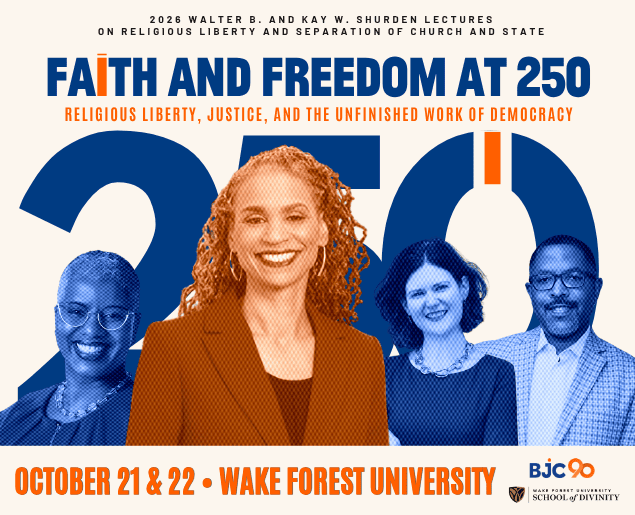
Faith and Freedom at 250: Religious Liberty, Justice, and the Unfinished Work of Democracy
October 21, 2026
Religious freedom and civil rights belong to the same unfinished American story. For our 2026 Walter...
Read More -
Post
25 years after 9/11: Recommitting to Religious Liberty
September 11, 2026
In the face of fear, we have an opportunity to recommit to shared values of who we want to be as a...
Read More -
Press Release
BJC: At-home worship and prayer deserve strong First Amendment protection
September 9, 2026
An Orthodox Jewish man should be able to sue the city trying to stop his at-home worship, even...
Read More -
Court Case
Grand v. City of University Heights
BJC joined a brief in support of Daniel Grand, defending his right to have a religious gathering in...
Read More -
Post
What Else Is Going Back to School?
September 2, 2026
A new school year means more than new notebooks and pencils. It also means new state and federal...
Read More -
Page
The Neighborhood Love Quest Curriculum
How can the next generation use their freedom to protect, advocate, and care for the freedoms of...
Read More -
Event
Amanda Tyler speaks on ‘How to End Christian Nationalism’ in Washington, D.C.
October 7, 2026
We’ve all seen what Christian nationalism can do. Now is the time for Christians to reckon...
Read More -
Event
Katie Callaway Leads Educational Session in Fairfax, Virginia
October 18, 2026
What is Christian nationalism? Where did it come from? How might Christians respond to it? What is...
Read More -
Magazine
Why I Testified Against Anti-Sharia Laws
August 10, 2026
The hearing was built around a premise that betrays our constitutional values — that Congress has...
Read More -
Magazine
Compelled to be Free
August 10, 2026
Journey across religious freedom, featuring just a few of the people who made an impact over the...
Read More -
Magazine
Whose Bible? Whose Kids?
August 10, 2026
Somewhere, a kindergartner is about to learn the Bible from the state of Texas — whether they’re...
Read More -
Magazine
Local Groups: Spring/Summer 2026
August 10, 2026
Local groups are people who show up, organize, and refuse to let religious freedom become a...
Read More