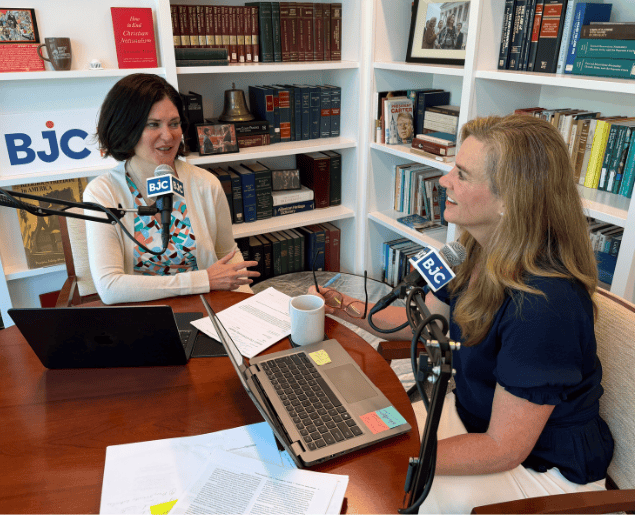
We return for a bonus episode of season 7, as we look to the new Supreme Court term and say farewell to our co-host, Holly Hollman. Before she leaves, Holly joins Amanda to preview two religious liberty cases the court will hear in the next few months. And, after 25 years of filing briefs with BJC, Holly reflects on some of the big moments during her time here as she heads toward a new chapter in life.
Show Notes
Segment 1 (starting at 00:33): The two religion cases on the new Supreme Court docket
We discussed the Landor case on three previous episodes:
- The decision: S7, Ep. 12: A disappointing religious freedom decision to end the SCOTUS term
- What’s at stake: S7 Ep. 01: The Supreme Court in a New Era
- The oral arguments: S7 Ep. 05: A Religious Freedom Caes Flying Under the Radar
For additional analysis of the Landor case, Holly wrote a new piece for our website: What can we do after the Supreme Court undercuts a prisoner’s relief?
Holly’s final Hollman Report previews the two cases the Supreme Court will hear: Saint Mary Catholic Parish v. Roy and Grand v. City of University Heights
For more on the cases regarding the Ten Commandments, visit our website.
Segment 2 (starting at 16:04): A new chapter for Holly
For more on the Trinity Lutheran case, including the text of Holly’s “Decidedly Narrow, Deeply Troubling” column, visit our website page dedicated to the case.
Your support keeps this podcast ad-free. Support these conversations with a gift to BJC.
Video of our episodes are now on YouTube! Click here for the season 7 playlist.
Transcript: Season 7, Episode 13
Supreme Court preview and farewell to Holly
AMANDA: So as you look back on all the briefs that you filed, what are some of the standouts?
HOLLY: We talk about the disappointing cases, because we were fighting hard for some principles that we thought were under-appreciated. But we also have been on the side of some 9-0 victories as well.
Segment 1: The two religion cases on the new Supreme Court docket (starting at 00:33)
AMANDA: Welcome to Respecting Religion, a BJC podcast series where we look at religion, the law, and what’s at stake for faith freedom today. I’m Amanda Tyler.
HOLLY: And I’m Holly Hollman.
AMANDA: So we know we wrapped up season 7 last month. Seems like a long time ago, but we are back for a special bonus episode. Surprise!
HOLLY: (Laughter.)
AMANDA: So today we’re going to preview a couple of cases that are headed to the U.S. Supreme Court next term, and we are also going to spend some time saying goodbye, as my co-host prepares for a new chapter in life and career.
HOLLY: Yes. This summer I announced my departure from BJC, and this is my last week, so we wanted to get one more show in. You know, gotta keep going while I’m on the payroll, Amanda.
AMANDA: Well, it is truly the end of an era, Holly, and we are going to talk much more about that later in the show. But it really is great to sit here again, one last time, as co-hosts, to talk about what’s happening at the Supreme Court.
HOLLY: That’s right. I have to keep going as long as I’m here. And just to kind of remind our listeners where we left off was at the end of the Supreme Court term, the Court decided the Landor case, Landor v. Louisiana Department of Corrections.
That was a case interpreting the Religious Land Use and Institutionalized Persons Act — a Rastafarian prisoner whose dreadlocks were shaved and was really treated horribly, violating his rights. And he sued, made it all the way to the Supreme Court to see what kind of remedy was available under that statute.
And while we were very disappointed with the decision, we remain strong defenders of that law.
AMANDA: Yeah. And we did talk much more about this in previous episodes, including the Supreme Court’s really, I think, strained and narrow reading of Spending Clause ability for the Congress that impacts not just people who are trying to seek relief under this important religious freedom law, but potentially other legislation that Congress might try to pass under that authority, now or in the future.
And we have a lot more on our website since we released that episode, so we’re going to link to that analysis in the show notes.
HOLLY: So any of you listeners who missed those episodes, you can go back and catch up and just know kind of where we left off at the Court last term.
AMANDA: And now the Supreme Court is on its summer break, but we do have a clearer picture of what the next term will look like. And, Holly, you wrote about two of these cases in your final column for our magazine, so we will link to that Hollman Report in the show notes.
The next term begins first Monday in October, and we know now that there will be at least two cases involving issues related to religious freedom law. So let’s talk about the first one of it, which is called St. Mary Catholic Parish v. Roy.
HOLLY: The Court will again look at this issue of the effect of nondiscrimination conditions on religious organizations. You know, they sometimes have particular needs and beliefs that they seek accommodation for, particularly in the government funding context. It makes it more complex.
The case comes from two Catholic parishes that operate preschools and some parents, who feel that they should be included in this government-funded universal pre-K program, despite the way the program is designed that has this nondiscrimination provision.
The program has a requirement for participants not to discriminate based on certain protected categories. Our listeners know about that — nondiscrimination laws often require equal opportunity, and that can be in employment or in access in this case, without regard to such categories as race, religion, sexual orientation, income level or disability.
And this is — to my mind, it looks like a unique program, Amanda, like a really good program, to try to expand child care before kindergarten or preschool, to have this sort of universal plan that Colorado has put in place, so that there’s at least a few days a week that parents could have child care coverage. And it’s widely open to participating organizations, including, of course, religious organizations, many of them who’ve been providing this kind of care for a long time —
AMANDA: That’s right.
HOLLY: — without the government’s involvement.
But these parishes want to participate, and they want to do so while serving only families that support Catholic teachings, including Catholic teachings on sex and gender. So these are particular parishes that are making that a priority — perhaps that’s how they’ve been operating all along — and they want to be able to do that. And, you know, the nondiscrimination read literally on its face would preclude that, because they could not exclude any families who perhaps had gay parents or, you know, other obvious ways of not being in agreement with those Catholic teachings.
AMANDA: Yeah. And so this case is involving another interpretation of the protections of the Free Exercise Clause of the U.S. Constitution, which since 1990 has been kind of, I think, an area of continued interpretation.
So in 1990, of course, was this big decision that we often point back to, Employment Division v. Smith, which changed the standard that Free Exercise claims would be evaluated by the High Court, and that as long as the provision, the government action, truly applied equally across the board, then it would not receive that higher standard of strict scrutiny review, which would require then the government to show a compelling government interest furthered by the least restrictive means.
So the question in this case is going to be, I think, probably, how is this provision and the way that Colorado is enforcing it, is it truly generally applicable?
HOLLY: That’s right.
AMANDA: And some of the facts that, I think, the Court’s going to be really interested in is some of these other exceptions or particular ways that schools and participating providers are allowed to give preference to certain student populations, including populations for kids with disabilities or kids who come from low income families.
You know, we can understand why there would be preference given to them. But does giving preference to those groups automatically make this a provision that then other providers should be able to give preference, particularly if it comes from their sincerely held religious beliefs?
HOLLY: That’s right. The law has gotten quite complex in this area. Those who know BJC well know that we were very concerned about that change in the law in 1990, because we thought Free Exercise rights should have a higher standard of protection, that sometimes the law should accommodate Free Exercise, even in the face of a neutral law of general applicability.
But the law has kind of — the court standards have evolved in a way that has sort of cut against the harshness of that Smith rule, in that courts have found ways to kind of get around Smith or it’s been interpreted in ways that make it not quite as decisive as we once thought.
Of course, there are also other protections, like the Religious Freedom Restoration Act, and other ways kind of to get to strict scrutiny. And, you know, these plaintiffs got to the High Court because of those changes in the law, those different interpretations, this opportunity to have a higher standard for their claimed Free Exercise right to participate in this government-funded program and do so according to their religious beliefs that require them to serve in this way and exclude certain families that don’t abide by their teaching and don’t live out their faith that way.
AMANDA: Yeah. And the opportunity has also presented itself — we might get into some of these cases a little later, but also this line of decisions that has opened up increasing allowance, I guess, of government funding and in some cases, you know, requiring if any private providers are allowed into a government program, that religious providers are to be included as well.
HOLLY: Yeah, yeah. And we know that there is certainly some logic to that, but there’s also some complexity. On the side of Colorado, I think it’ll be interesting to see, as we learn more about the case, Amanda, to hear their best arguments for what they’re trying to do to really administer, you know, a universal pre-K program but to make sure that it is open to everyone and that, to the best that they can, serve protected categories that might be more vulnerable to being left out of government programs.
So we’ll be following that case. It’s being briefed right now, and it’ll be heard in the new term.
The other case that we know the Court has granted that we’ll be interested in is a land use case, and that — we say that. That’s what it looks like to us. It’s a case about someone’s religious rights and how they use their home actually.
When we say “land use,” it’s because it reminds us of the protections in the Religious Land Use and Institutionalized Persons Act, known as RLUIPA. That was at the center of the Landor case, but this is the other part of it. So part of it protects prisoners — with this higher standard — and other institutionalized persons.
And then part of it is designed to make sure that governments don’t treat religious gatherings worse than other gatherings. So we know — we know because the record was established in passing RLUIPA that often that was an area of religious freedom concern, that land use laws had been used to really be hard on religious gatherings, even where they were causing the same traffic problems that nonreligious uses were.
So this case is called Grand v. City of University Heights. And it doesn’t have RLUIPA in the question presented. And, we’re learning about this case and kind of what’s behind it, how it’s going to be briefed and what all will be before the Court.
But it is, as I said, about a religious gathering in a private home. Grand refers to Daniel Grand, an Orthodox Jewish man who had a long-running — who has a long-running dispute with his neighbors and local authorities in his Ohio town.
And the City of University Heights where he lived, asked, after they got complaints, asked him to apply for a zoning permit that prohibited him from using his house, his home, as a place of religious assembly.
Now, Mr. Grand in his Orthodox practice was trying to get together people from his community to join in a specific prayer practice where he needed a certain number of people in his home to do this.
I imagine the facts are quite complicated. It’s been going on for a while. I’ve read the cert petition from Mr. Grand and some of the briefing. And the lower courts really didn’t get into the substantive claims, dismissing the case on procedural grounds.
It’s quite complex in what the Court’s looking at, and it deals with law that, Amanda, I don’t think you and I are experts in —
AMANDA: Right.
HOLLY: — but in the past, we have found ourselves delving pretty deep in different areas of law, because religious freedom touches on so many different areas of law, and we’re doing that here. We want to see what Mr. Grand went through, what’s going on, and if somehow the city is kind of hiding behind process and procedures that are depriving him of the fair right to use his home at least as well, if not better, than other uses based on his religion.
AMANDA: Yeah. So there’s a lot going on in that case.
HOLLY: (Laughing.) Yes.
AMANDA: And, you know, one kind of interesting thing about this case is that this was a pro se cert petition —
HOLLY: That’s true. Yeah.
AMANDA: — that Mr. Grand was not represented by attorneys, any attorneys, let alone attorneys versed in religious freedom law. But the Supreme Court was sufficiently —
HOLLY: Interested.
AMANDA: — swayed and interested in his issue that they took the case.
And so this will be very interesting to see how this particular case proceeds and how BJC can use our best religious freedom voice and help not just the Court but the public understand the issues here better.
There is another issue that we’re watching potentially for this term, and the question is this: Will the Supreme Court hear the cases about mandates to post the Ten Commandments in public schools? We have a split in the courts over the issue, now that the full sitting, the en banc sitting, of the 5th Circuit narrowly held and ruled that Texas could have a requirement to post these Ten Commandments without violating the First Amendment. And so we’re wondering, is the Supreme Court sufficiently interested in this question to take this case as well.
BJC has been involved at the circuit court stage, not just in the 5th Circuit, but also in the 8th Circuit Court of Appeals on this issue. We have served as a friend of the court, filing briefs to support the parents who have challenged these laws in several states, and we will continue to stand with the parents and against government-sponsored religious indoctrination and the government’s picking and choosing among different religious texts and trying to give its stamp of approval on to one. We think that violates core values related to religious freedom for all.
So waiting to see if the Court will take that case, waiting to see when the Court will hear arguments in these two cases that it will hear from. But it promises to be a busy year, busy term for religious freedom at the U.S. Supreme Court.
HOLLY: And, of course, BJC has long talked about the importance of religion being freely exercised and independent from the government, and specifically in the area of this apparently continuing temptation for government to like select some scripture and say, hey, we’ll put it up here as like what we’re advancing, and interfering with our religious freedom rights.
So there’s plenty of information, good arguments that BJC has made and lots of our coalition partners have made that don’t take very long to kind of understand the danger here of giving up our religious freedom to the government in letting them choose what sacred scripture to endorse and promote and basically try to indoctrinate in the public schools.
So we are glad that it’s being challenged and hopeful that if the Court takes this, that they’ll decide in a way that really protects our religious freedom going forward.
Segment 2: A new chapter for Holly (starting at 16:04)
AMANDA: Well, before we end this special episode, we want to have a little bit more personal talk, because Holly is wrapping up her time at BJC and also wrapping up her time as co-host of Respecting Religion.
So, Holly, earlier this year, you celebrated 25 years of leading BJC’s legal work, and so I have not been around BJC for all 25 of those years, but I was here for the beginning —
HOLLY: Oh, that’s right! Yes.
AMANDA: — of those 25 years.
HOLLY: In a different capacity. Right, Amanda?
AMANDA: Very different capacity. So I was in my first year out of undergrad. So, listeners, you can do the math if you want, but —
HOLLY: (Laughing.)
AMANDA: — I was working for BJC as assistant to the general counsel at the time, and I remember our then-executive director, Brent Walker, coming in with Holly Hollman, someone I’d never met before, and said, Meet your new general counsel.
HOLLY: (Laughing.)
AMANDA: And yeah. So that is definitely, I think, very special —
HOLLY: Who would have known? Yeah.
AMANDA: — that I was there at the beginning of this long career for you.
HOLLY: Yeah. It’s funny, because we’ve said this before. It just feels like I’ve always known you. So yes. Amanda was just getting ready to start off on her legal career, and I was starting a new chapter in mine. I’d been an attorney in private practice and was returning to the BJC, in that I had been an intern and legal assistant before I went to law school.
So, I had this warmness in my heart and experience for this organization, so that when I had the opportunity to come back as general counsel after I had moved to Washington, D.C., it was such a wonderful opportunity.
And as I’ve written, I’m really glad that I took it. And, yes. I got to know you, and I remember what we were up to in those early years. Actually RLUIPA had been recently passed, and then we were working to get state religious freedom laws passed, so these state RFRAs.
And I remember then your dedication to the legislative process and us working together, and it was great. And then I remember it being time for you to go off, go to law school, Amanda, chart your own path. And then —
AMANDA: And it was the same time you were starting a new chapter, too, because right when I was going to law school, you — I remember the baby shower that BJC hosted for you that year, too, so it’s also been 25 years since you —
HOLLY: That’s right.
AMANDA: — became a mom, and it was right around this time of the summer, I believe, as I recall.
HOLLY: That’s right. The first of my two boys was born soon after I joined BJC, so I have a full person to also represent for those 25 years.
And it has been a wonderful experience. You know, I felt very fortunate to follow in the footsteps of the incredible attorneys who worked here before: Buzz Thomas and Brent Walker and Melissa Rogers.
I had remembered so fondly my time as an intern and getting to know James Dunn and his executive leadership, and just the cast of characters from my very earliest time with BJC. Rosemary Brevard and Larry Chesser and all these folks had made such an impact on me that it was really fun to come back then in my professional role as a lawyer and to learn and grow with BJC.
And I’ve seen a lot in those 25 years, and I couldn’t really boil it all down. But I did make some — I did attempt to reflect on my time a bit in my last Hollman Report that friends of BJC can read online or maybe they get it in their mailbox, to talk about kind of what I’ve seen, as well as what’s going on now.
AMANDA: Yeah. And that long view, Holly, is just so helpful, you know, as we think through these issues and how they come up at the Court.
We’ve been doing this podcast together now for more than six years, but we worked together even longer, not just back in 2001 when you first came into the role, but also when I came back in 2017 to lead the organization.
And one of the earliest things we did that year is there was a case at the U.S. Supreme Court that year, Trinity Lutheran, and we went to the oral argument together, because you were sponsoring my application to the U.S. Supreme Court bar.
HOLLY: (Laughing.)
AMANDA: And so we got to stand up together on the front row of the Court that day.
HOLLY: I got to make a motion in front of the Supreme Court, and it was granted.
AMANDA: (Laughing.)
HOLLY: It was granted. I was successful. This is a fun —
AMANDA: I think you’re undefeated actually —
HOLLY: I am, I am.
AMANDA: — in all of your bar admissions.
HOLLY: I have helped some great attorneys get admitted to the bar, including you, Amanda. That was fun, and it was a nice reminder that we did it that day, which, of course, then — it was an important case that we worked in and filed a brief in. I feel very proud of that work. And, of course, the decision went the other way very narrowly, but we knew that that was an important decision. And for sure, it has been, as the Court has continued to weaken its stance on restrictions on government funding to religion.
AMANDA: Yeah. I mean, I think that just shows the depth of your experience really can make you a real seer, you know, on some of these things as they come out.
And I remember your column title actually about that Trinity Lutheran case: “Decidedly Narrow, Deeply Troubling.” And we have seen since then that that has really come to play.
HOLLY: Give it to me: I’m honest, but I’ll tell you what I’m seeing, too.
AMANDA: Yeah.
HOLLY: I mean, it was decidedly narrow. I mean, it was written in a way to say, Just this.
AMANDA: Tires on a playground surface.
HOLLY: Yeah. No big deal.
AMANDA: But I think we knew at the time, it was not just tires. –
HOLLY: No. The way it was decided, you could see the way the Court was going. And that was certainly the case in the next couple of cases are now known as kind of the trilogy that changed how people see this Court and the relationship between the two clauses.
AMANDA: Yeah. So as you look back on all the briefs that you filed as friend of the Court during your tenure and all the cases that we’ve been engaged in in any way — you know, just a little reflection. Like what are some of the standouts, maybe in the cases themselves but also any other kind of standout memories from your time? And obviously this has got to be a capsule, you know. We can’t fully cover 25 years.
HOLLY: What I would say is, we have been there. We have been in the church-state cases really since 1947, BJC has, and I have since 2001 and not every single one, but almost every single church-state case before the High Court, and, you know, I was really glad to carry that legacy forward and to develop our voice in different ways, to have different coalition partners to engage with us, do some work in-house, a lot of work with some wonderful pro bono attorneys in private firms — thank you very much; you know who you are — as well as close collaboration with wonderful law professors like Doug Laycock and Christopher Lund and the great Bob Tuttle and Chip Lupu, and just many others that have influenced our work and helped us.
And, you know, we talk about the disappointing cases, because we were fighting hard for some principles that we thought were under-appreciated. But we also have been on the side of some 9-0 victories as well on Free Exercise rights for employees, for ministers, and for churches.
And I’m proud of all the record. I’m proud that this organization has stood strong for Free Exercise and No Establishment. It’s been a great place to work.
And, look, I’m not leaving — I’ll tell everybody this. I am actually not moving far away and never to be heard from again. I am taking a break and really saying “thank you” to this organization, to you, Amanda, for your leadership, and to all of those that I’ve gotten to work with.
But I will be following how the law develops and will continue to have a great interest in that. Maybe as I reflect more, I’ll have more to say. But I’ll have time to reflect on all that we’ve seen.
It’s been a joy and real wonderful calling for this time of my career. And it has been a lot of fun. I really appreciate the great stories that we have, of people that we’ve met, both from members of Congress, justices, to just folks in the pews that we meet as we go do speaking engagements.
So I just would like to sign off with just great thanks for you, Amanda, for this project. We were a little late to the podcasting arena. Actually, BJC was not. We had done some great podcasts on specific issues and some nice series. And shout-out to our wonderful producer Cherilyn Crowe Guy who has been such a leader and helpful there.
But when we branded this, Respecting Religion, as a new thing, we weren’t sure how it was going to go. We said, We’ll give it a shot. And it’s been so good for us, that it has lived up to what Cherilyn thought people would like, which is like, You should take these inside conversations and let people outside hear them.
And we keep learning that they have meant something to people. We’ve heard from students and pastors and community members that they listen to this and that it helps them in some way, and that’s really gratifying.
AMANDA: It is. And I’m going to echo your gratitude back to you, Holly, for really sharing your immense gifts and who you are as a person with this organization, with me personally, and with this cause, religious freedom for all, which you are not leaving. Right?
You are as committed to the cause as you ever have been, and, you know, you get to have another chapter in your life and career. And we’re just grateful that you chose to spend so much of it here, working with us at BJC, and we know we’re going to continue to find ways to collaborate and work together in the future.
HOLLY: Well, that brings us to the close of this episode of Respecting Religion. Thank you all for joining us for this episode and for so many others.
AMANDA: For links related to today’s show and a transcript, visit our website at RespectingReligion.org.
HOLLY: You can learn more about our work at BJC, building a movement toward a just society that cultivates and expands religious freedom for all by visiting our website at BJConline.org.
AMANDA: If you want to email the show, send an email to [email protected].
HOLLY: You can follow BJC on social media, too. We’re at BJConthehill.
AMANDA: Thank you for supporting this podcast. You can donate to these ad-free conversations by visiting the special link in our show notes.
HOLLY: Thank you for joining us for conversations over these past six years Respecting Religion.